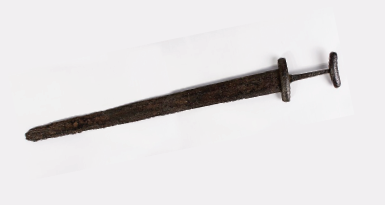
A remarkable collection of Viking artifacts dating back more than 1,100 years has been discovered on the Isle of Man, offering new clues about the island's earliest Scandinavian settlers. Metal detectorists Daniel Crowe and Rhett Britton uncovered a decorated sword, rare bronze brooches, trading equipment and other objects that archaeologists believe may have come from a double burial around AD 900. The discovery was announced on November 9, 2026, after the objects were formally declared Treasure.
The collection includes three bronze brooches, a partially preserved sword, decorated trading weights, fragments of balance scales, a bronze ladle and an axehead. Several objects are rare or previously unknown on the island, making the discovery especially important to researchers studying Viking settlement in the Irish Sea.
Rare Viking Sword Found in Ancient Burial
The sword is the thirteenth Viking-era sword discovered on the Isle of Man. Approximately two-thirds of the weapon survives, including sections of its decorated hilt.
Archaeologists identified fine silver inlay and twisted silver wire within the handle. These details were revealed through X-ray examinations conducted before conservation began.
The elaborate metalwork suggests that the sword belonged to someone with considerable wealth or social standing. According to Manx National Heritage, only two other Viking swords discovered on the island have comparable decoration.
The weapon was broken, possibly as part of a burial ritual. Additional damage appears to have occurred after it was buried, leaving researchers unable to determine exactly how the sword was originally placed in the ground.
The presence of a prestigious weapon alongside jewelry typically associated with women has raised the possibility that the objects came from the graves of two individuals.
However, investigators have not established whether the discoveries represent a shared burial or separate graves from approximately the same period.
Bronze Brooches Offer Clues About Viking Women
Among the most important discoveries are two oval bronze brooches decorated with interlocking animal patterns. This artistic style was common in Scandinavia during the Viking Age.
Women traditionally wore these brooches in pairs to fasten their clothing. Their presence suggests that Scandinavian women were living on the Isle of Man during the early stages of Viking settlement.
The newly discovered pair may be approximately 50 years older than the only other comparable pair previously found on the island.
That earlier discovery was made in 2018 by Daniel Crowe's father, John Crowe, and fellow metal detectorist Craig Evans. The family connection adds an unusual detail to the island's growing archaeological record.
A third brooch is also significant. Originally gilded, it features spiral decorations surrounding a glass center.
The circular brooch is the first example of its kind discovered on the Isle of Man. Researchers believe its design may reflect artistic traditions from Ireland or neighboring regions.
Allison Fox, curator of archaeology at Manx National Heritage, said the objects could provide important evidence of early Scandinavian women living on the island.
The brooches also suggest that Viking settlement involved more than warriors and traders. Families and communities were establishing permanent connections across the Irish Sea.
Trading Weights Reveal Viking Commercial Activity
The collection contains decorated lead weights and fragments of bronze balance scales, equipment used to measure precious metals and coins.
During the Viking Age, traders often weighed silver to establish its value in commercial exchanges. Portable scales allowed merchants to conduct transactions involving different forms of currency and precious metal.
The recently discovered weights are the first examples of their particular type recorded on the Isle of Man.
One weight contains a decorative bronze fitting that may have been reused from a small chest or religious object. Its artistic features resemble metalwork produced in Britain and Ireland.
This detail suggests that Viking settlers incorporated objects from neighboring cultures into their own equipment.
A bronze ladle was also recovered. Archaeologists believe it may have been used during feasts or ceremonies, although its original purpose remains uncertain.
Together, the artifacts offer evidence of a community engaged in trade, craftsmanship and cultural exchange.
Metal Detectorists Help Preserve Ancient Evidence
Daniel Crowe and Rhett Britton discovered the objects in February 2026. Britton assisted with the search and recovered the axehead, part of the balance scales and additional iron objects.
Crowe made an important decision after recovering the artifacts: he did not attempt to clean them.
Leaving the objects in their original condition allowed conservators to examine soil deposits and other traces that might have been destroyed through cleaning.
Before conservation work began, radiology specialists from Manx Care used imaging equipment to examine the discoveries beneath layers of compacted soil.
The scans revealed concealed metalwork and provided information that helped conservators plan their work.
Manx National Heritage praised the detectorists for their cooperation and thanked the landowner for supporting the investigation.
The objects were subsequently declared Treasure by the Isle of Man Coroner for Inquests, recognizing their historical and archaeological significance.
Could the Discovery Represent a Double Burial?
One of the most intriguing questions concerns the people who originally owned the objects.
A sword traditionally associated with a male burial was recovered alongside brooches commonly associated with female clothing. This combination suggests that a man and woman may have been buried at the same location.
However, the burial site was disturbed sometime during the past thousand years.
Because the original arrangement of the objects has changed, archaeologists cannot yet establish whether they were deposited together or in separate graves.
Researchers are also examining whether the jewelry represents some of the earliest evidence of a female Scandinavian burial on the Isle of Man.
The discovery may help explain how Viking communities developed during the ninth and tenth centuries, when Scandinavian settlers were establishing connections with communities across the British Isles.
Viking Heritage Remains Visible on the Isle of Man
The Isle of Man occupies a strategic position in the Irish Sea between Ireland, England, Scotland and Wales.
Viking seafarers began arriving during the ninth century, initially developing trading relationships before establishing settlements.
The island later became an important center of Scandinavian influence, with Viking traditions continuing long after the conventional end of the Viking Age in England.
Previous archaeological discoveries have included swords, brooches, silver coins and gold jewelry. Each find has helped researchers understand the island's role in medieval trade and settlement.
The latest discovery adds evidence of both wealth and everyday activity among the island's early Scandinavian inhabitants.
A selection of the artifacts went on public display in the Viking Gallery at the Manx Museum in Douglas on November 11, 2026.
Conservation and research will continue as specialists examine the objects and investigate their origins. Among the questions still unresolved is whether the sword and jewelry belonged to two people buried together more than 1,100 years ago.