

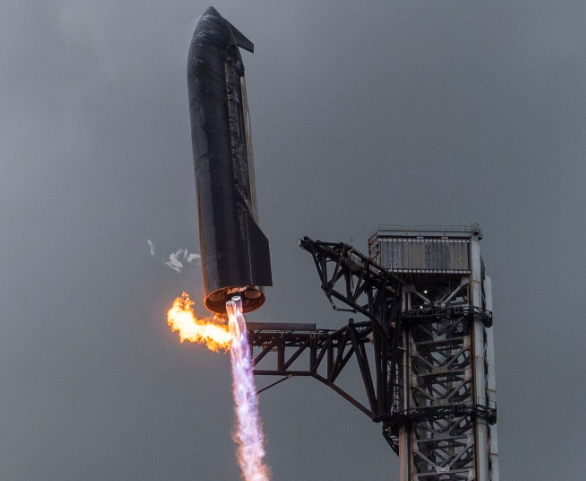
SpaceX has released new slow-motion footage showing the historic recovery of its Starship spacecraft at the company's Starbase facility in South Texas. The videos, shared on Tuesday, November 17, 2026, provide close-up views of the spacecraft being captured by enormous mechanical arms attached to the launch tower. The successful maneuver occurred on Saturday, November 14, and marked the first time SpaceX had recovered a Starship upper stage returning from orbit.
The achievement came during Starship's 15th integrated test flight, which began the previous evening. After spending nearly 22 hours in space and deploying 26 Starlink satellites, the spacecraft returned to the same launch site where its journey began. Although the mission experienced problems with its Super Heavy booster, the upper-stage recovery represented an important breakthrough in SpaceX's efforts to develop a fully reusable orbital rocket system.
New Videos Reveal the Tower Catch
The newly released footage shows the spacecraft descending toward the approximately 480-foot-tall launch tower at Starbase. Four slow-motion camera angles capture the final moments as Starship approaches the tower's giant mechanical arms, nicknamed chopsticks. The system is designed to support the returning spacecraft without requiring conventional landing legs.
As Starship neared the tower, its engines controlled the final descent while the mechanical arms positioned themselves to receive the vehicle. The spacecraft settled into the arms, completing a recovery maneuver that SpaceX had never previously attempted with an upper stage. The videos offer a clearer view of the precision required to bring such a large spacecraft safely back to its launch infrastructure.
Space.com reported that the cameras were positioned near the top of the tower, providing perspectives not visible in the original wide-angle footage. The company had already shared images and video of the successful recovery shortly after the event. Tuesday's release focused on the final approach and the mechanical operation that made the landing possible.
The tower-based system forms part of SpaceX's larger plan to eliminate the need for traditional recovery equipment on its Starship spacecraft. Engineers hope that catching rockets directly at the launch site will eventually simplify inspections and preparations for another flight. However, a successful catch does not by itself establish that Starship can be quickly refurbished and launched again.
Flight 15 Began With a Challenging Launch
Starship Flight 15 lifted off from Starbase on Friday, November 13, at 4:47 p.m. local time. The rocket consisted of two major sections: the Super Heavy booster and the Starship upper stage, also known as Ship. Together, they form the largest and most powerful rocket system SpaceX has developed.
During launch, the Super Heavy booster's 33 Raptor engines generated more than 18 million pounds of thrust. The rocket successfully completed its initial ascent before the two stages separated approximately two and a half minutes after liftoff. Starship continued toward low Earth orbit while the booster began its return toward the Texas coast.
SpaceX had originally planned to recover both sections using the tower's mechanical arms. However, the Super Heavy booster experienced a problem during its return, and the company abandoned its planned tower catch. A low-fuel warning was reported during the recovery sequence, leading the booster to divert toward the Gulf of Mexico.
The booster was not recovered, preventing SpaceX from achieving the planned double catch. The company had previously demonstrated successful Super Heavy catches on three earlier test flights. Recovering the upper stage was a different challenge because it had to survive the much greater heating and speed associated with returning from orbit.
Starship Completes Its First Orbital Tower Recovery
While the booster recovery failed, the upper stage continued its planned mission. Starship reached orbit and released 26 next-generation Starlink V3 satellites, adding to SpaceX's growing communications network. The deployment followed the first orbital delivery of this satellite generation during Flight 14 on September 28, 2026.
The spacecraft then spent roughly 22 hours in space before beginning its journey home. Its return required a controlled departure from orbit, atmospheric reentry and a carefully managed final descent toward Starbase. Unlike the Super Heavy booster, which separates early in flight, the upper stage must withstand the extreme conditions of orbital reentry.
SpaceX had tested several aspects of Starship's reentry capabilities during earlier missions. Previous flights helped engineers evaluate heat-shield performance, vehicle control and landing maneuvers, but none had attempted to catch the upper stage with the launch tower. Flight 15 brought these systems together in a successful end-to-end orbital recovery demonstration.
The spacecraft returned to Starbase on Saturday afternoon and approached the tower under engine power. Its final positioning allowed the mechanical arms to support the vehicle, completing the first successful Ship catch. The result established that a Starship upper stage could return from orbit and be captured at its original launch facility.
Why the Catch Matters for Reusable Rockets
SpaceX has already demonstrated substantial rocket reusability through its Falcon 9 launch system. Falcon 9 boosters routinely return to landing platforms or ground-based landing zones, allowing the company to refurbish and fly them again. Starship is intended to go further by making both major rocket stages reusable.
The new recovery approach is designed to reduce the mass of landing hardware carried by the vehicle. Rather than relying on landing legs, Starship can transfer its weight directly to equipment built into the launch tower. SpaceX hopes this arrangement will eventually make recovery operations faster and improve the economics of launching large payloads.
The V3 version of Starship measures approximately 408 feet tall when fully assembled with its booster. Its enormous size creates substantial engineering challenges during launch, reentry and landing. The successful upper-stage catch demonstrates progress in one of those areas, although durability, safety and turnaround performance still require further testing.
SpaceX must also show that recovered upper stages can be inspected, refurbished and flown again reliably. Heat-shield protection, engine performance and structural loads remain important considerations after each mission. The November 14 catch provides valuable engineering data, but operational reusability will require repeated demonstrations.
Starship's Role in Future Space Missions
Starship is central to SpaceX's plans for launching larger satellite payloads and supporting future missions beyond Earth orbit. The spacecraft's large cargo capacity is intended to accommodate payloads that would be difficult or impossible to launch aboard smaller rockets. SpaceX also envisions using Starship for eventual crewed missions to Mars.
NASA has selected a modified Starship spacecraft for its Human Landing System program, which is intended to help transport astronauts during future Artemis missions. Those plans require technologies beyond the tower catch, including orbital refueling and reliable operations in space. The November achievement therefore supports one part of a much larger development effort.
The successful deployment of 26 Starlink V3 satellites also demonstrated Starship's potential commercial role. SpaceX is developing the satellites to expand the capacity of its broadband network, which already serves customers in numerous countries. Carrying large batches of satellites is one of the immediate applications the company hopes Starship will support.
More Testing Remains Before Routine Flights
Despite the milestone, Flight 15 did not achieve all of its objectives. The unsuccessful booster recovery showed that problems can still arise even as Starship's upper stage demonstrates improved performance. SpaceX must continue testing both sections of the rocket before it can establish consistent full-system reusability.
The November 17 videos provide a detailed record of a maneuver that had remained unproven until Flight 15. They show how Starship's engines, guidance systems and tower equipment worked together during the final moments of recovery. SpaceX's next challenge is to turn this successful demonstration into a repeatable process that supports future launches.