

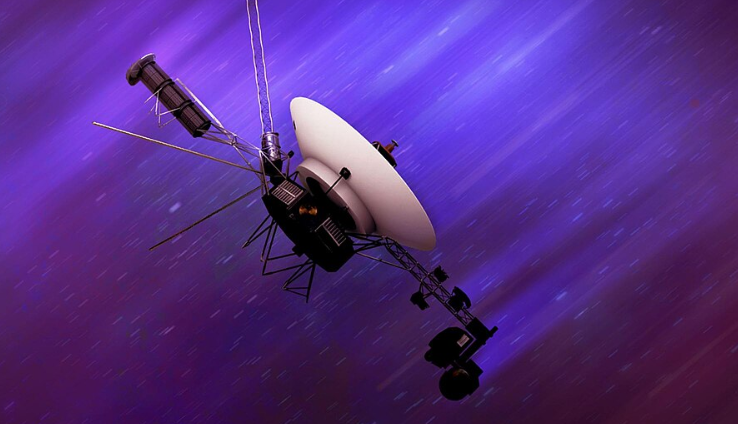
NASA's Voyager 1 spacecraft reached a historic milestone on Wednesday, November 18, 2026, becoming the first human-made object to travel one light-day from Earth. The spacecraft crossed the threshold at 2:16 a.m. Pacific time, approximately 16.1 billion miles from its home planet. Scientists confirmed the achievement Thursday after receiving a radio signal that had spent an entire day traveling across interstellar space.
The milestone comes more than 49 years after Voyager 1 launched in September 1977 to explore the outer planets. The spacecraft is still operating far beyond the region dominated by the solar wind, although a recent technical problem has interrupted its science and engineering data transmissions. Engineers at NASA's Jet Propulsion Laboratory in Southern California are investigating the interruption while celebrating the mission's latest achievement.
What One Light-Day Means
A light-day is a measurement of distance rather than time. It represents how far light travels through a vacuum in 24 hours, approximately 16.094 billion miles or 25.902 billion kilometers. Because radio waves travel at the speed of light, a message sent from Voyager 1 now takes an entire day to reach Earth.
The enormous distance creates an unusual challenge for NASA's mission controllers. When engineers send a command to the spacecraft, it takes approximately 24 hours to arrive. They must then wait another 24 hours for a response, making even a simple exchange a two-day process.
For comparison, sunlight reaches Earth in about eight minutes and 20 seconds. Light takes approximately 1.3 seconds to travel from Earth to the Moon, while signals sent to Mars can take several minutes, depending on the planets' positions. Voyager 1 has traveled so far that normal communication requires extraordinary patience and careful planning.
Despite the remarkable achievement, Voyager 1 has traveled only a small fraction of a light-year. One light-year equals approximately 5.88 trillion miles, or the distance light covers in an entire year. The spacecraft moves at roughly 38,000 miles per hour, an impressive speed that remains tiny compared with the speed of light.
NASA Confirms the Historic Distance
Scientists and engineers gathered Thursday at NASA's Jet Propulsion Laboratory in Pasadena, California, to recognize the milestone. The event brought together mission leaders who reflected on Voyager's discoveries, engineering challenges and continuing exploration of interstellar space. It also provided an opportunity to discuss how much longer the aging spacecraft might remain operational.
NASA confirmed that Voyager 1 reached the one-light-day mark early Wednesday morning. The mission team received its radio signal approximately 24 hours later through the Deep Space Network, an international system of antennas used to communicate with distant spacecraft. A receiving station near Madrid, Spain, helped relay the signal to mission controllers.
The confirmation was particularly important because Voyager 1 had recently stopped transmitting its usual science and engineering information. Nevertheless, NASA could still detect the spacecraft's carrier signal, the radio transmission that normally carries those data. Combined with the probe's well-established trajectory, the signal allowed engineers to verify its location.
For the mission team, the achievement reflects decades of scientific and engineering work. Voyager project manager Suzanne Dodd has helped oversee efforts to keep the spacecraft operating despite declining electrical power and aging components. The new distance record comes as those challenges become increasingly difficult to manage.
Communications Problem Complicates the Celebration
On November 14, engineers discovered that Voyager 1 had stopped sending readable science and engineering data. A Deep Space Network antenna in Canberra, Australia, detected the carrier signal but could not receive the information normally transmitted with it. NASA began investigating the interruption while preparing to confirm the distance milestone.
The continued carrier signal provides some reassurance because it indicates that important communications equipment remains operational. It also suggests that the spacecraft is maintaining the orientation needed to keep its antenna directed toward Earth. However, engineers have not yet determined why the normal data stream stopped.
NASA reported that the problem might involve the onboard computer responsible for collecting and formatting information from the spacecraft's systems. Mission controllers are also examining whether the interruption is connected to a separate communications incident in October. During that earlier event, Voyager 1 temporarily lost contact with Earth before resuming transmissions.
A similar problem occurred in 2023, when a computer malfunction prevented the spacecraft from sending usable information. Engineers eventually developed a solution, but repairs required extensive testing and careful communication across enormous distances. The current interruption may also take considerable time to diagnose because every exchange of commands and responses requires nearly two days.
A Mission That Began in 1977
Voyager 1 launched on September 5, 1977, from Cape Canaveral, Florida, aboard a Titan IIIE rocket. Its twin spacecraft, Voyager 2, had launched approximately two weeks earlier, on August 20. Both missions were designed to take advantage of a rare planetary alignment that made encounters with several outer planets possible.
Voyager 1 reached Jupiter in 1979, returning images and scientific measurements that transformed understanding of the giant planet and its moons. Among the mission's discoveries was evidence of active volcanoes on Jupiter's moon Io. The spacecraft also studied Jupiter's atmosphere, magnetic environment and surrounding radiation.
In 1980, Voyager 1 continued to Saturn, where it photographed the planet's rings and examined several moons. Its close encounter with Titan, Saturn's largest moon, revealed important information about the moon's dense atmosphere. That encounter also altered Voyager 1's trajectory, sending it away from the plane of the planets.
Voyager 2 followed a different route, eventually visiting Uranus in 1986 and Neptune in 1989. It remains the only spacecraft to have visited those two planets up close. Together, the Voyager missions dramatically expanded scientific knowledge of the outer solar system.
From the Solar System Into Interstellar Space
After completing its planetary encounters, Voyager 1 continued traveling outward into previously unexplored regions of space. In August 2012, it crossed the heliopause, the boundary where the outward pressure of the solar wind gives way to the surrounding interstellar environment. NASA announced the discovery in September 2013 after analyzing measurements from the spacecraft's instruments.
Crossing the heliopause made Voyager 1 the first spacecraft to enter interstellar space. However, that does not mean it has escaped every part of the solar system. The distant Oort Cloud, a vast region of icy objects believed to surround the Sun, extends much farther than Voyager has traveled.
The spacecraft remains valuable because it can directly examine an environment that scientists cannot reproduce in laboratories on Earth. Its instruments have studied magnetic fields, charged particles and plasma waves beyond the heliosphere. Those observations help researchers understand how the Sun interacts with the surrounding interstellar medium.
As Voyager moves farther away, its observations provide additional information about conditions outside the Sun's protective magnetic bubble. Scientists use those findings alongside measurements from other spacecraft to study energetic particles and the boundaries of the heliosphere. The mission has become an important part of modern heliophysics research.
The Golden Record Carries a Message From Earth
Voyager 1 also carries a gold-plated phonograph record designed to preserve information about Earth for any civilization that might eventually encounter it. The record contains music, natural sounds, spoken greetings in dozens of languages and images representing life on our planet. A team led by astronomer Carl Sagan helped select the material before launch.
The record was not designed as a communication system that could send information back to Earth. Instead, it serves as a time capsule documenting humanity and the planet from which the spacecraft departed. An identical record travels aboard Voyager 2, giving both spacecraft a cultural role alongside their scientific missions.
In 1990, Voyager 1 captured one of the most famous photographs in the history of space exploration. The image, known as Pale Blue Dot, shows Earth as a tiny point of light viewed from approximately 3.7 billion miles away. The photograph became a lasting symbol of humanity's small place within the enormous universe.
How Much Longer Can Voyager 1 Operate?
Voyager 1 receives electricity from a radioisotope power system that converts heat from decaying plutonium into electrical energy. Unlike spacecraft operating near Earth, it cannot rely on solar panels because sunlight is far too weak at its distance. The power supply has gradually declined throughout the mission.
Engineers have responded by shutting down instruments and other equipment to conserve electricity. In April 2026, NASA turned off Voyager 1's Low-Energy Charged Particles instrument as part of that effort. The spacecraft's magnetometer and plasma wave instrument remained available for continued observations.
NASA hopes to preserve scientific operations for as long as the spacecraft's remaining power and equipment allow. However, future instrument shutdowns and unexpected technical failures are increasingly likely as the mission approaches its 50th anniversary. Once communication is no longer possible, Voyager 1 will continue traveling through space without active control from Earth.
The spacecraft is moving in the general direction of a star known as Gliese 445. NASA estimates that it will pass within approximately 1.7 light-years of that star in about 40,000 years. Its journey will continue long after its instruments and radio transmitter have stopped operating.
Voyager 2 Continues Its Own Journey
Voyager 2 remains humanity's second most distant spacecraft and continues exploring interstellar space on a different trajectory. It crossed the heliopause in November 2018, becoming the second spacecraft to directly measure conditions beyond the Sun's heliosphere. Like its twin, it is operating with limited electrical power.
NASA estimates that Voyager 2 will reach a distance of one light-day from Earth in November 2035. Whether it will still be communicating with mission controllers at that time remains uncertain. Both spacecraft have already operated for decades beyond their original planetary missions.
For Voyager 1, the immediate challenge is restoring normal science and engineering transmissions following the November 14 interruption. NASA's engineers continue examining the communications problem while preparing for the spacecraft's 50th launch anniversary in September 2027. The one-light-day milestone has been confirmed, but the effort to keep humanity's most distant spacecraft working is far from finished.