

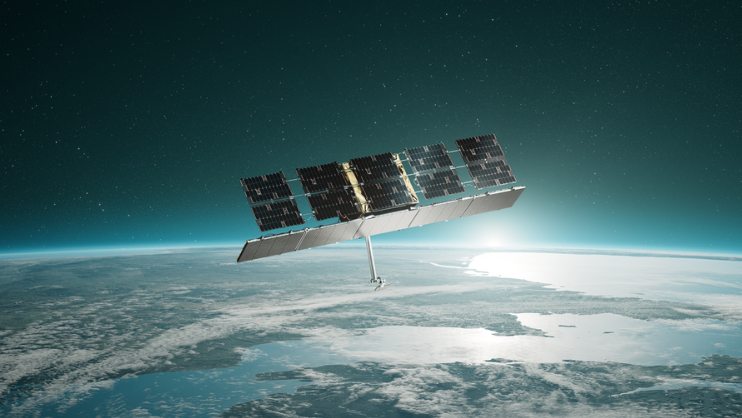
A Russian military satellite maneuvered dangerously close to a U.S.-registered commercial imaging satellite on October 18, 2026, in an unusual orbital encounter involving technology associated with Ukraine's military intelligence operations. Independent tracking specialists say the Russian spacecraft deliberately approached the satellite, remained nearby and then moved away.
The Russian satellite, Kosmos 2612, approached ICEYE-X36, a commercial radar-imaging spacecraft operated by the Finnish-founded company ICEYE. Analysts believe the two objects passed within a few hundred meters of one another, although the precise separation remains uncertain.
The incident has raised concerns about the growing military use of space and the safety of commercial satellites providing information to countries involved in armed conflicts. There is no confirmed evidence that either spacecraft was damaged or that Russia attempted to disable the ICEYE satellite.
Russian Satellite Executes Deliberate Orbital Maneuvers
LeoLabs, a company specializing in satellite tracking and space surveillance, identified an unusual sequence of movements involving Kosmos 2612.
According to the company's analysis, the Russian spacecraft changed its orbit to approach ICEYE-X36 from hundreds of kilometers away. It then moved around the commercial satellite, remained nearby for an extended period and eventually began separating from it.
The behavior was different from an ordinary close encounter between satellites passing through similar orbital regions. Kosmos 2612 repeatedly adjusted its position in ways consistent with a controlled rendezvous.
In a report published October 19, Ars Technica described the operation as a potentially unprecedented noncooperative rendezvous involving two active spacecraft in low-Earth orbit.
The distinction is important because satellites routinely pass near one another without either operator intentionally arranging the encounter. In this case, the Russian spacecraft appeared to adjust its path specifically to approach ICEYE-X36.
Spacecraft rendezvous operations are not inherently hostile. Similar techniques can support satellite servicing, inspections and docking when the operators coordinate their activities.
However, approaching another country's satellite without prior coordination creates uncertainty about the approaching spacecraft's intentions and increases concerns about possible interference.
Russia has not publicly explained the purpose of Kosmos 2612's maneuvers.
How Close Did the Satellites Come?
The closest approach occurred during the early hours of October 18, according to independent satellite tracking specialists.
Dutch satellite analyst Marco Langbroek reported that Kosmos 2612 may have passed within a few hundred meters of ICEYE-X36. Other calculations produced considerably smaller distances, including estimates approaching 25 to 30 meters.
Those smaller figures should not be treated as confirmed measurements.
Publicly available orbital information does not provide enough precision to establish the minimum distance with certainty. Small errors in estimated satellite positions can produce substantial differences when calculating such close encounters.
An independent reconstruction published by KeepTrack examined thousands of archived orbital observations and identified significant gaps in the available data during the closest approach.
Its analysis indicated that publicly available information was consistent with a separation of roughly 150 to 650 meters, depending on when the Russian spacecraft conducted its final maneuver. Even that range depends on orbital calculations rather than a direct measurement of the minimum distance.
The uncertainty does not change the broader finding that Kosmos 2612 deliberately approached and spent considerable time near ICEYE-X36.
By October 16, the spacecraft were separated by approximately three kilometers. During the following day, that distance decreased to less than one kilometer.
Tracking information subsequently showed the Russian satellite moving away. LeoLabs reported that the latest observations confirmed the close-proximity activity had ended.
Russian Spacecraft Had Been Moving Into Position for Months
The October encounter followed several months of suspicious orbital activity.
Kosmos 2612 launched aboard a Soyuz-2.1b rocket from Russia's Plesetsk Cosmodrome on April 16, 2026. It was part of a group of Russian military satellites placed into orbit during the same mission.
Within weeks, analysts noticed that four spacecraft from the launch had adjusted their orbital paths to align more closely with ICEYE-X36.
Matching orbital planes allows satellites to pass near one another more frequently and can be an important preliminary step toward a controlled approach.
In late September, Kosmos 2612 began making additional adjustments that gradually positioned it for the October encounter.
Orbital reconstructions show that the spacecraft raised its orbit, changed its alignment and later lowered its altitude to approach ICEYE-X36. By October 16, the Russian satellite was traveling close to the commercial spacecraft.
These movements required deliberate use of the satellite's propulsion system. They were not simply the result of two spacecraft crossing paths by coincidence.
Although such operations demonstrate precise maneuvering capabilities, they do not establish whether the Russian spacecraft was conducting surveillance, testing technology or preparing for another activity.
Why ICEYE Satellites Matter to Ukraine
ICEYE operates a network of satellites equipped with synthetic aperture radar, commonly known as SAR.
Unlike conventional optical imaging satellites, radar spacecraft can gather information at night and through cloud cover. This makes them especially useful for monitoring military movements and identifying changes on the ground.
ICEYE has provided satellite imagery to Ukraine since 2022.
Under an agreement announced in August of that year, the company supplied Ukraine with dedicated access to one radar satellite and additional imagery from its wider constellation.
In January 2026, ICEYE announced an expanded partnership with Ukraine's Ministry of Defence to provide more high-resolution radar imagery for military intelligence.
The information can help Ukrainian forces monitor transportation routes, military equipment and other activity across contested territory.
However, the specific operational role of ICEYE-X36 has not been publicly established. Although the spacecraft belongs to a satellite system that supports Ukraine, that does not prove that this particular satellite was collecting intelligence for Ukrainian forces during the encounter.
ICEYE-X36 is registered in the United States and operated within ICEYE's commercial satellite network.
Growing Concerns About Military Activity in Orbit
The incident has renewed attention to Russia's ability to maneuver spacecraft close to satellites operated by other countries.
Russia has previously conducted operations that placed military spacecraft near American surveillance satellites.
In 2020, U.S. officials expressed concern after a Russian satellite designated Kosmos 2542 maneuvered near a U.S. reconnaissance spacecraft.
Such encounters have become increasingly important as military forces depend on satellites for communications, navigation, surveillance and intelligence.
Commercial companies also play a growing role in these operations, supplying governments with information that was once available primarily through national intelligence agencies.
This creates additional risks because commercial spacecraft can become strategically important during conflicts even when they are not owned by military organizations.
Close approaches are particularly sensitive because satellites travel at extremely high orbital speeds. Although two spacecraft in nearly identical orbits may have relatively low speeds compared with each other, unexpected maneuvers can still create collision hazards.
Damage to a satellite could interrupt important services and produce orbital debris that threatens other spacecraft.
An intentional close approach also demonstrates capabilities that could potentially be used for inspection, electronic interference or physical attacks. None of those activities has been confirmed in the October encounter.
International Rules Leave Questions About Satellite Approaches
International space law establishes broad responsibilities for nations operating spacecraft, but it does not specify a universal minimum separation distance between satellites.
The 1967 Outer Space Treaty requires countries to conduct space activities with due regard for the interests of other nations. It also provides for consultations when activities may cause potentially harmful interference.
Determining whether a particular satellite maneuver violates those obligations can be difficult without knowing its purpose, the risks involved and the circumstances of the operation.
This uncertainty has encouraged calls for clearer standards governing close approaches and military activities in orbit.
The Kosmos 2612 encounter illustrates the difficulties facing satellite operators when another spacecraft unexpectedly moves into their immediate vicinity.
For now, independent trackers report that the Russian satellite has departed from ICEYE-X36's immediate orbital neighborhood.
The purpose of the maneuver remains unexplained, and Russia has not publicly identified the spacecraft's mission objectives. Further observations will help determine whether Kosmos 2612 resumes similar activity near ICEYE-X36 or other commercial and military satellites.