

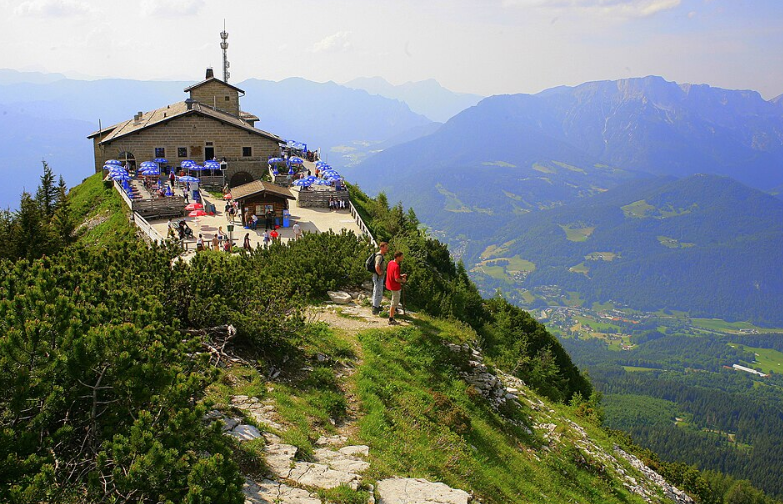
A massive fire has left the Kehlsteinhaus, the Nazi-era mountain retreat commonly known as Hitler's Eagle's Nest, nearly destroyed in the Bavarian Alps of southern Germany. The blaze broke out on Friday evening, October 23, 2026, and continued burning into Saturday as approximately 200 emergency personnel battled flames, strong winds and difficult mountain conditions.
German police arrested a 33-year-old man on suspicion of arson after firefighters encountered him near the burning building. No deaths or injuries from the fire were reported, but officials said the historic structure suffered extensive damage that could cost millions of euros to repair.
The Kehlsteinhaus stands on the Obersalzberg mountain above Berchtesgaden, approximately 1,834 meters (6,017 feet) above sea level. Built in 1938 for the Nazi leadership, it survived World War II and later became a tourist attraction, restaurant and historical exhibition.
Fire Engulfs Historic Mountain Retreat
Emergency services received an automatic fire alarm from the Kehlsteinhaus at approximately 9:15 p.m. local time on Friday. Firefighters dispatched to the remote location could already see flames rising from the building as they traveled up the mountain.
By the time the first emergency crews reached the site, the structure was fully engulfed in flames. The fire rapidly spread through the building, damaging its roof, interior rooms and other historic features.
The mountainous location made firefighting especially difficult. Emergency vehicles had to travel along a narrow, winding road that includes tunnels and steep sections, limiting access for large fire engines.
The situation became more dangerous as rain changed to snow and strong winds swept across the exposed summit. Firefighters were forced to suspend some operations overnight because of worsening conditions and concerns about their safety.
Crews initially needed heavy respiratory protection to approach the building. As the structure weakened, falling debris and unstable sections made entering the interior too dangerous.
The fire continued burning into Saturday morning, with emergency workers concentrating on containing the remaining flames and preventing further destruction.
The response involved firefighters from several surrounding communities, mountain rescue teams, police officers and Bavarian Red Cross personnel.
Police Arrest Suspect in Arson Investigation
Investigators quickly began examining whether the fire had been deliberately started. Their attention turned to a motorcyclist encountered on the road leading away from the Kehlsteinhaus shortly after the alarm.
Police stopped and arrested the man, identifying him as a 33-year-old German citizen with connections to the Berchtesgaden region. Authorities said he currently lives in Berlin.
The investigation was transferred to the Traunstein criminal police under the supervision of local prosecutors.
During a Saturday press conference, prosecutors said evidence had strengthened their suspicion that the man was responsible for starting the fire. A judge subsequently authorized his temporary placement in a psychiatric hospital after an expert medical assessment.
Authorities also said they were examining whether the alleged arson could have been politically motivated because of the building's connections to Adolf Hitler and Nazi Germany.
Investigators have not established a motive, and the suspect has not been convicted of a crime. Police said they had found no indication that additional people were involved.
Fire investigators were unable to conduct a full inspection of the damaged building immediately because parts of the structure remained unsafe. Specialists from Bavaria's State Criminal Police Office are expected to assist with further examinations.
Severe Damage Raises Questions About Preservation
Photographs released by Bavarian police showed much of the Kehlsteinhaus reduced to a burned-out shell. Large sections of its roof and interior were destroyed, while firefighters continued working around unstable walls and debris.
Local tourism officials said it was too early to determine how much of the original building could be preserved. Initial assessments suggested that the damage would run into millions of euros.
The extent of the destruction prompted immediate questions about whether the historic structure could be rebuilt and what form any reconstruction should take.
Bavarian Interior Minister Joachim Herrmann indicated that the state government favored restoration rather than permanently abandoning the site.
"We're not going to leave a ruin there," Herrmann told reporters in Berchtesgaden.
He explained that the building's future would require discussions involving local officials, historians, preservation specialists and other interested groups.
Bavaria's state government owns the Kehlsteinhaus. Officials said insurance coverage would be examined as part of planning for repairs or reconstruction.
The fire also affected tourism operations around the mountain. Authorities closed the immediate area, introduced restrictions on drone flights and asked hikers and climbers to avoid the surrounding region while emergency work continued.
Eagle's Nest Was Built for Nazi Leaders in 1938
The Kehlsteinhaus was completed in 1938 as a prestigious guesthouse and reception venue for the Nazi leadership. Its location high above Berchtesgaden was intended to provide an impressive setting for official visitors and political gatherings.
Although commonly described as Hitler's mountain retreat, the building was not his primary residence. Hitler spent considerably more time at the nearby Berghof, his home on the Obersalzberg.
The Eagle's Nest was used for selected visits, receptions and meetings. Its remote location and difficult access meant Hitler visited relatively infrequently.
The building was connected to the Nazi leadership's larger Obersalzberg complex, which included residences, military facilities and administrative buildings.
Unlike many buildings associated with Nazi Germany, the Kehlsteinhaus survived the war largely intact. It escaped the destruction that affected much of the surrounding complex during Allied attacks in 1945.
The Berghof itself was damaged during the war, and its remaining ruins were demolished in 1952.
The Kehlsteinhaus survived and became one of the most recognizable buildings connected to the Nazi era.
Historic Building Became a Popular Tourist Destination
Since 1952, the Kehlsteinhaus has operated as a mountain restaurant and tourist destination. Visitors have traveled to the site to experience the Alpine scenery and learn about its history.
Access normally involves a special mountain bus journey followed by a distinctive elevator built inside the rock. The elevator carries visitors from a tunnel at the end of the road to the building near the summit.
The unusual approach has long been part of the attraction. From the mountain, visitors can see extensive views of the Berchtesgaden Alps and the surrounding region.
The restaurant also included an exhibition explaining the building's origins and its association with the Nazi regime.
Local authorities have sought to present the site in its historical context rather than celebrate its association with Hitler. The building's protected status reflected its importance as physical evidence of the Nazi leadership's presence in the region.
The nearby Obersalzberg Documentation Center provides more extensive information about National Socialism, the Nazi dictatorship and the history of the mountain complex.
That documentation center, located farther down the mountain, was not damaged by Friday's fire.
Future of Eagle's Nest Remains Uncertain
The destruction has created a difficult preservation question for Bavarian authorities. Rebuilding the Kehlsteinhaus would require careful decisions about restoring original materials, replacing damaged sections and explaining the site's history to future visitors.
The building's association with Nazi Germany also gives the restoration debate unusual sensitivity. Officials must consider how reconstruction would serve historical education without turning the former Nazi reception venue into a place of glorification.
Herrmann emphasized that preserving historical memory would remain important in decisions about the building's future.
The state government has not announced a reconstruction budget, reopening date or detailed restoration plan. Officials first need a comprehensive assessment of the damage and an investigation into the cause of the fire.
Meanwhile, police continue examining evidence against the detained suspect. Investigators are also considering possible motives, including whether the site's Nazi history influenced the alleged attack.
As of Saturday evening, October 24, emergency crews remained at the Kehlsteinhaus securing the area and dealing with the aftermath of the fire. The historic mountain landmark faces an uncertain future, with authorities preparing to determine what can be saved from the devastation.