

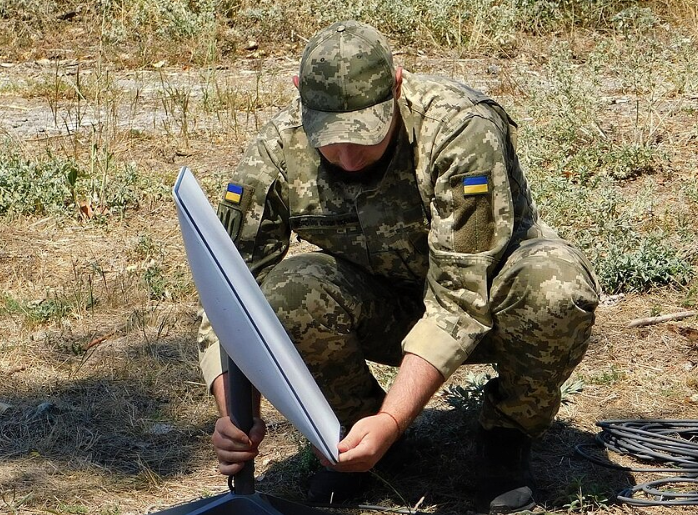
Ukraine has restored Starlink and Starshield satellite communications to their previous operating capabilities after more than a week of restrictions disrupted military operations against Russia. President Volodymyr Zelenskyy announced the recovery on Saturday, October 24, 2026, saying the systems were functioning at the speeds Ukraine needed for frontline communications, drone operations and logistics.
The announcement followed nearly two weeks of difficulties with satellite connections on fast-moving military equipment. Ukraine's Defense Ministry confirmed that its monitoring systems recorded stable connections on equipment traveling faster than 400 kilometers per hour (249 mph), a significant improvement over the restrictions reported earlier in October.
Zelenskyy said the restoration began overnight, with tests confirming that the systems were working by Saturday morning. He credited American officials and international partners for helping resolve a disruption that had threatened several important Ukrainian military operations.
Starlink Restrictions Disrupted Ukrainian Drone Operations
Starlink, operated by Elon Musk's SpaceX, provides satellite internet connections through a network of orbiting satellites. Starshield is a related service designed for government and military applications, including secure communications and operations involving remotely controlled equipment.
Ukraine has relied heavily on these systems since Russia launched its full-scale invasion in February 2022. Satellite connections help military units communicate across damaged infrastructure, coordinate battlefield activities and operate drones in areas where conventional networks are unavailable.
Restrictions first reported around October 14 caused some terminals to lose connectivity when moving faster than approximately 160 kilometers per hour (99 mph). The limitations affected drones and other equipment that require dependable connections while traveling at higher speeds.
Ukrainian commanders reported that some drone missions had been disrupted or canceled because of the restrictions. The problems also complicated efforts to intercept Russian attack drones, including faster variants of the Iranian-designed Shahed weapons used against Ukrainian cities.
The reported speed limits referred to how fast equipment could travel while maintaining satellite connectivity. They did not describe internet download or upload speeds, an important distinction because the restrictions primarily affected moving military platforms.
Ukraine's Defense Ministry said Saturday that connections remained stable at speeds exceeding 400 kilometers per hour. However, the ministry did not disclose the systems' maximum operating limits or independently establish that every affected terminal had recovered.
Defense Minister Yevhenii Khmara credited direct diplomatic discussions involving Zelenskyy with helping restore service. He described the recovery as particularly important for Ukrainian soldiers, military logistics, drone operations and battlefield communications.
Elon Musk Acknowledges SpaceX Restricted Starlink
The restoration came as questions continued about who ordered the restrictions and why they were imposed.
Hours after Ukraine announced the recovery, Musk acknowledged that SpaceX had restricted the civilian Starlink service. In a statement posted on X, he accused the Ukrainian military of violating the company's terms by using Starlink for offensive drone strikes.
"That loophole was closed last week," Musk wrote, arguing that civilian commercial services should not be used for offensive military operations.
Musk maintained that the U.S. government controls Starshield, distinguishing the military system from SpaceX's commercial Starlink service. His statement did not establish who authorized the restrictions affecting Starshield or explain why the two services experienced similar problems.
The disagreement over responsibility had already caused tensions between Kyiv and Washington. President Donald Trump denied ordering the restrictions, while senior administration officials offered differing explanations about the government's role.
Vice President JD Vance had suggested possible White House coordination with Musk. Secretary of State Marco Rubio and Defense Secretary Pete Hegseth denied administration involvement, according to reporting by The Associated Press.
Reuters reported that the order to restrict Starshield originated inside the White House. That reporting conflicts with public denials from administration officials, leaving the chain of responsibility disputed.
Ukrainian officials also challenged Musk's explanation for the restrictions. They disputed allegations that the military was using Starlink for the types of long-range offensive drone missions described in the controversy.
The available statements do not establish whether SpaceX's restrictions on commercial Starlink and the limitations affecting Starshield were ordered through the same process.
Zelenskyy Thanks Washington but Seeks More Military Assistance
Zelenskyy welcomed the restoration and thanked members of Congress, senators, the U.S. State Department and President Trump for their involvement in resolving the disruption.
He also acknowledged the role of news organizations and Ukraine's international partners in drawing attention to the problem. The Ukrainian president emphasized that reliable communications are essential for protecting soldiers and civilians from Russian attacks.
In his October 24 address, Zelenskyy said the restoration was particularly important for defending Ukraine against jet-powered Shahed drones. These faster attack weapons present additional challenges for Ukrainian forces attempting to detect and intercept them.
The president also used the address to urge the United States and European partners to resume deliveries of air defense interceptors. Ukraine needs additional missiles to defend against Russian ballistic missile attacks, and Zelenskyy said previously approved shipments were still awaiting delivery.
Although satellite connectivity had improved, he indicated that other areas of military cooperation with Washington still required attention.
Restoration Comes Amid Renewed Peace Negotiations
The satellite communications dispute unfolded during a renewed diplomatic effort involving Ukraine, Russia and the United States.
Russia agreed to resume three-way negotiations with Washington and Kyiv in November, according to reports published Saturday. The planned talks follow a period of tension over American policy toward Moscow and Ukraine's continuing attacks on Russian energy infrastructure.
A separate humanitarian arrangement was also reached around Oleshky, a Russian-occupied city in southern Ukraine's Kherson region. The agreement is intended to allow humanitarian assistance into the area and help civilians leave dangerous conditions.
Zelenskyy said roads around Oleshky had been mined and that residents urgently needed food, medicine and evacuation routes. He expressed hope that American mediation would help make the arrangement operational.
The limited agreement does not represent a broader ceasefire. Fighting and long-range attacks continued elsewhere as both sides targeted military and industrial facilities.
Russian and Ukrainian Strikes Continue
Ukraine's military reported attacks on Russian industrial facilities during the weekend, including a chemical plant in Tolyatti and an electronics facility in Oryol.
Ukraine's General Staff said the Tolyatti plant produces materials used in rocket fuel. It also identified the Oryol facility as a producer of components for missiles employed against Ukrainian targets.
Local Russian officials reported industrial damage in Tolyatti and said three people were killed in an attack in Oryol. The full extent of the damage at the targeted facilities was not independently established.
Ukrainian drones also reached Russia's Omsk region in western Siberia, more than 2,000 kilometers from the Ukrainian border. Russian online retailer Ozon said one of its logistics centers was struck but reported no casualties.
Meanwhile, Russian attacks continued inside Ukraine. Officials reported that a missile strike in Lozova, in the Kharkiv region, killed one person and wounded two others.
The continuing exchanges show that restoring satellite communications has not reduced the immediate dangers facing civilians and military personnel.
For Ukraine, the restored Starlink and Starshield connections provide an operational improvement after days of disruption. The Defense Ministry said it would continue monitoring both services, while responsibility for the Starshield restrictions remains disputed and Washington faces renewed pressure over military assistance.