

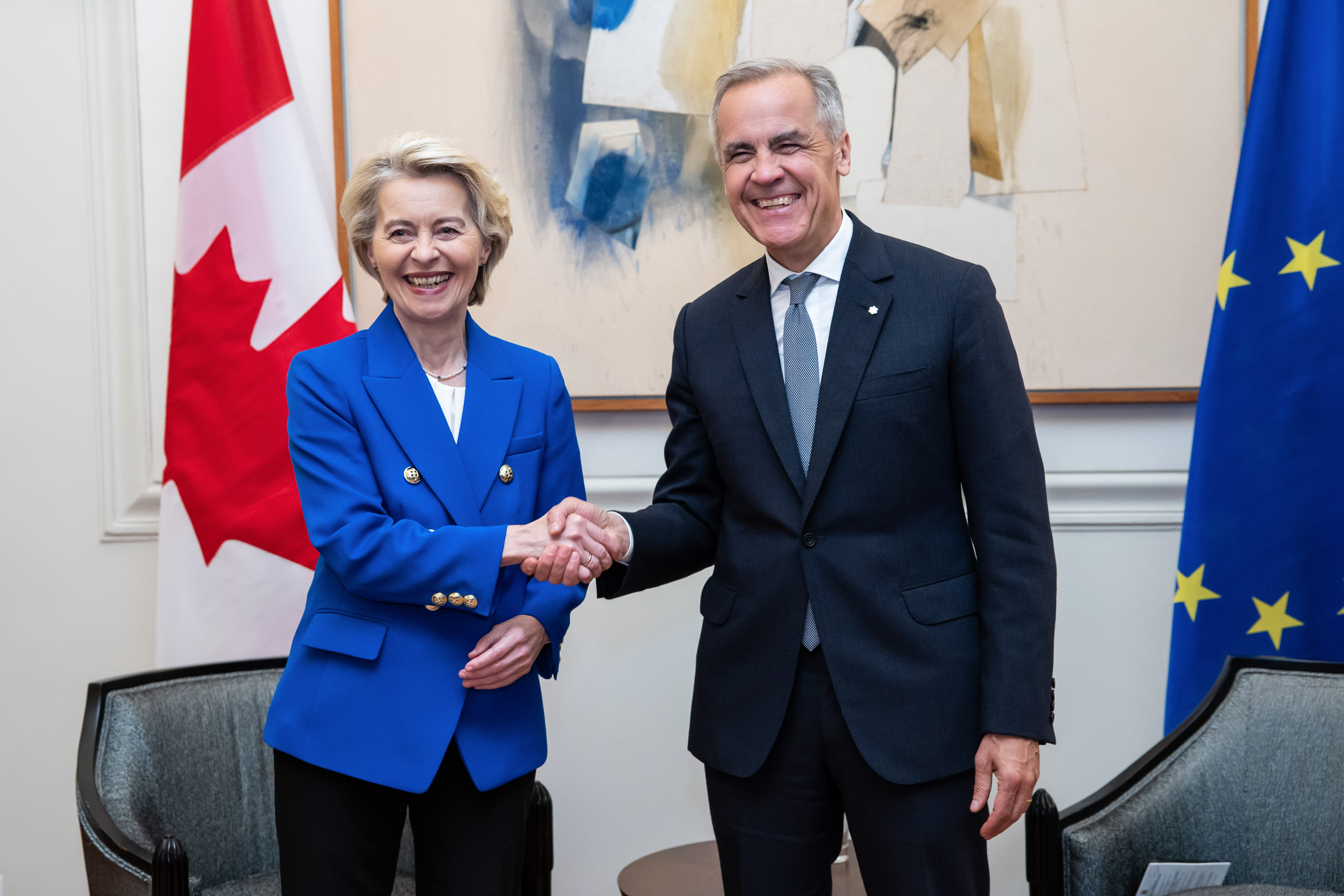
Canada and the European Union launched a new economic and security partnership on Friday, October 30, 2026, as Prime Minister Mark Carney outlined plans to establish a closer relationship with the 27-member bloc. The agreement follows a two-day summit in Montreal and could eventually give Canada a unique form of association with the EU without becoming a full member.
Carney met with European Commission President Ursula von der Leyen and European Council President António Costa to announce the Alliance for the Future. The initiative aims to expand cooperation on trade, defense, energy, technology and access to critical resources.
The leaders agreed to define the terms of a closer partnership by their next summit in 2027. Carney said he hopes negotiations will produce an agreement by June, although the exact meaning of associate membership remains unsettled.
The summit produced more than 20 new measures, including progress on digital trade, competition rules and scientific research. Canada also formally joined a European high-performance computing initiative that will give Canadian researchers access to some of Europe's most powerful supercomputers.
Associate Membership Proposal Faces Resistance
The most politically sensitive issue involves whether Canada should become the European Union's first associate member. Von der Leyen proposed the arrangement in September as part of a broader effort to strengthen relations with countries that share European economic and security interests.
Carney supports the concept but has emphasized that Canada is not seeking full EU membership. Instead, he wants an arrangement that provides greater cooperation and market access while preserving Canadian sovereignty.
The final Montreal declaration did not use the term associate membership. Instead, the leaders committed to defining an even closer association that would stop short of full membership.
The omission reflected concerns among some EU governments. German Chancellor Friedrich Merz and other European leaders reportedly objected to introducing a membership category that has no established legal meaning under existing EU arrangements.
EU membership normally involves extensive legal and institutional obligations, including representation in European institutions and participation in common rules. The proposed Canadian arrangement would be different, but officials have not determined its precise structure.
Von der Leyen continued to support the idea following the summit. She said the objective was to make Canada as close a partner as possible while respecting the independence of both sides.
Any formal agreement would require additional negotiations and appropriate political approvals. Carney has indicated that an enhanced partnership would also need consideration by Canada's Parliament.
Digital Trade and Supercomputing Agreements Advance
One of the summit's most concrete achievements was the completion of substantive negotiations on a Canada-EU Digital Trade Agreement. The proposed deal is intended to simplify online transactions and establish more predictable rules for businesses operating across the Atlantic.
The agreement would address electronic contracts, digital signatures, cross-border data transfers and other issues affecting online commerce. It would complement the existing Comprehensive Economic and Trade Agreement, known as CETA.
The Canadian government said its businesses exported nearly $15 billion in digitally deliverable services to the European Union in 2024. Officials believe clearer regulations could help software developers, financial technology businesses and other digital service providers reach additional European customers.
Canada also became a participating state in the European High Performance Computing Joint Undertaking, known as EuroHPC. The partnership creates opportunities for Canadian institutions and businesses to use advanced European computing infrastructure.
That includes access to JUPITER, one of the world's most powerful supercomputers. Such systems can support research involving artificial intelligence, weather forecasting, medical science, engineering and complex computer simulations.
The two sides also agreed to expand cooperation on quantum technologies and advanced computing. Future negotiations could give Canadian researchers greater access to Horizon Europe, the EU's major research and innovation funding program.
Another proposal would expand Canadian participation in Erasmus+, a European program supporting international education and student exchanges. The goal is to create more opportunities for Canadians to study and develop professional skills in Europe.
Security, Energy and Critical Minerals Take Priority
The new alliance extends well beyond commercial relations. Canada and the EU want to reduce dependence on vulnerable supply chains and strengthen their ability to respond to international emergencies.
One agreement establishes a framework for the European Investment Bank to support Canadian critical minerals projects. These resources are essential for batteries, advanced electronics, renewable energy systems and military equipment.
The partners also plan to explore arrangements for stockpiling important raw materials and encouraging investment in secure supply chains.
Defense cooperation is another major priority. Canada became the first non-European country to participate in the EU's Security Action for Europe initiative in February 2026, opening opportunities for Canadian defense companies to compete for European procurement contracts.
During the Montreal summit, officials highlighted a contract worth more than $44 million for Canadian company Galvion to supply military helmets to Latvia. The agreement follows earlier Canadian defense sales connected to European security initiatives.
The two sides also discussed cooperation on Arctic security, cybersecurity, border protection and threats involving foreign interference.
Additional projects could improve satellite communications and navigation services. Canadian participation in European initiatives such as IRIS² and Galileo could provide alternatives for secure communications and positioning systems.
Energy cooperation includes examining whether Canada could increase liquefied natural gas exports to European markets. Officials said any expansion would depend on commercial demand, infrastructure requirements and other practical considerations.
Trump's Tariff Threats Add Pressure
The closer relationship comes amid continued tensions between Canada and the United States over trade policy and economic security.
President Donald Trump has criticized the possibility of Canada becoming an EU associate member. In September, he described the proposal as potentially hostile and threatened additional tariffs on European goods if he believed the arrangement was intended to undermine American interests.
Trump also said cooperation would be acceptable if European leaders pursued it with good intentions. No new tariffs directly resulting from the Montreal summit were announced.
Canadian officials have maintained that the proposed alliance is not directed against the United States. They describe it as an effort to strengthen economic resilience and create additional opportunities for Canadian businesses.
The economic challenge is substantial. The United States received 71.7% of Canada's merchandise exports in 2025, while the European Union accounted for a much smaller share.
Canada's total trade in goods and services with the EU reached approximately $178 billion in 2025, making the bloc its second-largest global trading partner when both categories are combined.
Carney has set a goal of doubling Canada's exports to markets outside the United States over the next decade. Expanding access to Europe is a central part of that strategy.
Next Steps Toward a New Partnership
The Alliance for the Future establishes a broad framework, but many of its proposed benefits will require additional agreements before taking effect.
Canadian and European officials plan to continue negotiations over financial services, research programs, energy infrastructure and the proposed association arrangement. They will also examine ways to connect instant payment systems and develop secure communications links between the continents.
Carney has announced plans for further meetings between Canadian and European officials in March 2027. Leaders expect to clarify the legal and political structure of the closer relationship by their next summit.
For Canada, the immediate results include new research opportunities and completed negotiations on important trade measures. The larger question is whether the two sides can establish a durable form of association that expands cooperation without creating the obligations of full EU membership.
The June 2027 target will be the next major test of how far Canada and the European Union are prepared to take their proposed partnership.