

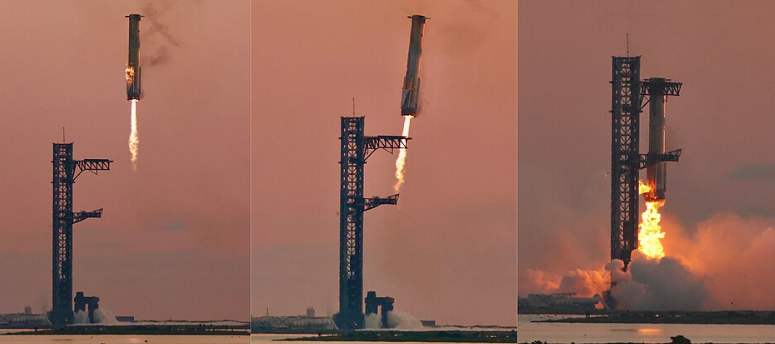
SpaceX completed a landmark Starship test on Saturday, November 14, 2026, catching the spacecraft's upper stage at its launch tower in South Texas after more than 22 hours in orbit. The successful recovery followed Friday's launch from Starbase and marked the first time a returning orbital Starship had been captured by the tower's mechanical arms. The mission fell short of its original plan to recover both stages because the Super Heavy booster diverted away from the launch site and was destroyed over the Gulf of Mexico.
The 15th integrated flight test demonstrated a difficult part of SpaceX's plan to build a fully reusable launch system. Starship circled Earth 14 times and deployed 26 next-generation Starlink satellites before returning to Texas. Engineers now have an intact upper stage to inspect, although reusing a recovered spacecraft on another mission remains an unproven step.
Starship Returns to Its Launch Tower
Flight 15 lifted off Friday, November 13, at approximately 4:47 p.m. Central time from Starbase, near the Texas Gulf Coast. The rocket consisted of the Super Heavy booster beneath the Starship spacecraft, also known as Ship 42. Following stage separation, Starship continued into orbit while the booster began its return toward Earth.
The upper stage's mission lasted roughly 22 and a half hours, considerably longer than earlier Starship tests. It completed 14 orbits before firing an engine to leave orbit and begin its descent. SpaceX evaluated the spacecraft's heat shield and other critical systems before authorizing the attempt to return directly to the launch site.
As Starship descended through the atmosphere, its heat-shield tiles protected the spacecraft from extreme reentry temperatures. The vehicle then maneuvered toward the launch tower and fired its engines to slow its final descent. Around 3:20 p.m. Central time Saturday, the tower's two large mechanical arms caught the returning spacecraft.
The arms are nicknamed chopsticks, and the surrounding tower system is commonly called Mechazilla. SpaceX had already caught Super Heavy boosters during earlier test flights, beginning in October 2024. Capturing a spacecraft returning from orbital speed was a different challenge because the upper stage had to survive reentry before approaching the tower accurately.
Booster Recovery Attempt Ends in Gulf
SpaceX also intended to catch Super Heavy during Flight 15, creating the possibility of recovering both major sections of the vehicle in a single mission. That attempt was abandoned minutes after Friday's liftoff. Instead of approaching the tower, the booster diverted toward a designated offshore area in the Gulf of Mexico.
During Saturday's mission coverage, SpaceX said early information suggested a low-fuel-mass alarm had caused the booster's return burn to stop sooner than planned. Its guidance system then recognized that the vehicle was not positioned safely for a tower catch. The automated abort redirected the booster away from the launch infrastructure.
The booster subsequently exploded above the Gulf before it could complete a normal recovery. SpaceX said its engineers were still investigating the underlying reason for the early shutdown. The company has not established that the same problem affects the recovered Starship upper stage.
The booster loss matters because the long-term design depends on recovering and flying both stages repeatedly. A successful catch of the spacecraft alone does not make the rocket fully reusable. Future flights must demonstrate reliable returns, inspections and relaunches without requiring a new vehicle each time.
Starlink Satellites Deployed During Orbital Mission
The flight also served a practical purpose beyond testing rocket recovery. SpaceX reported deploying all 26 Starlink V3 satellites carried aboard Ship 42. The larger satellites are intended to increase the capacity and performance of the company's satellite internet network.
Three of the satellites carried cameras designed to examine the spacecraft's heat shield from orbit. Those observations supplemented information from sensors and cameras on Starship itself. The results helped engineers assess whether the spacecraft was in suitable condition for its planned return to Texas.
Starship is designed to carry heavier payloads than SpaceX's Falcon 9 rocket. Increased capacity could allow the company to deploy larger groups of satellites on future missions. However, the number a Starship can carry will depend on its final configuration, the satellites' design and the destination orbit.
Successfully releasing the payload and completing the catch gave SpaceX two useful outcomes from the same test. The first showed that Starship could perform satellite deployment during an extended orbital mission. The second demonstrated that the spacecraft could return to its launch site rather than being discarded after delivering its cargo.
Two Separate Aviation Disruptions Occur Friday
The launch took place on a day when commercial aviation was already experiencing major problems. The Federal Aviation Administration ordered a nationwide ground stop on November 13 because telecommunications failures affected air traffic control systems. Federal officials attributed that emergency action to communications and radar instability, not to the Starship launch.
Hawaii's Department of Transportation separately reported a temporary halt affecting flights between Hawaii and the U.S. West Coast because of a space-debris concern associated with the SpaceX launch. That restriction was announced after some flights had started resuming from the nationwide ground stop. State officials later reported that both restrictions had been lifted.
The two disruptions should not be confused. The nationwide ground stop involved the FAA's air traffic control communications network, while the Hawaii restriction was linked by state officials to a launch-related debris warning. Available reporting does not establish that the booster failure caused the national telecommunications outage.
Space launches routinely require coordination with aviation authorities to keep aircraft away from designated hazard areas. The timing of Friday's events nevertheless complicated an already difficult day for airlines and passengers. The FAA and state transportation officials managed the restrictions as separate safety concerns.
NASA and Future Missions Depend on More Testing
Starship's development is closely watched by NASA, which has contracted with SpaceX to develop a version capable of transporting astronauts to the lunar surface. The agency is working toward crewed Artemis lunar landings as early as 2028. A successful orbital recovery provides useful engineering experience, but it does not demonstrate that the lunar version is ready to carry astronauts.
Lunar missions will require additional capabilities, including reliable in-space propellant transfer and operations far from Earth's atmosphere. SpaceX must also demonstrate that the vehicle can land safely on the Moon and support the demands of crewed flight. NASA is developing lunar landing options with SpaceX and Blue Origin rather than depending on this single test result.
Elon Musk has also described Mars transportation as a long-term objective for Starship. Achieving that goal would require many more advances in vehicle reliability, fueling and operations. The successful catch represents progress toward reuse, not proof that routine interplanetary transportation is close.
SpaceX's next steps include inspecting Ship 42 and examining the data behind the failed booster return. Engineers will need to determine whether the recovered spacecraft can be refurbished and eventually flown again. Flight 15 ended with an unprecedented upper-stage catch, but a fully recovered and repeatedly flown Starship system remains a goal for future tests.