

Researchers examining the relationship between sleep and weight-loss medications have found preliminary evidence that better sleep may contribute to more successful obesity treatment. Their findings suggest that sleep duration and quality deserve greater attention when treating patients with GLP-1 medications such as semaglutide.
The research comes as Health Canada issued a separate safety advisory on November 25, 2026, warning about a very rare but potentially serious eye condition associated with semaglutide.
Together, these developments illustrate the importance of understanding both the factors that may influence treatment outcomes and the potential risks associated with these increasingly popular medications.
Researchers Examine the Relationship Between Sleep and Weight Loss
A scientific review published in the journal Current Diabetes Reports examined whether sleep influences the effectiveness of medications used to treat obesity.
The researchers focused on everyday sleep habits, including sleep duration, quality and consistency, rather than exclusively examining diagnosed sleep disorders.
GLP-1 receptor agonists mimic the activity of a naturally occurring hormone called glucagon-like peptide-1. These medications help regulate appetite, blood sugar and feelings of fullness.
Although these drugs have substantially expanded obesity treatment options, patients do not necessarily experience the same amount of weight loss.
Researchers wanted to determine whether differences in sleep habits might help explain some of that variation.
Their literature search, covering published research through May 2026, identified remarkably little direct evidence concerning sleep and the effectiveness of newer obesity medications.
Japanese Study Finds a Link Between Sleep and Semaglutide Outcomes
One study published in 2025 examined 367 adults in Japan who received oral semaglutide for weight management between 2022 and 2024.
The investigators reviewed medical records containing information about body weight and patients' reported sleeping habits.
Approximately one-third of participants initially reported sleeping fewer than six hours per night. More than 40 percent reported poor sleep quality.
After three months of treatment, participants reporting longer sleep duration were more likely to achieve a reduction of more than 3 percent of their initial body weight.
Better reported sleep quality was also associated with more favorable weight-loss outcomes.
Participants whose sleeping habits improved during treatment were more likely to achieve the study's weight-loss target.
However, the investigation was observational. Participants reported their own sleeping habits, and the study did not include a separate comparison group receiving a placebo.
Researchers also could not fully account for changes in conditions such as obstructive sleep apnea. Improvements in those conditions might have influenced both sleep and body weight.
The findings therefore establish an association rather than proving that improved sleep makes semaglutide more effective.
Sleep May Help Patients Maintain Weight Loss
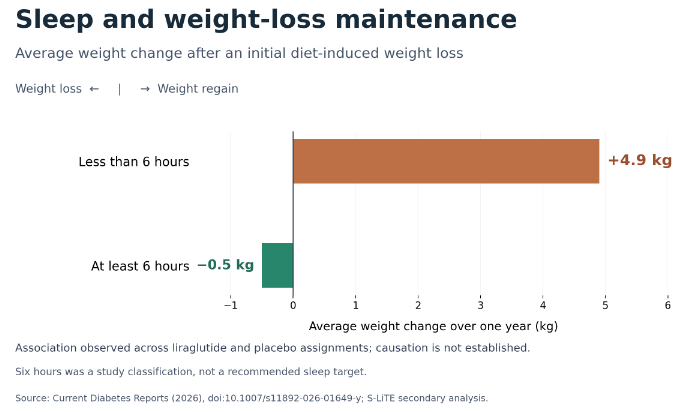
A separate investigation published in the journal Sleep examined information from 195 adults who participated in a randomized weight-management trial.
Participants initially completed an eight-week low-calorie dietary program. They were then assigned to weight-maintenance strategies involving exercise, liraglutide, a placebo or a combination of these interventions.
Unlike the Japanese study, researchers used wrist-worn activity monitors to measure sleep duration.
During the following year, participants who slept at least six hours per night generally maintained their weight loss. Those sleeping fewer than six hours regained substantially more weight.
Importantly, the relationship was observed regardless of whether participants received liraglutide or a placebo.
This suggests that sleep could contribute to successful weight management independently of medication.
The investigation also found that liraglutide initially increased sleep duration, suggesting that the relationship between sleep and obesity treatment may operate in both directions.
Nevertheless, the six-hour threshold used in the study should not be interpreted as an optimal sleep recommendation.
How Sleep Could Influence Appetite and Metabolism
Scientists are investigating several possible explanations for the relationship between sleep and weight management.
Insufficient sleep can affect hunger, food preferences, energy levels and willingness to participate in physical activity. These behavioral changes could influence treatment outcomes even when patients receive effective medications.
The body's natural GLP-1 production also appears to be influenced by sleep patterns and internal biological rhythms.
Previous research has examined how insufficient or interrupted sleep affects hormone secretion following meals. Changes in these responses could potentially influence appetite regulation.
However, medications such as semaglutide remain active much longer than naturally occurring GLP-1.
Researchers have not established whether changes in natural hormone production substantially affect the appetite-suppressing action of these medications.
Further randomized trials are needed to determine whether deliberately improving sleep produces additional weight loss during GLP-1 treatment.
Health Canada Warns of Rare Vision-Loss Risk
In a separate development, Health Canada announced that a completed safety review identified a possible association between semaglutide and non-arteritic anterior ischemic optic neuropathy, commonly abbreviated as NAION.
The condition develops when the optic nerve receives insufficient blood flow. It can result in sudden, usually painless vision loss that may be permanent.
Symptoms can include blurred or cloudy vision, diminished color perception and loss of part of the visual field. The condition often affects one eye.
Health Canada described the risk associated with semaglutide as very rare.
The warning applies to prescription medications containing semaglutide, including Ozempic, Wegovy, Rybelsus and approved generic alternatives.
Canadian regulators are working with manufacturers to update prescribing information. They are also reviewing whether similar risks exist with other GLP-1 receptor agonists.
People with diabetes, high blood pressure or elevated cholesterol already have an increased risk of developing NAION.
The agency advises patients experiencing sudden vision loss or rapidly worsening eyesight while taking semaglutide to seek urgent medical attention. Health Canada recommends discontinuing semaglutide when a diagnosis of NAION is confirmed.
Patients concerned about medication risks should discuss their circumstances with a healthcare professional.
The advisory follows a November 9 announcement from the U.S. Food and Drug Administration requiring updated safety warnings for GLP-1 medications concerning the potential risk of NAION.
Further Research Is Needed
The sleep review and the regulatory safety announcements address separate aspects of obesity treatment. The review does not establish a connection between sleeping habits and the medication-related risk of vision loss.
Researchers studying sleep hope that future clinical trials will determine whether improving rest can enhance medication effectiveness or help patients maintain weight loss over longer periods.
For now, evidence supporting sleep as a way to improve GLP-1 treatment outcomes remains limited. The potential benefits of addressing sleep habits must be distinguished from the established need to monitor medication safety and provide appropriate medical supervision.