

Listening to personalized music before and during a heart procedure may help patients maintain lower blood pressure, according to new clinical research. An international team of scientists found that patients who listened to music throughout coronary angiography had significantly lower systolic blood pressure immediately afterward.
The study, known as the MUS.E I trial, was published in the medical journal Heart on November 23, 2026. It involved researchers affiliated with institutions in France, the United States and Italy.
Although the results are encouraging, the researchers did not establish whether music reduces serious medical complications or improves long-term cardiovascular health.
Why Heart Procedures Can Cause Stress
Coronary angiography allows doctors to examine the arteries supplying blood to the heart. It is commonly used to identify narrowed or blocked arteries in patients with suspected coronary artery disease.
During the procedure, a physician guides a thin, flexible tube called a catheter through a blood vessel. A contrast dye and X-ray imaging allow doctors to examine blood flow through the coronary arteries.
Depending on the findings, doctors may perform an additional procedure to improve circulation. This can involve inserting a small mesh tube called a stent to keep a narrowed artery open.
Patients may experience anxiety because of unfamiliar equipment, concerns about discomfort or uncertainty about their diagnosis.
Psychological stress can activate the body's sympathetic nervous system, which controls responses to perceived threats. This reaction can temporarily increase blood pressure and heart rate.
The researchers wanted to determine whether personalized music could help manage these physiological responses alongside standard medical care.
How the Clinical Trial Was Conducted
The trial took place at Grand Hôpital de l’Est Francilien in France between November 2024 and March 2025.
Researchers initially evaluated 181 potential participants. Of those, 104 qualified for the study and were randomly assigned to treatment groups.
Four participants were subsequently excluded, leaving 100 people in the final analysis. Their average age was 67.3 years, and women represented 19 percent of the participants.
The researchers excluded patients requiring emergency cardiac procedures, those with hearing impairments and individuals whose medical conditions made participation unsuitable.
Participants were divided into three groups:
- Group A: 34 patients listened to personalized music for 30 minutes before their procedure.
- Group B: 32 patients listened before and throughout their procedure.
- Group C: 34 patients received standard medical care without the music intervention.
A professional music therapist prepared individual playlists using information about each patient's musical preferences.
Patients listened through earphones, allowing them to hear their selected recordings without requiring music to be played throughout the treatment room.
Continuous Music Produced the Strongest Blood Pressure Results
The main measurement was systolic blood pressure immediately after coronary angiography.
Systolic pressure is the higher number in a blood pressure reading. It measures the pressure exerted against artery walls when the heart contracts.
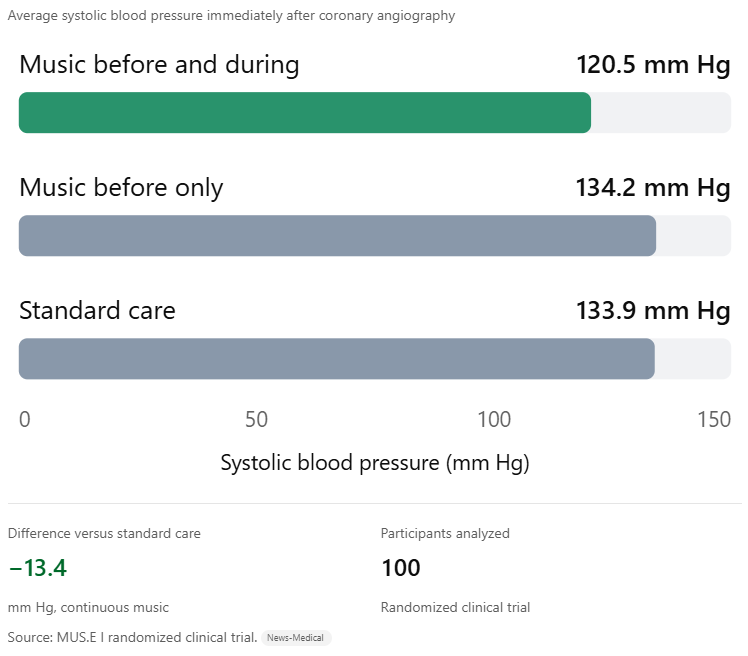
Patients who listened to music before and throughout their procedure recorded an average systolic pressure of 120.5 millimeters of mercury (mm Hg) afterward.
The corresponding averages were 134.2 mm Hg among patients who listened only beforehand and 133.9 mm Hg among those receiving standard care.
The continuous-music group therefore recorded an average pressure 13.4 mm Hg lower than the control group. The researchers found that this difference was statistically significant.
An additional analysis accounting for differences in blood pressure before treatment supported the main finding.
However, listening to music only before angiography did not produce a significant improvement in the primary measurement compared with standard care.
These results suggest that the timing and duration of music listening may influence its physiological effects.
Heart Rate and Sedative Use Also Showed Differences
The researchers examined several other measurements, including heart rate, oxygen saturation, pain and indicators of cardiac muscle injury.
Both music groups had lower average heart rates after angiography than the control group.
Another notable observation involved sedative medication. Six patients receiving standard care requested sedation, compared with none of the patients receiving the music intervention.
All participants received local anesthesia. Music was used alongside medical treatment, rather than as a replacement for pain relief or other necessary care.
The researchers also reported differences in blood concentrations of troponin, a protein commonly measured when assessing possible heart muscle damage.
However, differences between the groups before treatment and variations in the cardiac procedures performed make these findings difficult to interpret.
The trial was primarily designed to evaluate systolic blood pressure. Its other results should be considered preliminary until confirmed by additional research.
Anxiety and Pain Results Remain Inconclusive
Despite the encouraging physiological measurements, the researchers did not find statistically significant improvements in patient-reported anxiety.
Pain levels were generally low throughout the study. Although patients receiving continuous music reported less discomfort on average, the trial did not establish a reliable difference between groups.
Measurements of oxygen saturation and diastolic blood pressure also showed no significant differences.
These findings illustrate an important distinction between measurable physical responses and a patient's personal experience of stress.
A person can experience changes in heart rate or blood pressure without reporting a corresponding change in emotional anxiety.
Larger Clinical Trials Are Needed
The study involved a relatively small number of patients at a single medical center. Participants also knew whether they were receiving the music intervention, which could have influenced their expectations and experiences.
Another limitation was the absence of a comparison between personalized playlists and standard relaxing music. Consequently, researchers cannot determine whether selecting music according to individual preferences provides additional benefits.
The study also did not establish whether the immediate blood pressure differences continued after patients left the hospital.
Previous research has examined music as a supportive intervention during cardiovascular procedures. A published analysis of earlier studies reported potential benefits involving anxiety, pain and cardiovascular measurements.
The MUS.E I trial adds evidence that continuing music throughout coronary angiography may be more effective than providing it only beforehand.
The researchers have designed a follow-up trial called MUS.E II to investigate continuous music therapy in a larger patient population.
Further studies will need to determine whether the observed short-term benefits translate into meaningful improvements in patient recovery, safety and cardiovascular health.