

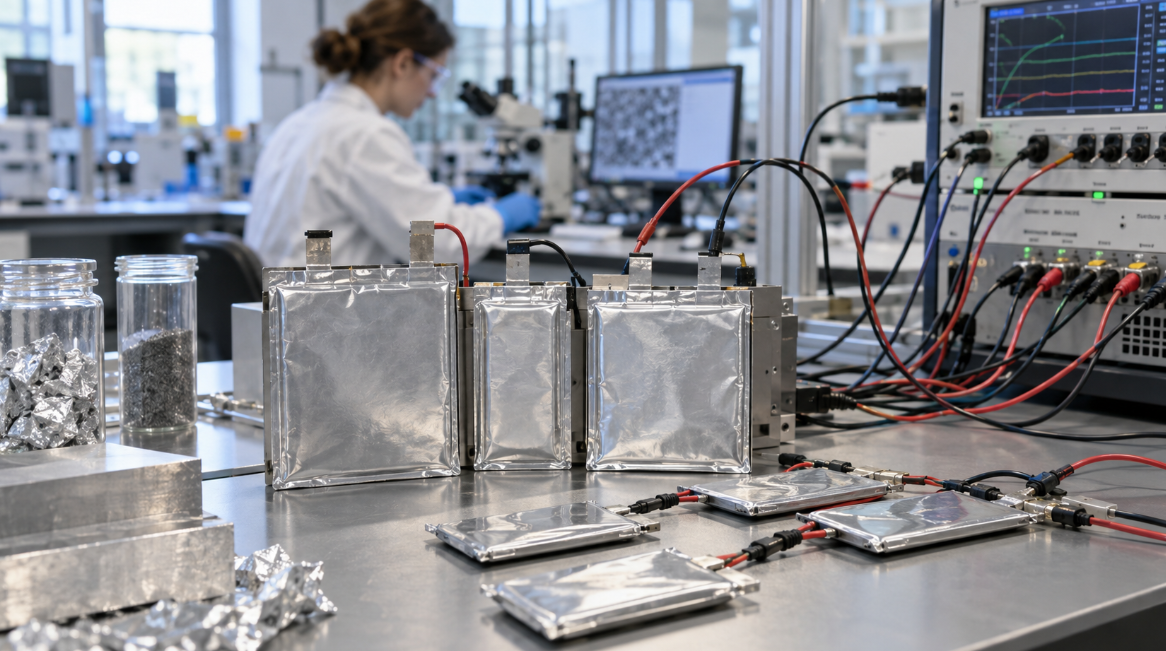
Aluminum-ion batteries are getting new attention after several research groups reported progress in fast charging, long battery life, and safer energy storage. The technology is still far from replacing lithium-ion batteries in cars and phones. However, recent tests show that aluminum batteries may have a future in transportation, electronics, and large energy storage systems.
One of the most interesting developments comes from Graphene Manufacturing Group, a company working with the University of Queensland. The company is developing a graphene aluminum-ion battery called G CELLS. It works with Rio Tinto and the Battery Innovation Center in Indiana.
GMG reported in September that its one amp-hour pouch cells completed 489 full charging and discharging cycles without a measurable loss of performance.
The cells were charged in six minutes and then discharged in six minutes during the tests. That is a 10C charge and discharge rate. It is much faster than charging most batteries in consumer products and electric vehicles.
The tests were performed by the Battery Innovation Center using cells made there with materials supplied by GMG. Outside testing matters because battery companies often announce results from their own laboratories. Independent testing can check whether the performance can be repeated.
GMG compared the cells with a lithium titanate oxide battery, an LTO battery. The LTO cell was tested using the same charging pattern. It fell to 86 percent of its original capacity after 64 cycles, while the GMG cells had reached 489 cycles without measurable capacity loss.
Heat is important when batteries charge quickly. Fast charging can cause resistance inside a battery to create heat. Too much heat can damage a cell, shorten its life, or require cooling.
The GMG cells had an internal resistance of about five milliohms during testing. Their temperature increased by about four degrees Celsius above ambient. The LTO comparison cell rose by about 19 degrees Celsius during testing.
There is a major weakness involving how much energy the battery can store for its weight.
Earlier testing showed better energy density than the cells used in the September cycling test. In April, GMG reported 49 watt-hours per kilogram when its pouch cells were charged in six minutes. When charging took 60 minutes, the company reported an energy density of 101 watt-hours per kilogram.
Those numbers remain below the energy density available from many modern lithium-ion batteries. That means an aluminum-ion battery pack could need more weight or space to store the same amount of energy. GMG also said the cells used for the long cycling tests were not yet optimized for energy density.
The company believes further work could bring the fast-charging version back toward 50 watt-hours per kilogram. That is a company goal, not a proven future result. Larger cells will also have to show that they can match the performance seen in the current one amp-hour pouch cells.
Other researchers are working on different types of aluminum batteries.
A study published in Nature Communications in August described a molten-salt aluminum battery that uses a cement and graphite electrode. Researchers were trying to solve a problem caused by the hot and corrosive environment inside this type of battery. Traditional polymer materials can weaken under those conditions.
The researchers created a self-supporting electrode using graphite for electrical conduction and cement for strength. The battery operated at about 150 degrees Celsius. In laboratory testing, it lasted for more than 11,000 cycles under one high-rate test condition.
This kind of battery is not designed to go inside a smartphone. Its high operating temperature makes it better suited to stationary uses, where batteries could store electricity for the power grid. Aluminum is attractive for this purpose because it is abundant, recyclable, and widely available.
Another study published in Electrochimica Acta in September examined an aqueous aluminum-metal battery. These batteries use a water-based electrolyte, which could offer safety and cost advantages. However, aluminum can develop surface layers and unwanted chemical reactions that make repeated charging difficult.
Researchers tested an amorphous alloy made from aluminum, nickel, and lanthanum as the battery anode. The disordered structure of the alloy helped aluminum deposit more evenly during cycling. A symmetric test cell operated for more than 6,000 hours under the conditions used by the researchers.
A full cell using the alloy also retained a capacity of 43.5 milliamp-hours per gram after 200 cycles. The result does not mean the battery is ready for factories. It shows that researchers may have found another way to improve one of the difficult parts of rechargeable aluminum batteries.
Aluminum has several reasons to interest battery researchers. It is one of the most common metals in Earth’s crust and already has a huge global production system. It also does not depend on lithium or many of the other materials that have created concerns about mining and supply chains.
Aluminum ions can also carry three positive charges. Lithium ions carry one. In theory, that gives aluminum interesting possibilities for storing and moving electrical charge, although turning that advantage into a practical battery has proved difficult.
Researchers still must solve problems involving electrolytes, electrode materials, energy density, corrosion, and manufacturing. A laboratory cell that survives thousands of cycles is not automatically ready for mass production. Cost, reliability, safety, and performance must also hold up when manufacturers make much larger numbers of cells.
The recent results show that aluminum battery research is moving in several directions at once. Some designs focus on extremely fast charging. Others are aimed at long-life grid storage or safer water-based batteries.
Lithium-ion batteries will probably remain dominant for some time because factories already produce them on an enormous scale. Their performance has also improved through decades of research and manufacturing experience. Aluminum batteries are starting much further behind.
Still, the latest work gives researchers more evidence that aluminum can be used in serious rechargeable battery systems. The next important step will be moving from impressive laboratory results to larger cells and practical products. If that happens, aluminum could eventually become another important tool for storing electricity.