

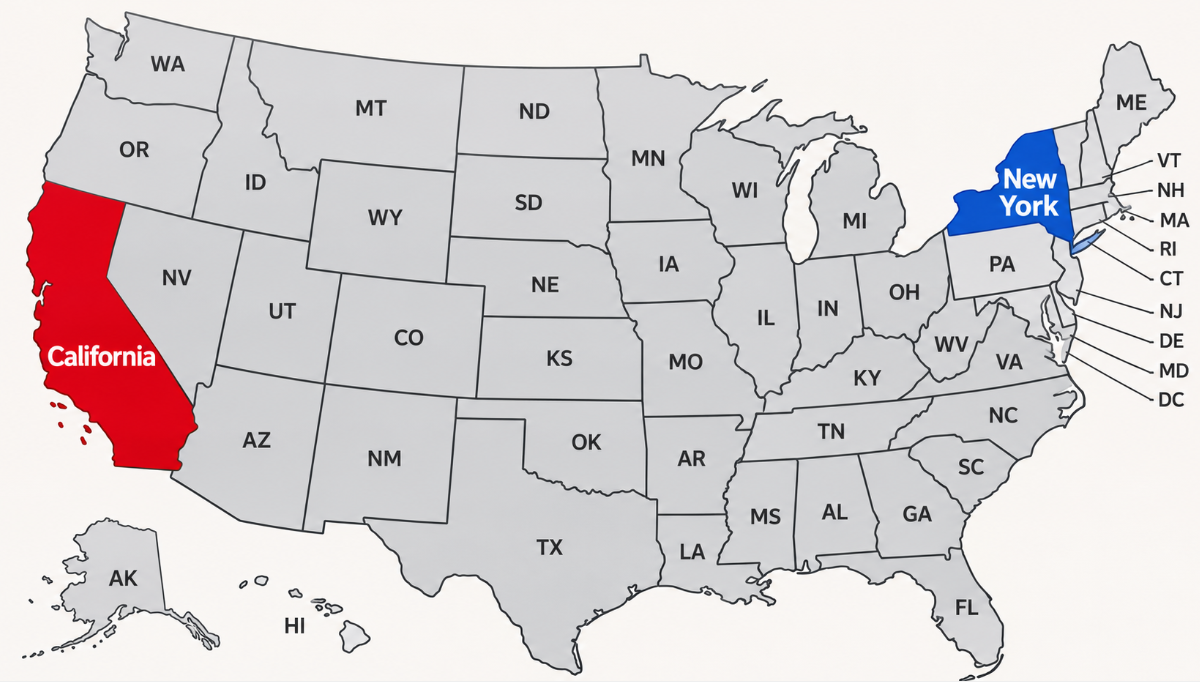
California and New York City voters decided a broad set of ballot measures in the November 3 election, with housing, taxes, election rules and government operations among the biggest issues. The results were especially sweeping in New York City, where voters approved all five proposed charter amendments.
California had a much larger statewide ballot. Fourteen propositions went before voters, and several had been called by the Associated Press by Wednesday evening. Other measures remained too close or too early to call as California continued counting millions of mail ballots.
California voters approve major housing measures
California Proposition 1 passed, authorizing $11.25 billion in state bonds for housing affordability programs. The measure includes $10 billion for housing programs and $1.25 billion for the CalVet home loan program.
With about 61 percent of the expected vote counted, the measure had roughly 59.6 percent support. The Associated Press called the race for the “yes” side early Wednesday.
Proposition 37 also passed. It authorizes up to $25 billion in bonds for a second-mortgage program aimed at qualifying middle-income buyers purchasing certain new homes.
The measure was receiving about 61.2 percent of the vote when it was called. Together, Propositions 1 and 37 represented two of the largest housing-related financial commitments on the California ballot.
Rainy day fund and high-income tax measures pass
Proposition 2 was also approved. It changes California’s budget rules by increasing the maximum size of the state Budget Stabilization Account, commonly known as the rainy day fund, from 10 percent to 20 percent of estimated general fund tax revenue.
The measure was running at about 59.8 percent support when the Associated Press called it.
California voters also approved Proposition 3, which makes the state’s higher income tax rates on upper-income taxpayers permanent instead of allowing them to expire in 2031.
Those rates range from 10.3 percent to 12.3 percent for taxpayers in the affected brackets. Revenue from the higher rates is directed primarily to K-12 schools, with a smaller share going to community colleges.
Proposition 3 had about 58.9 percent support in the latest Associated Press count.
Voter ID proposal rejected
One of the clearest defeats came on Proposition 39, which would have required government-issued identification for in-person voting and identification information for mail voting.
The measure also would have required election officials to use government data in efforts to verify citizenship information on voter rolls.
Voters rejected the proposal. About 58.8 percent were voting “no,” compared with roughly 41.2 percent voting “yes,” when the race was called.
Proposition 44 was defeated by an even larger margin. That measure would have required nonprofit federally qualified health centers to spend at least 90 percent of annual revenue on activities related to their health care missions.
About 81.9 percent of voters were opposing Proposition 44 in the latest count. The Associated Press called the measure defeated.
Several California propositions remain unsettled
A number of California measures had not yet been called Wednesday evening.
Proposition 4, which would allow state and local governments to create publicly financed campaign programs, was trailing. The “no” side had about 51.7 percent of the vote.
Proposition 5, which would change California’s recall process for state officers, was extremely close. The “yes” side held about 50.6 percent, while the “no” side had about 49.4 percent.
Proposition 38, an $8.4 billion bond measure for immunology and immunotherapy research, was leading with about 55.5 percent support but had not been called.
Proposition 40, the closely watched proposal for a one-time 5 percent tax on wealth above $1 billion, was trailing. About 55.3 percent of voters were opposing it in the latest count.
Three other tax-related measures also remained unresolved. Proposition 41, which would require audits of some tax programs and impose additional limits involving new taxes, was trailing with about 47.3 percent support. Proposition 42, which would prohibit certain new taxes on personal savings, assets and retirement holdings, was leading with about 54 percent.
Proposition 43, which would require a two-thirds vote for citizen-initiated local special taxes, was trailing with about 44.8 percent support. Proposition 45, which would shorten environmental review and permitting deadlines for certain projects, was also behind, with about 45.7 percent voting yes.
California counts many ballots by mail, so close propositions can take days or longer to settle. The state’s results were still in active tabulation Wednesday evening.
New York state had no comparable statewide proposition slate
New York did not have a statewide proposition package comparable to California’s 14 measures. The prominent New York ballot questions were local measures, including five citywide charter amendments in New York City.
All five New York City proposals passed.
Question 1 changes the process for approving certain uses of public space. It removes mandatory hearings in some cases and changes City Council review of sidewalk cafe permits.
Question 2 gives the Procurement Policy Board more authority to simplify paperwork for city contractors and requires the board to meet quarterly.
Question 3 speeds the review of street safety projects, including some bike and bus lane projects. It also changes procedures involving unused city property and office leasing.
Question 4 creates a more centralized construction permitting process and shifts waterfront permitting responsibilities to the Department of Buildings.
Question 5 establishes a target for the city’s rainy day reserves and requires a method for determining future contributions.
The Associated Press declared all five New York City measures approved. Preliminary reporting showed the first four receiving roughly 61 percent to 67 percent support, while the rainy day fund proposal was receiving about 72 percent.
The results gave New York City Mayor Zohran Mamdani’s Commission on Government Efficiency a clean sweep. The commission developed the five amendments as part of an effort to shorten city approval processes and change several administrative rules.
California’s ballot produced a more divided result. Voters approved major housing bonds, expanded the rainy day fund and retained higher tax rates on upper-income residents, while rejecting voter ID requirements and the health-center spending mandate.
Several of the most consequential California proposals are still undecided. The billionaire tax, tax restrictions, campaign financing, recall rules and environmental review changes could still shift as additional ballots are counted.