

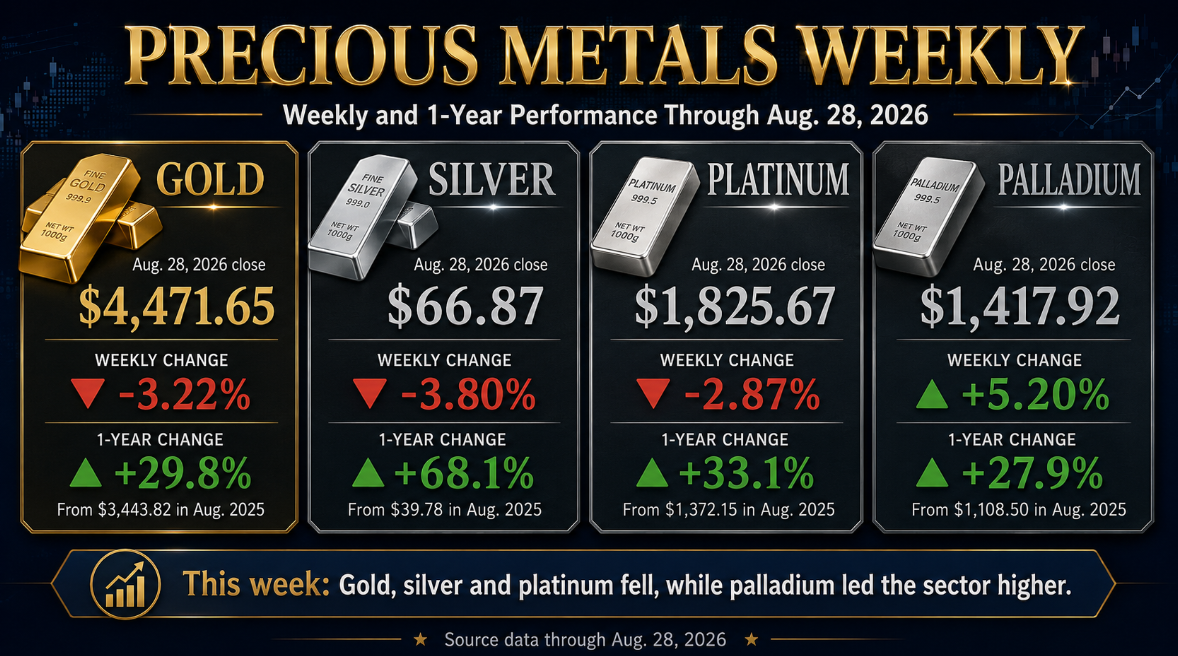
Gold and silver ended the final trading week of August with losses after a strong run earlier in the month, while palladium broke sharply higher and became the standout performer among the major precious metals.
The week of August 24–28 was heavily influenced by changing expectations for U.S. interest rates. Gold began the week near three-month highs as investors remained concerned about government debt, the U.S. dollar and geopolitical uncertainty. By Friday, however, Federal Reserve Chairman Kevin Warsh had shifted the mood by emphasizing that inflation remained a problem and that policymakers could still have more work to do.
That message sent the dollar higher, increased expectations for another interest-rate increase and triggered a broad selloff in gold and silver.
A Friday-to-Friday comparison from Precious Metals International showed gold falling 3.22% for the week, silver dropping 3.80% and platinum declining 2.87%. Palladium moved in the opposite direction, gaining 5.20%.
Gold Gives Back Part of Its August Rally
Gold began the week with considerable momentum.
Spot gold climbed to $4,680.70 an ounce Monday, its highest level since May, as technical buying, a weaker dollar and concerns about U.S. fiscal policy supported demand. Gold-backed exchange-traded funds had also attracted 46.7 metric tons of inflows during the previous week, the strongest weekly demand in 10 months.
The rally continued into Tuesday, when gold reached approximately $4,696 an ounce.
Gold has gained nearly 30% over the past year, rising from about $3,443.82 an ounce on August 29, 2025, to $4,471.65 on August 28, 2026. The advance has been anything but smooth. Gold reached a record above $5,500 an ounce in January before falling below $4,000 during June and then staging a strong rebound in August. Central-bank buying, concerns about U.S. debt and the dollar, geopolitical uncertainty and changing expectations for Federal Reserve policy have all influenced prices. Central banks have remained particularly important buyers, reinforcing gold's role as a reserve asset and a hedge against currency and political risk.
Then the market reversed.
On Friday, Warsh told investors that the Federal Reserve still had work to do if underlying inflation was not clearly moving toward the central bank's 2% objective. Traders responded by increasing expectations that the Fed could raise interest rates as early as September.
The probability assigned to a September increase rose to 58% following Warsh's comments, compared with 36% beforehand, according to CME FedWatch data cited by Reuters.
Gold fell roughly 3% Friday alone.
Higher interest rates tend to hurt gold because bullion does not pay interest. When Treasury yields and other interest-bearing investments become more attractive, investors face a greater opportunity cost for holding precious metals.
A stronger dollar added another source of pressure because gold is priced internationally in U.S. currency.
Despite the weekly decline, gold remains considerably stronger than it was earlier in August. LPL Research calculated that gold was still up approximately 10.5% over the preceding month as of Friday afternoon.
Silver Falls Nearly 4%
Silver followed many of the same forces affecting gold but experienced somewhat greater volatility.
Silver ended Friday near $66.87 an ounce, down from approximately $69.51 the previous Friday, representing a weekly decline of about 3.8%.
Reuters reported spot silver falling 3.5% during Friday's selloff alone, to approximately $66.81 an ounce.
Silver has been the strongest performer of the four major precious metals over the past 12 months. Silver rose from approximately $39.78 an ounce in late August 2025 to $66.87 by August 28, 2026, a gain of about 68%. The metal experienced enormous volatility along the way, including a surge above $120 an ounce in January followed by a decline into the mid-$50 range during the summer. Silver has benefited not only from investor demand for precious metals but also from tightening physical supplies and growing industrial consumption. Solar power, electronics, electrical-grid expansion, AI data centers and other technologies are consuming increasing amounts of silver, helping create a structural supply deficit even as prices fluctuate sharply.
Silver's movements are often larger than gold's because the silver market is smaller and because the metal serves two roles. It is purchased as an investment and store of value, but it is also heavily used by industry.
Demand from solar manufacturing, electronics, electrical equipment and other technologies gives silver an industrial component that gold does not have to the same extent.
Even after the week's decline, silver's recent performance remains impressive. LPL Research put silver's one-month gain at more than 16% through August 28.
The combination of a strong monthly gain and a nearly 4% weekly decline illustrates just how volatile the silver market has become.
Platinum Pulls Back
Platinum also finished the week lower.
Friday-to-Friday closing prices showed platinum falling from $1,879.64 to approximately $1,825.67 an ounce, a decline of 2.87%.
The metal briefly traded above $1,900 during the week before retreating.
Platinum differs from gold because a significant portion of demand is tied to industry. The metal is used in catalytic converters, chemical processing, petroleum refining, electronics and other applications.
Automotive demand is particularly important.
Platinum has also produced a strong 12-month return, climbing from roughly $1,372.15 an ounce in August 2025 to $1,825.67 by August 28, 2026, an increase of about 33%. Unlike gold, platinum's price is heavily influenced by industrial conditions because the metal is widely used in vehicle emissions systems, chemical processing, refining and other manufacturing applications. Supply is also concentrated in a relatively small number of producing countries, particularly South Africa, making the market sensitive to mining disruptions and production constraints. Platinum's rise over the past year shows that investor interest has spread beyond gold and silver as buyers seek scarce physical metals with both investment and industrial uses.
That means platinum prices can respond not only to interest rates and the dollar but also to expectations for global manufacturing, vehicle production and mine supply.
The metal remains substantially higher than it was a year ago. Friday-to-Friday data from Precious Metals International put platinum about 33% above its late-August 2025 level.
Palladium Becomes the Week's Big Winner
Palladium was the clear exception to the weakness elsewhere in precious metals.
The metal rose approximately 5.2% from Friday to Friday, climbing from $1,347.89 to $1,417.92 an ounce.
Much of that move occurred Friday.
Palladium has risen about 28% over the past year, moving from approximately $1,108.50 an ounce in late August 2025 to $1,417.92 on August 28, 2026. Its performance has been especially volatile because palladium depends heavily on demand from gasoline-powered vehicle manufacturers, which use the metal in catalytic converters. Supply concentration adds another layer of uncertainty, with Russia and South Africa historically accounting for a large share of global production. Palladium's 5% jump during the final week of August helped lift its annual gain substantially and demonstrated how quickly prices can move when traders anticipate changes in industrial demand, mine production or geopolitical supply risks.
Reuters reported palladium gaining 5.3% during Friday's session even as gold, silver and platinum declined. Spot palladium was quoted around $1,422 an ounce late in the session.
Palladium is particularly dependent on the automobile industry because it is widely used in catalytic converters for gasoline-powered vehicles.
The market can also be highly sensitive to supply conditions. Russia and South Africa have historically accounted for a large portion of world palladium production, making geopolitical events and mining disruptions especially important to pricing.
Palladium's Friday surge left it as the only one of the four major precious metals to finish the week substantially higher.
Investors Continue Moving Money Into Precious Metals
The late-week selloff did not eliminate investor interest in the sector.
Global commodity funds attracted approximately $4.21 billion during the week ending August 26, the strongest inflow in six months, with gold and precious-metals funds leading the increase.
That is notable because investors were simultaneously pulling money out of equities. Global stock funds experienced their first weekly outflow in 13 weeks.
The flows suggest that some investors continue to view precious metals as protection against fiscal uncertainty, geopolitical instability, currency weakness and inflation even as higher interest rates create short-term pressure.
August Has Still Been Strong for Metals
The weekly numbers also need to be viewed in the context of a much stronger month.
Gold entered Friday having rallied sharply during August. Kitco reported that even after Friday's selloff, the metal remained up around 10% for the month.
LPL Research calculated one-month gains of approximately 10.5% for gold and 16% for silver.
The week's pullback therefore looks less dramatic when viewed against the broader August rally.
Gold had risen for five consecutive weeks before Friday's reversal, while investors had increasingly turned toward metals amid concerns over U.S. government debt, Treasury markets and the value of the dollar.
Interest Rates Could Decide the Next Move
The next major test for precious metals may come from U.S. employment data and the Federal Reserve.
Markets are now debating whether Warsh's comments at Jackson Hole were an early warning that another rate increase could arrive in September.
If inflation remains elevated and employment data remains strong enough to support higher rates, gold and silver could continue facing pressure from a stronger dollar and higher yields.
Weak economic data could quickly change that calculation.
The August employment report is therefore likely to become one of the most closely watched economic releases for precious-metals traders.
The broader picture remains divided. Gold, silver and platinum finished the week lower after strong recent rallies, while palladium surged. Yet investor flows into precious-metal funds remain substantial, and gold and silver are still well above where they began August.
For investors, the final week of the month demonstrated both sides of the precious-metals market: continuing demand for protection against economic and fiscal uncertainty, but also extreme sensitivity to changing expectations about Federal Reserve interest-rate policy.