

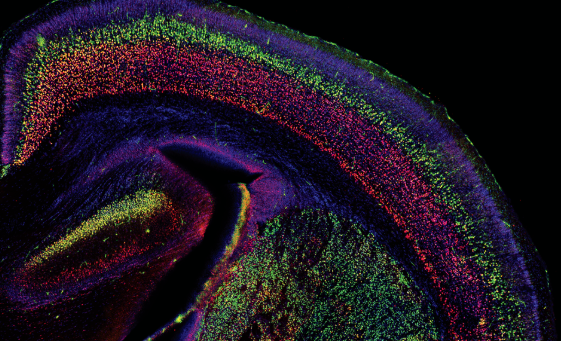
Learning may not change the cerebral cortex in one uniform way. A new study in mice found that different layers of the cortex develop distinct, and sometimes opposite, patterns of activity as an animal learns to connect a sensation with an action.
The research was published September 26 in Nature Communications. Scientists from the Hebrew University of Jerusalem and Humboldt University of Berlin studied activity across 25 areas of the cerebral cortex while mice learned a task involving their whiskers.
The cerebral cortex is the outer portion of the brain involved in sensation, movement, perception, decision-making and many other functions. It is not a single sheet of identical nerve cells. The cortex is organized into layers containing neurons with different connections and roles.
Researchers have known about these layers for more than a century. However, scientists are still working to understand how the layers cooperate when an animal learns something new.
The new study focused mainly on layers 2/3 and layer 5.
Layers 2 and 3 are relatively close to the surface of the cortex. Layer 5 is deeper and contains neurons that can send signals to distant parts of the brain and other parts of the nervous system.
The researchers wanted to see whether learning changed activity in these layers in the same way.
To investigate, the scientists trained male mice on a whisker-based go/no-go task. Mice rely heavily on their whiskers to gather information about nearby objects and surfaces. Their brains contain specialized areas that process this touch information.
During the experiment, the mice learned to use sensory information from their whiskers to determine whether they should perform an action. This allowed researchers to follow the process from an incoming sensation to a learned behavioral response.
The team used wide-field calcium imaging to observe brain activity. Calcium levels inside neurons change when the cells become active. Genetically encoded fluorescent indicators can therefore provide researchers with a way to observe changing patterns of neural activity.
The researchers separately monitored neurons associated with layers 2/3 and layer 5. They followed activity across 25 cortical areas rather than examining only one small part of the brain.
That broad view revealed an important difference.
According to the Nature Communications study, layer 5 developed widespread suppression of activity before the sensory information arrived. This effect appeared around the auditory cue that preceded the whisker-related portion of the task.
Layers 2/3 did not show the same widespread suppression.
When the mice approached the point at which they would receive sensory information, activity in layers 2/3 increased in some higher-order sensory regions. These included the secondary somatosensory cortex and a region known as the rostrolateral area.
Layer 5 showed a different response in these areas. Its activity decreased.
The two layers were therefore not simply becoming more active as learning progressed. In some parts of the cortex, learning pushed their activity in opposite directions.
There was also an important exception.
When the whiskers actually touched the texture, both layers showed increased learning-related activity in the barrel cortex. The barrel cortex is a specialized part of the somatosensory cortex that processes information coming from a rodent's whiskers.
This suggests that some stages of sensory processing can recruit the cortical layers in similar ways, even though other stages produce very different activity.
Another difference appeared as sensory information was converted into action. Layer 5 showed stronger activity in frontal portions of the cortex. At the same time, layers 2/3 showed reduced activity in posterior cortical regions.
The researchers describe this as a frontal-posterior divergence that emerged with learning.
The results support the idea that learning is distributed across the cortex. Instead of one brain region simply storing a new response, many areas appear to change their activity and their relationships with one another.
The study also found an unexpected pattern in how different regions were correlated.
Learning-related correlations were often stronger between distant cortical layers than between layers located in the same cortical column. Traditional descriptions of the cortex often emphasize vertical columns, with information moving among layers within a local region.
The findings suggest learning can organize communication on a much larger scale.
A superficial layer in one cortical region may participate in a learning-related network with a deeper layer located somewhere else. The brain may therefore coordinate learning both horizontally across cortical areas and vertically through its layers.
This does not mean researchers have discovered exactly where memories are stored.
The experiment examined sensorimotor learning, meaning learning that connects sensory information with an appropriate action. It also measured patterns of neural activity rather than directly proving that a particular layer causes a specific part of learning.
The study was conducted in mice, which is another important limitation when considering what the findings mean for people. Mammalian cortices share important organizational features, but human learning is far more complex than the whisker-based task used in this experiment.
Still, mouse experiments allow scientists to examine neural circuits in ways that would generally not be possible in healthy humans.
The research may also help scientists develop better models of how the cortex works. A simple model in which information moves through the cortex in one direction may not adequately describe what happens during learning.
Instead, learning appears to create a changing pattern of activity across layers, brain regions and different moments in time.
The work was led by Yael E. Pollak, Robert N. S. Sachdev, Matthew E. Larkum and Ariel Gilad. The researchers are affiliated with the Hebrew University of Jerusalem and Humboldt University of Berlin.
An earlier version of the research appeared as a bioRxiv preprint in 2025. The peer-reviewed paper was accepted by Nature Communications on September 4, 2026, and published online September 26.
The study adds another piece to a basic neuroscience question that remains far from settled: what physically changes in the brain when something is learned?
Its answer suggests that scientists may need to look not only at which brain area is active, but also at which layer is active, when it becomes active and which distant layers it is communicating with.