Lithium-ion batteries power much of the modern world, from smartphones and electric vehicles to home energy systems and enormous electricity storage facilities. However, concerns about battery fires, manufacturing costs and dependence on critical minerals have encouraged scientists and companies to develop alternatives. In 2026, several competing technologies are making progress, and one has already begun moving toward mass-market electric vehicles.
Sodium-ion, aluminum-ion, zinc-based and iron-air batteries are attracting investment from major manufacturers, universities and government research programs. Some are approaching commercial production, while others remain laboratory experiments. The central question is no longer whether alternatives can store electricity, but whether they can compete with lithium-ion batteries on cost, safety, lifespan and performance.
Why Lithium-Ion Batteries Are Difficult to Replace
Lithium-ion technology has dominated rechargeable batteries for decades because it stores substantial energy in relatively small, lightweight packages. Manufacturers have spent billions of dollars improving production, increasing battery lifespan and reducing costs.
The technology also has disadvantages. Certain lithium-ion batteries can enter thermal runaway, a chain reaction that produces intense heat and may cause fires. Damage, manufacturing defects and improper charging can increase these risks, although modern battery management systems and improved chemistries reduce them.
Not all lithium-ion batteries are equally hazardous or expensive. Lithium iron phosphate batteries, commonly called LFP batteries, avoid nickel and cobalt and generally offer greater thermal stability than some other lithium-ion chemistries. According to the International Energy Agency, LFP batteries accounted for more than 55 percent of electric vehicle battery deployment worldwide in 2025.
That creates a difficult target for competing technologies. New batteries must compete not against the lithium-ion technology of 20 years ago, but against batteries that continue getting cheaper and better.
Sodium-Ion Batteries Are Moving Into Production
Sodium-ion technology is currently among the most advanced alternatives that do not require lithium. Sodium is abundant and widely available, and these batteries can avoid several expensive materials used in conventional lithium-ion cells.
Chinese battery manufacturer CATL is leading one of the largest commercialization efforts. In February 2026, CATL and automobile manufacturer Changan unveiled a passenger vehicle designed around CATL's Naxtra sodium-ion battery technology. CATL subsequently announced that its technology was moving toward full-scale mass production by the end of 2026.
The batteries also perform well in extremely cold conditions, an important advantage for electric vehicles operating in northern climates. However, they typically store less energy per kilogram than their lithium-ion competitors.
The International Energy Agency reports that advanced sodium-ion cells can reach approximately 175 watt-hours per kilogram. The latest lithium iron phosphate cells can reach about 205 watt-hours per kilogram, while some nickel-rich lithium-ion cells reach approximately 265.
That difference limits driving range when battery weight remains constant. It is one reason manufacturers are initially targeting smaller electric vehicles, industrial equipment, cold-weather applications and stationary electricity storage.
European companies are also participating. Sweden's Altris announced progress in September 2026 with Clarios and Slovakia-based InoBat. Their partnership has tested sodium-ion battery designs for vehicle applications, including cold-start performance at temperatures as low as minus 40 degrees Celsius.
Aluminum-Ion Batteries Could Offer Major Advantages
Aluminum is particularly attractive because it is abundant, recyclable and supported by an enormous existing metals industry. It also has a high theoretical capacity for storing electrical charge.
Scientists have investigated rechargeable aluminum batteries for decades, but several technical problems have prevented mass production. Conventional electrolytes can corrode the aluminum electrode, and some react strongly with moisture. Researchers must also find suitable electrode materials that provide enough energy while surviving repeated charging.
A research team led by Wei Wang and Shuqiang Jiao reported an important development in ACS Central Science in 2025. Their solid-state aluminum battery design used an aluminum fluoride framework to improve stability and reduce corrosion.
In laboratory experiments, the battery completed 10,000 charging cycles while retaining more than 99 percent of its original capacity. It also demonstrated improved thermal stability and allowed researchers to recover and reuse much of one electrolyte component.
The research involved scientists associated with the University of Science and Technology Beijing and Lanzhou University of Technology. The results were promising, but they did not establish that the battery could be manufactured economically at commercial scale.
Another effort involves Australia's Graphene Manufacturing Group and the University of Queensland. The company is developing graphene aluminum-ion batteries designed for rapid charging and long service life.
In April 2026, the company reported pouch-cell energy density of approximately 49 watt-hours per kilogram. That remains substantially below the energy density of mainstream electric vehicle batteries and illustrates why aluminum-ion technology has not yet displaced lithium-ion.
More recently, researchers published work in Nature Communications on cement-graphite electrodes for molten-salt aluminum batteries. The research addressed electrode deterioration in corrosive, high-temperature conditions, another obstacle to practical aluminum energy storage.
Aluminum batteries may eventually become attractive for stationary storage and applications where low materials cost and long lifespan matter more than weight. Replacing the batteries in long-range electric vehicles will require greater energy density and further engineering improvements.
Zinc Batteries Are Already Entering Commercial Manufacturing
Zinc-based technology offers another alternative, especially for storing electricity generated by wind and solar power.
American manufacturer Eos Energy Enterprises is producing aqueous zinc-based batteries in Pennsylvania. In June 2026, the company announced commercial production at a second manufacturing facility in Marshall Township.
Unlike many conventional lithium-ion batteries, these systems use a water-based electrolyte. Their design targets industrial facilities and electricity networks rather than lightweight consumer electronics.
The U.S. Department of Energy provided substantial financial support through a loan guarantee completed in 2024. The project is intended to expand domestic battery manufacturing and strengthen long-duration energy storage.
Zinc batteries generally cannot match lithium-ion batteries for energy stored per kilogram, but that is less important when batteries remain stationary. For a utility company, installation cost, durability, maintenance and operating life may matter more than compact size.
Iron-Air Batteries Use One of the World's Cheapest Metals
Iron-air batteries take a different approach. They store and release electricity through electrochemical reactions involving iron and oxygen, often described as controlled rusting and reversing that process.
Massachusetts-based Form Energy is developing iron-air systems capable of delivering electricity for approximately 100 hours. That makes the technology suitable for periods when wind and solar production remain low for several days.
Form Energy is manufacturing these systems in Weirton, West Virginia. In August 2026, the company announced a $750 million financing round to expand manufacturing and commercial deployments.
The company has also reached agreements supporting planned installations for utilities and data centers. Its March 2026 agreement with Crusoe reserved 12 gigawatt-hours of iron-air battery capacity for AI infrastructure beginning in 2027.
Iron-air batteries are far too large and heavy for most electric vehicles or smartphones. Their importance lies in potentially replacing lithium-ion systems where inexpensive storage over several days is the primary requirement.
Solid-State Batteries Could Improve Safety Without Eliminating Lithium
Some of the most heavily funded battery research does not seek to eliminate lithium. Instead, scientists are trying to replace conventional flammable liquid electrolytes with solid materials.
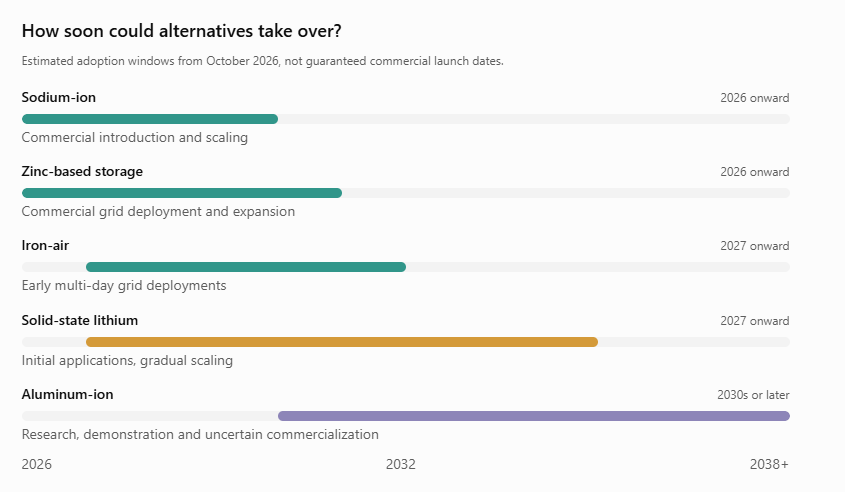
Toyota and Japanese energy company Idemitsu Kosan are developing all-solid-state batteries for electric vehicles. Toyota has targeted initial commercialization during 2027 or 2028, followed by efforts to expand manufacturing.
California-based QuantumScape is pursuing solid-state lithium-metal technology. In February 2026, the company inaugurated its Eagle Line pilot manufacturing facility in San Jose to produce cells for testing and customer evaluation.
Solid-state designs may offer improved safety and higher energy density, but researchers must solve problems involving material interfaces, manufacturing consistency, charging behavior and long-term durability.
Importantly, most of these designs still use lithium. They could make batteries safer and more effective without solving concerns about lithium dependence.
What Is Preventing Faster Adoption?
The largest obstacle is not simply discovering a chemical reaction that stores electricity. Scientists must turn that reaction into millions of identical battery cells capable of surviving years of normal use.
Laboratory results often involve small experimental cells operating under carefully controlled conditions. Commercial batteries must withstand vibration, temperature changes, manufacturing variations and repeated charging without developing dangerous failures.
Manufacturing presents another challenge. Existing lithium-ion factories benefit from established equipment, experienced suppliers and enormous production volumes. A new battery may use inexpensive materials but still cost more because factories cannot yet produce it efficiently.
The International Energy Agency estimates that global sodium-ion cell manufacturing capacity amounts to just over one percent of lithium-ion capacity. Building alternative supply chains will require additional factories, investment and years of practical experience.
Energy density remains particularly important for transportation. A battery that is inexpensive, safe and long-lasting may still be unsuitable for an electric aircraft or passenger vehicle if it weighs too much.
When Could Lithium-Ion Batteries Be Replaced?
Replacement is unlikely to happen through one universal technology. Different battery chemistries are increasingly being developed for different jobs.
Sodium-ion batteries are already beginning their commercial expansion and could become more common in affordable electric vehicles and stationary storage during the late 2020s. Zinc and iron-air systems are also entering specialized commercial markets, particularly where batteries must store electricity for many hours or days.
Aluminum-ion batteries face a longer and more uncertain path. Laboratory advances in 2025 and 2026 demonstrate progress, but there is not yet sufficient evidence to predict mass-market replacement of lithium-ion cells within the next few years.
Solid-state batteries may begin appearing in selected vehicles later this decade. Large-scale adoption will depend on whether manufacturers can meet performance targets at competitive prices.
The most likely change is a gradual division of the battery market. Lithium-ion technology may continue powering devices that demand lightweight, high-density storage, while sodium, zinc and iron-based systems capture applications where cost, safety and longevity matter most.
For consumers concerned about battery fires and high replacement costs, the encouraging development is that the industry is no longer relying exclusively on one battery chemistry. The next generation of energy storage is already taking shape, but a complete replacement of lithium-ion batteries remains much further away.
Companies and research institutions to watch
Organization | Location | Technology |
|---|---|---|
CATL | China | Sodium-ion, commercial manufacturing |
Changan Automobile | China | Sodium-ion electric vehicles |
Altris | Sweden | Sodium-ion cathode materials |
Graphene Manufacturing Group | Australia | Graphene aluminum-ion batteries |
University of Queensland | Australia | Aluminum-ion battery research |
University of Science and Technology Beijing | China | Solid-state aluminum-ion research |
Lanzhou University of Technology | China | Aluminum battery materials |
Eos Energy Enterprises | United States | Zinc-based grid batteries |
Form Energy | United States | Iron-air batteries |
QuantumScape | United States | Solid-state lithium-metal batteries |
Toyota Motor Corporation | Japan | Solid-state battery development |
Sources
- International Energy Agency — Global EV Outlook 2026: Electric Vehicle Batteries. Market shares, energy density and commercialization barriers.
- CATL — Sodium-Ion Passenger Vehicle Announcement. February 5, 2026.
- CATL — Battery Technology and Manufacturing Update. Sodium-ion industrialization plans.
- American Chemical Society — New Design Makes Aluminum Batteries Last Longer. January 24, 2025.
- ACS Central Science — Solid-State Aluminum-Ion Battery Research. Original research paper.
- Nature Communications — Cement-Graphite Electrodes for Aluminum Batteries. August 2026.
- Altris — Sodium-Ion Partnership With Clarios and InoBat. September 14, 2026.
- Graphene Manufacturing Group — Graphene Aluminum-Ion Battery. Research and development updates.
- Eos Energy — Second Manufacturing Facility Begins Commercial Production. June 16, 2026.
- Form Energy — $750 Million Financing Announcement. August 12, 2026.
- Toyota — Solid-State Battery Cooperation With Idemitsu. Development plans and commercialization targets.
- QuantumScape — Eagle Line Pilot Production. February 4, 2026.