

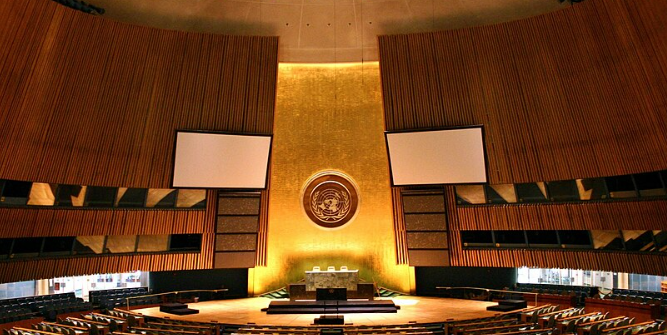
The United States declined to support a United Nations political declaration on pandemic preparedness during a high-level meeting in New York on September 25, preventing the document from receiving the consensus approval organizers had sought. The declaration was intended to strengthen international cooperation before the next major disease outbreak. It will now return to the General Assembly for further consideration.
The U.S. position was delivered by CDC Director Erica Schwartz, who represented the United States at the meeting. She said the administration could not support the text in full because important issues remained unresolved. She pointed to language involving what she called “divisive ideologies that lack definitional consensus” and references to unfinished negotiations over pathogen access and benefit sharing.
The proposed declaration is not a treaty and would not itself create legally binding obligations for the United States. It is a political statement meant to establish common priorities among governments. Those priorities include stronger disease surveillance, better laboratory capacity, improved emergency planning, more reliable financing, and wider access to vaccines, medicines, diagnostics and other health products.
The disagreement does not mean the United States rejected the idea of preparing for future pandemics.
The administration said it remains willing to work with other countries to detect dangerous outbreaks and stop them before they spread. Its objection was directed at portions of the declaration and at the international framework connected to it.
One major point of disagreement involves the proposed Pathogen Access and Benefit-Sharing system, known as PABS. The system is being negotiated as an annex to the World Health Organization Pandemic Agreement. It is designed to encourage countries to rapidly share samples and genetic information from pathogens with pandemic potential while also creating a system for sharing benefits that result from those materials.
Those benefits could include vaccines, diagnostic tests, medicines and other medical products developed from shared pathogen information. Supporters argue that such a system could speed research while preventing poorer countries from being left behind when medical products become available.
The negotiations are not finished.
The World Health Organization said member states continued negotiating the PABS annex during 2026. The organization has described the system as an important part of making its broader Pandemic Agreement operational. The United States withdrew from the WHO and stopped participating in negotiations over the Pandemic Agreement under an executive order signed by President Donald Trump in January 2025.
That earlier decision helps explain the administration’s objection to references to the unfinished PABS system in the new UN declaration. The White House order directed U.S. officials to stop negotiations on the WHO Pandemic Agreement and amendments to the International Health Regulations. It also said actions taken to effectuate those agreements would have no binding force on the United States.
The White House has continued taking a skeptical approach toward some international organizations.
In January 2026, Trump directed federal agencies to withdraw from dozens of international organizations and UN entities that his administration said did not serve American interests. A White House fact sheet said the administration wanted to end participation and funding for organizations it believes operate against U.S. national interests, security, economic prosperity or sovereignty.
There does not appear to have been a separate White House statement released specifically about the September 25 pandemic declaration. Instead, the administration’s position was presented directly at the UN meeting by Schwartz.
The United States was not the only participant with objections.
The European Union said it supported the overall goal of stronger pandemic preparedness but raised concerns about portions of the declaration involving financing, accountability and other provisions. Germany called for greater emphasis on preventing outbreaks before they begin. Other governments supported moving forward with the declaration.
The Associated Press reported that countries including South Korea, Cape Verde and Guatemala supported the declaration. African and Caribbean representatives also spoke in favor of international cooperation. General Assembly President Khalilur Rahman said the document would be considered again later.
The UN meeting came six years after COVID-19 changed public health policy around the world. Supporters of the declaration argued that governments should use the lessons of that crisis to build stronger surveillance systems and maintain emergency capacity before another pandemic begins.
World Health Organization Director-General Tedros Adhanom Ghebreyesus said the declaration contained commitments aimed at addressing weaknesses exposed by COVID-19. WHO has argued that outbreaks can cross borders quickly and that countries therefore benefit from sharing information, pathogens and medical resources.
The U.S. position reflects a different concern: that international cooperation should not place the country inside agreements or policy frameworks that the administration has not accepted.
That distinction is important because the declaration itself would not give the United Nations authority to order lockdowns, vaccination programs or other domestic health measures in the United States. It is a nonbinding political declaration. The dispute centers more on the principles, future commitments and international systems referenced in the document.
The unfinished PABS negotiations are especially significant. Countries are still debating how pathogens and genetic sequence information would be shared and what manufacturers or governments would be expected to provide in return. WHO says the annex is needed before member states can begin national consideration of the Pandemic Agreement and expects the issue to return to the World Health Assembly in May 2027.
Until those negotiations are finished, the United States argues that the UN should not treat the proposed system as settled policy.
The episode also shows how difficult pandemic cooperation has become since COVID-19. Governments generally agree that another major outbreak could have severe health and economic effects, but they disagree over financing, intellectual property, access to medical products, national sovereignty and the role of international organizations.
For supporters, a global declaration provides a framework for cooperation before a crisis begins. For the Trump administration, parts of the current document go beyond areas where the United States believes an international consensus actually exists.
The declaration therefore remains alive, but without the unanimous approval originally planned for the September 25 meeting.
Member states can bring the text back before the General Assembly later in the session. It could still be adopted without full consensus, but the U.S. objection means it would not represent the universal political agreement that organizers had hoped to demonstrate.