A single dollar spent on desert locust surveillance can return up to $680 in prevented damage. That figure comes from a new study measuring the economic value of one of the world's oldest and longest-running disaster monitoring programs.
The research, published by the National Bureau of Economic Research as part of its working papers series, draws on 30 years of data to evaluate what happens when locust monitoring breaks down. According to Phys.org, the study used gaps caused by armed conflicts as a natural experiment, comparing periods of normal surveillance against periods when field workers could not safely survey breeding areas.
The findings are direct. Reduced monitoring, combined with favorable breeding conditions such as heavy rainfall, leads to more locust swarms. The researchers used machine learning to map migration paths, tracing connections between conflict zones, rainfall patterns, and the human populations eventually hit by swarms hundreds of miles away.
The human cost is severe. "When locust swarms develop, they destroy the crops and pastureland in their path — consuming as much food each day as about 625,000 people," said Eyal Frank, an assistant professor at the Harris School of Public Policy and co-author of the study. "This leads to food shortages, making locusts a severe threat to food security across Africa, the Middle East and South Asia."
Children bear a disproportionate share of the consequences. The study found that children exposed to locust swarms before birth are 18% more likely to experience stunted growth. They also face a higher risk of dying before age five. These are not abstract projections. The 2019 locust outbreak, which spread across East Africa and into South Asia, provided a recent and documented case.
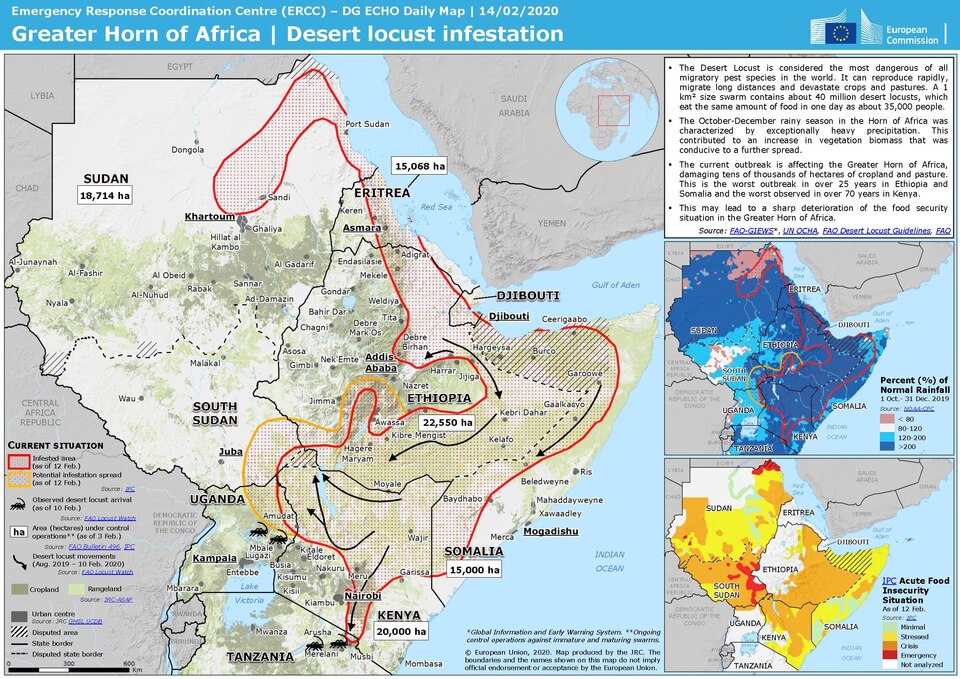
During that outbreak, the ongoing civil war in Yemen created gaps in locust reporting. Those gaps allowed swarms to develop, migrate, and devastate crops before adequate responses could be mounted. The study estimates that roughly 445,000 additional children experienced stunted growth as a result. A striking 83% of those children lived not in Yemen itself, but in neighboring countries, illustrating how quickly a monitoring failure in one place becomes a regional crisis.
The economic consequences extend well beyond a single season. The study found that a rise in stunted growth among children reduces long-term productivity enough to decrease a country's gross domestic product by roughly $25 billion per year over time.
Co-author Anouch Missirian, an assistant professor at the Toulouse School of Economics and INRAE, noted a built-in challenge in measuring the value of surveillance. "A difficulty in assessing those benefits is that when the monitoring succeeds, locust swarms are nipped in the bud and little to no damage occurs... and therefore don't get reported," Missirian said. That invisibility of success makes it harder to justify the cost of maintaining monitoring programs, even when the evidence for their value is strong.
The costs of running the monitoring system, the study notes, are relatively modest compared to the scale of damage it prevents. The $680 return-on-investment figure represents the upper bound of what surveillance can generate in avoided losses from improved crop outcomes and reduced health impacts.