A newly identified feathered dinosaur with four wing-like limbs likely glided through lakeside forests in what is now northwestern China, snatching early birds out of the Cretaceous sky.
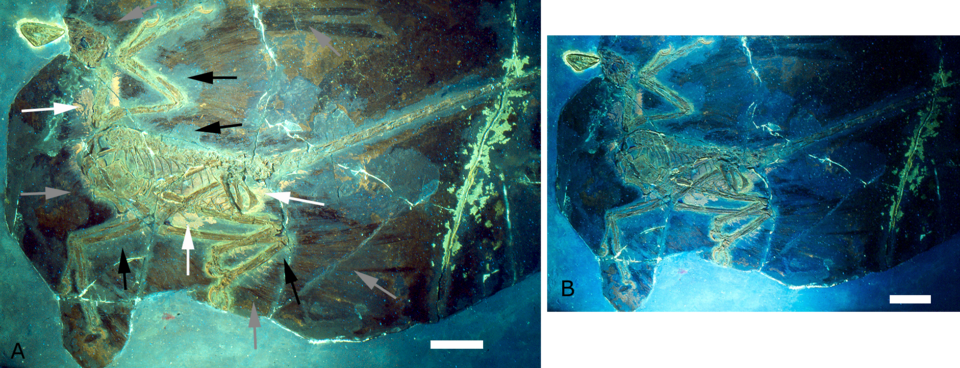
The animal, named Jian changmaensis, belonged to a group of small dinosaurs called microraptors and was a close relative of Velociraptor. Unlike the large, scaly raptors made famous by Jurassic Park, microraptors were lightweight, feathered, and built for gliding. J. changmaensis had long feathers on both its arms and legs, giving it the appearance of a tiny four-winged dragon.
The fossil was described June 4 in the journal Annals of Carnegie Museum. It consists of only a partial left shoulder and forelimb, recovered from the Lower Cretaceous Xiagou formation near Changma village in Gansu province. The rocks where the fossil was found date to between 120 million and 124 million years ago, when the region was home to a large lake filled with birds, fish, turtles, and other animals.
The Changma Basin is already well known to paleontologists. Since 2002, researchers have pulled more than 100 partial bird skeletons from the site, some with preserved feathers, skin, and claw sheaths. The site is particularly famous for fossils of Gansus yumenesis, one of the first Mesozoic birds ever found in China. But until J. changmaensis, no non-avian dinosaur fossil had ever been found there.
That context made the discovery more significant. The basin is also littered with broken bird bones that resemble the pellets coughed up by modern owls, suggesting a predator was regularly consuming birds in the area. J. changmaensis is now a strong candidate for that predator.
"Our team has recovered more than one hundred bird fossils at Changma, but only this single non-avian dinosaur specimen," said Matthew Lamanna, a senior dinosaur researcher and curator of vertebrate paleontology at the Carnegie Museum of Natural History in Pittsburgh, in a statement.
Lamanna told Live Science that microraptors offer a rare look at what the immediate ancestors of birds were probably like. "[Microraptors] provide a window into what the closest ancestors of the first birds were probably like," he said. "Studying them yields clues as to how birds got their start and how they learned to fly."
The fossil was preserved in three dimensions, which is unusual for microraptors, many of which have been found flattened in the rock. The shoulder blade, upper arm, radius, and ulna were all fused together, providing enough anatomical detail for researchers to confirm they were looking at a new species.