A team of biologists in Germany has shown that one of the most fundamental mechanisms in animal development, a cellular system that tells an embryo which direction is up and which is front, was already present in animals living more than 700 million years ago.
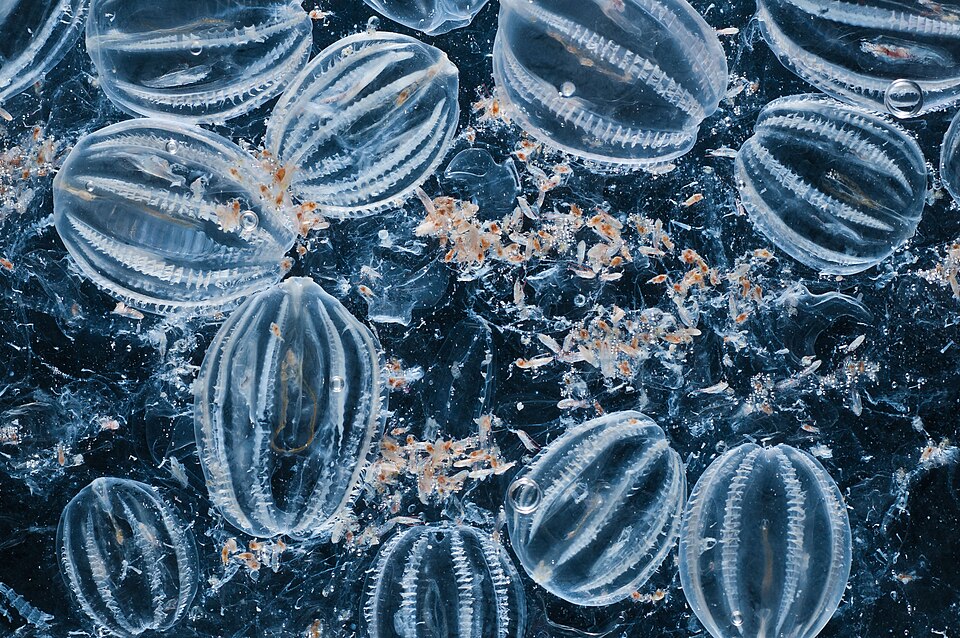
The research, published in the journal Nature, focused on comb jellies, also called ctenophores. These sea creatures represent one of the earliest branching lineages of animals alive today. The University of Jena team conducted experiments on ribbed jellyfish embryos and found that the same body-organizing system found in vertebrates operates in comb jellies as well, according to Phys.org.
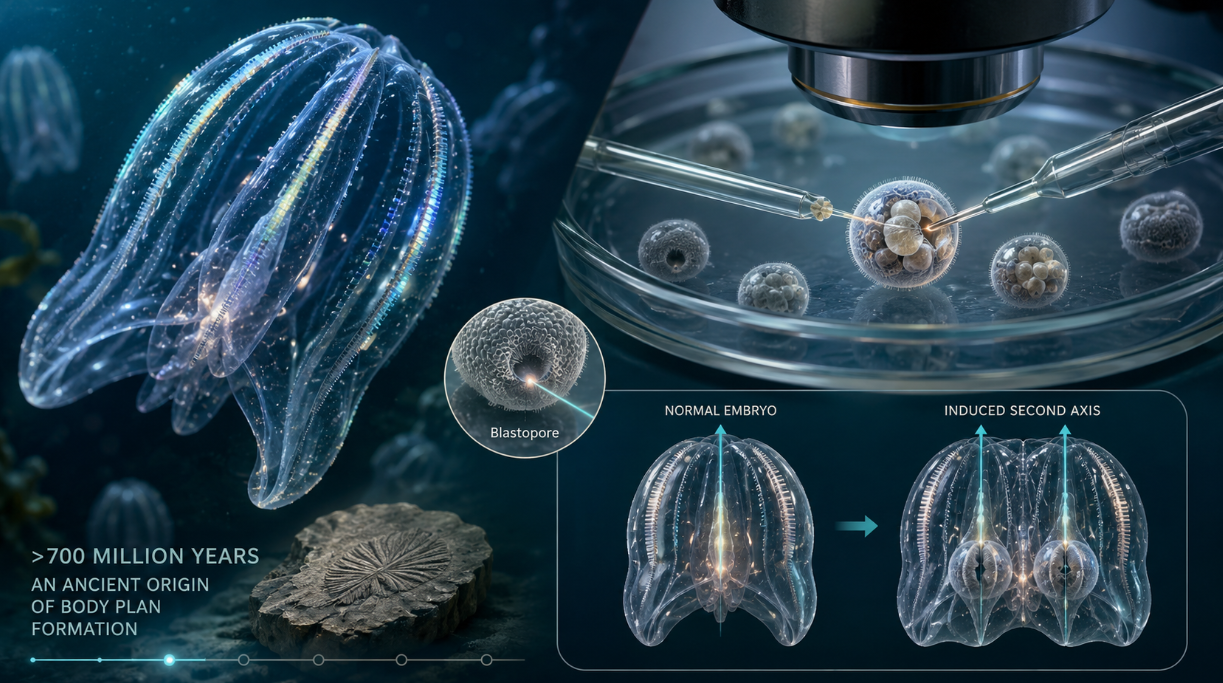
The experiment mirrored a famous one from 1924, when biologist Hans Spemann and his student Hilde Mangold transplanted tissue from one amphibian embryo into another and found that the transplanted cells caused a second body axis to develop. They concluded the transplanted tissue was acting as an organizer, directing the three-dimensional structure of the developing animal. Spemann received the Nobel Prize in 1935 for the discovery. Mangold had died in 1924 and was ineligible.
The Jena team repeated that procedure on comb jelly embryos, transplanting tissue from the blastopore of one ribbed jellyfish embryo into another. The result was the same: a second body axis formed. By staining the transplanted cells, the researchers also confirmed that the introduced tissue was actively influencing the surrounding cells in the recipient embryo, not just passively sitting there.
The technical difficulty involved was extreme. The species used grows up to 12 centimeters, or about 4.7 inches, as an adult, but its embryos are only slightly wider than a human hair, measuring about 120 micrometers across. The tissue sample being transplanted measured roughly 20 micrometers. Researcher Dr. Stanislav Kremnyov had to insert the cells directly into the recipient tissue to prevent rejection.
"Through our experiments, we were able to show that this key mechanism, which coordinates the axes of the entire body, dates back in evolutionary terms to the dawn of animal multicellularity," said Prof. Dr. Andreas Hejnol, the evolutionary biologist heading the research team. "This is because, according to current understanding, the lineage of the Ctenophora — the scientific name for comb jellies — diverged from ours around 700 million years ago."
The findings suggest that the body-axis organizing system is not a later evolutionary invention specific to vertebrates or more complex animals. Instead, it appears to be a deeply ancient feature that was present near the very beginning of multicellular animal life.
The study adds a significant data point to ongoing debates about how early animal body plans evolved and how conserved developmental mechanisms are across wildly different branches of the animal tree.