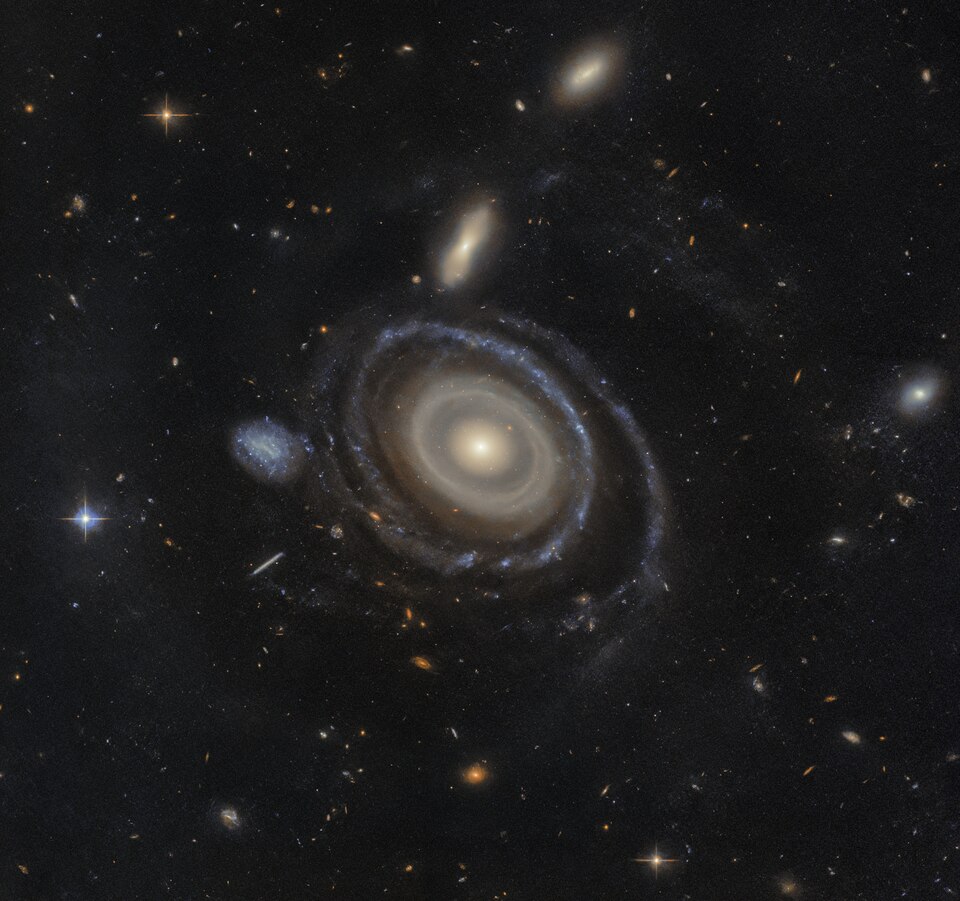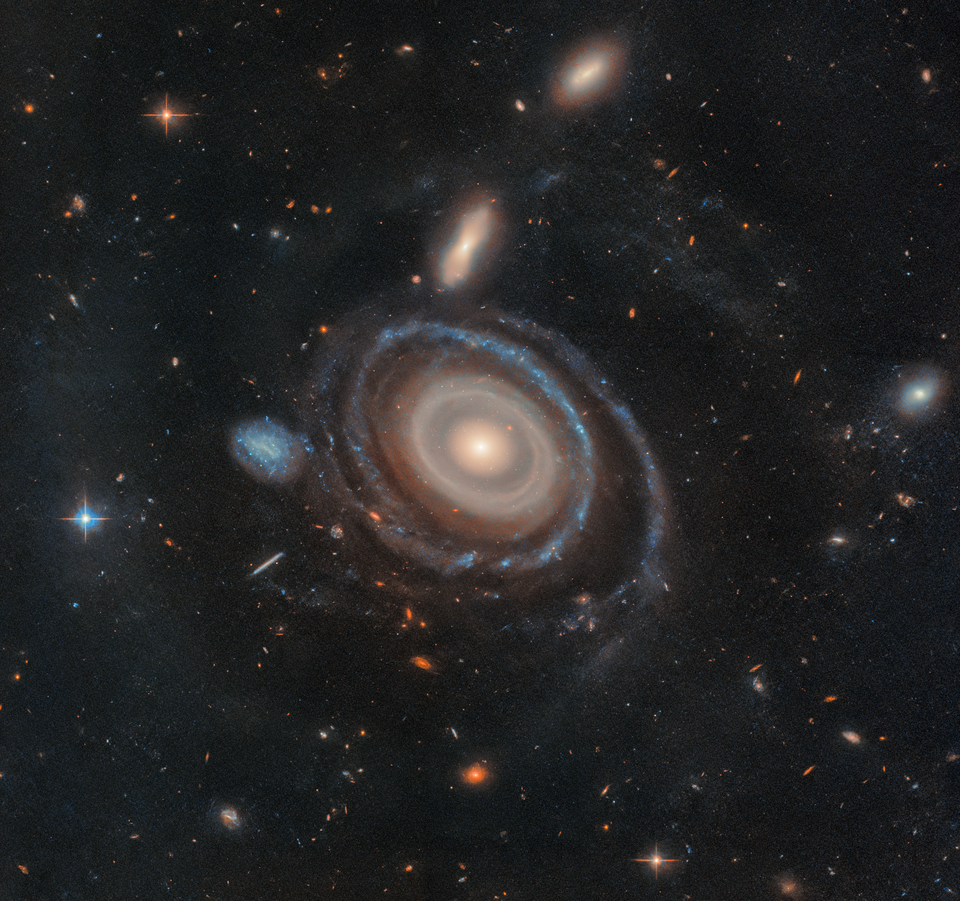
The galaxy LEDA 1313424 has nine concentric rings around it. No other galaxy known to science has that many. Now two physicists think they know why those rings exist, and their answer involves dark matter behaving like a quantum fluid.
According to a report by Phys.org, Pierre Sikivie and Yuxin Zhao at the University of Florida published their analysis in The Astrophysical Journal. They argue the rings were not produced by a collision between galaxies, as earlier researchers had proposed. Instead, they say the rings emerged from a Bose-Einstein condensate of axions, hypothetical particles thought by some physicists to be the building blocks of dark matter.
The Bullseye galaxy, as LEDA 1313424 has come to be called, was discovered in 2025 by a team led by Imad Pasha at Yale University. The find was unusual from the start. Most ringed galaxies have one ring. A few have two or three. Nine rings surrounding a single galaxy had never been seen before.
After the discovery, astronomers proposed that the rings resulted from a particularly energetic impact on LEDA around 56 million years ago. The standard explanation for ringed galaxies holds that when a smaller galaxy strikes the center of a larger one, waves of density ripple outward, forming rings. It is the same basic physics as dropping a stone into still water.
Sikivie and Zhao examined that explanation and found a problem with it. For the collision theory to work, the outermost ring would have had to travel outward from the galaxy's center at 1,220 kilometers per second, which equals roughly 758 miles per second. The researchers concluded that speed was implausibly fast given what is known about the collision and the behavior of galactic material.
Their alternative starts with dark matter itself. Dark matter is thought to make up around 85 percent of the total mass of the universe, but it has never been directly detected. Astronomers infer its existence from the way galaxies rotate and how gravity behaves at large scales. One leading theory holds that dark matter is made of axions, particles that interact only extremely weakly with ordinary matter.
Sikivie had already been working on the axion model before the Bullseye galaxy became a subject of debate. His earlier research argued that if axions make up dark matter, those particles must still obey conservation of angular momentum. As axions interact with galaxies, the innermost parts of dark matter halos would develop structures called caustic rings. "We had earlier proposed that disk galaxies have caustic rings of dark matter with a pattern of ring radii, very," the report states, with the analysis connecting those predicted caustic ring patterns to the spacing observed in LEDA's nine rings.
The Bose-Einstein condensate aspect of their theory refers to a quantum state of matter in which particles stop behaving as individuals and act collectively as a single quantum system. At the temperatures and densities relevant to dark matter halos, axions could in theory enter this state. The quantum behavior that results would then produce the ring structures visible around the Bullseye galaxy, according to Sikivie and Zhao.
The collision theory is not ruled out entirely by their paper. Rather, the two physicists present the axion condensate model as a more physically consistent explanation given the observed ring spacing and the speed problem with the collision interpretation.
The galaxy was only identified in 2025, and the debate over what produced its rings is ongoing. Sikivie and Zhao's paper now puts the axion dark matter hypothesis formally on the table as a competitor to the collision model.