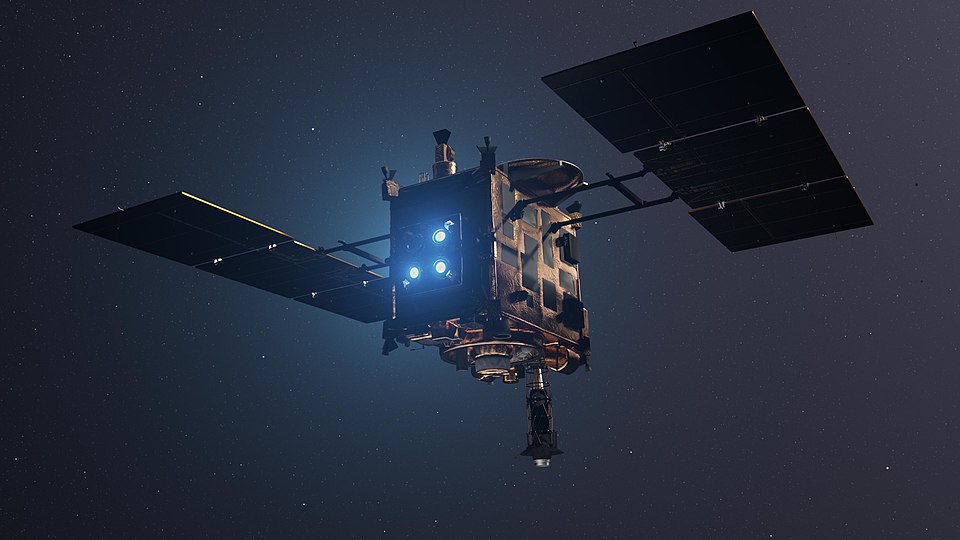
Japan's Hayabusa 2 spacecraft flew past asteroid Torifune on July 5, coming within about 800 meters of the surface while traveling at 5 kilometers per second, roughly 3.1 miles per second. The speed made both navigation and image capture difficult for the probe.
According to Phys.org, Hayabusa 2 used its Optical Navigation Camera, known as the ONC-T, to capture close-up images that revealed details about Torifune's surface. Ground-based observations had already suggested the asteroid was elongated and possibly a contact binary, but only the new images confirmed it. In contact binaries, two separate asteroids orbit a shared center of mass until they gradually spiral inward and merge into a single body. Scientists do not consider contact binary asteroids to be rare.
Torifune measures about 450 meters, or roughly 1,476 feet, in diameter. It is classified as an S-type asteroid, meaning it is stony or siliceous in composition. S-type asteroids are high-density objects that make up about 17 percent of the known asteroid population, making them the second most common type after carbonaceous C-type asteroids.
Hayabusa 2 began observing Torifune in June using the ONC-T for navigation purposes. On June 20, the camera directly imaged the asteroid. Then, beginning about one hour before closest approach on July 5, the spacecraft turned on three additional instruments: the NIRS3 near-infrared spectrometer, the TIR thermal infrared imager, and the LIDAR light detection and ranging instrument. Together, these tools gathered data on the asteroid's composition and surface temperature.
The spacecraft has less than half of its xenon propellant remaining. That is enough to power its ion thrusters to reach both Torifune and its next target, but not enough for any extra maneuvers.
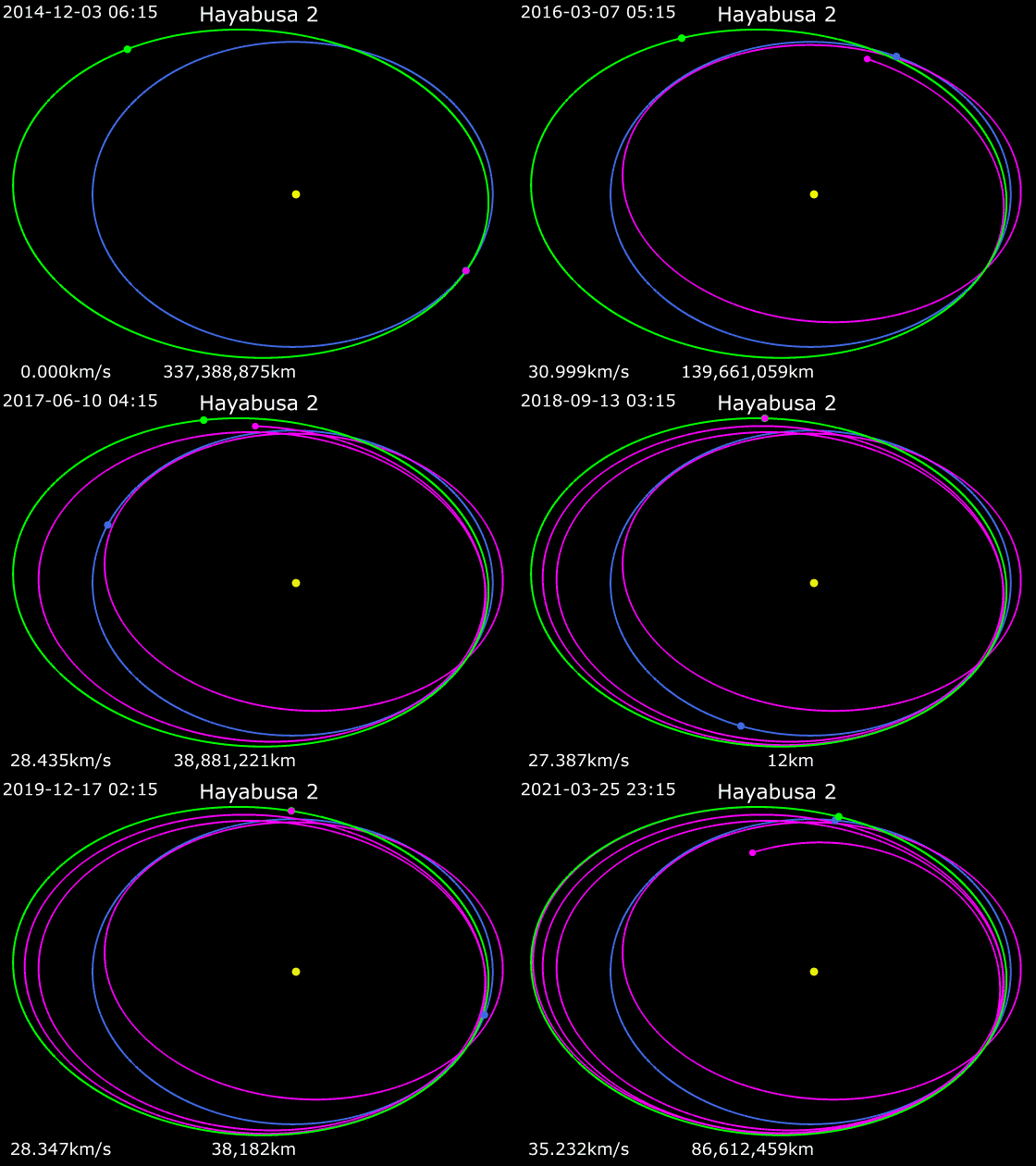
Hayabusa 2's primary mission ended years ago. The spacecraft rendezvoused with asteroid Ryugu in June 2018, studied it for 1.5 years, and returned a sample to Earth in December 2020. After that, JAXA sent Hayabusa 2 on an extended mission to visit additional targets, though another sample return is no longer possible.
Its ultimate destination is a tiny near-Earth object called 1998 KY26, which measures only about 11 meters, or 36 feet, across. Observations in optical and radar suggest it may be a water-rich asteroid. Because it is a fast rotator, scientists believe it is almost certainly a single solid chunk of rock rather than a loosely bound rubble pile. It could also potentially be an X-type asteroid, a broad category that includes objects appearing similar through a telescope but composed of different materials.
Before reaching 1998 KY26, Hayabusa 2 still has several steps ahead. It will swing past Earth in December 2027, then again in June 2028. That second flyby will set up its final rendezvous with 1998 KY26 in July 2031.
Not all of the data from the Torifune flyby has yet reached Earth, so the findings remain preliminary.