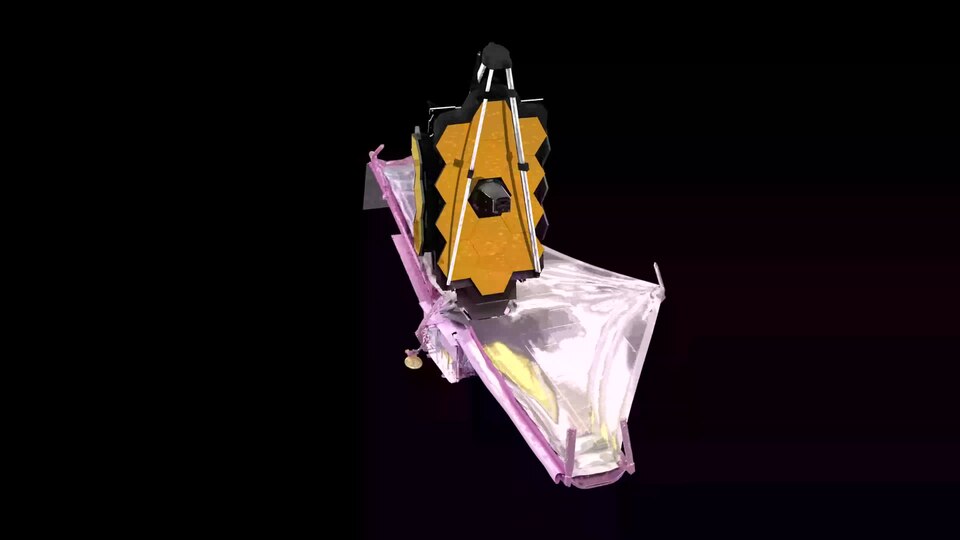
Astronomers studying a group of unusually massive and X-ray-silent black holes spotted by the James Webb Space Telescope have found that those objects may not actually be as massive as they appear. The research was published in Astronomy and Astrophysics on June 19.
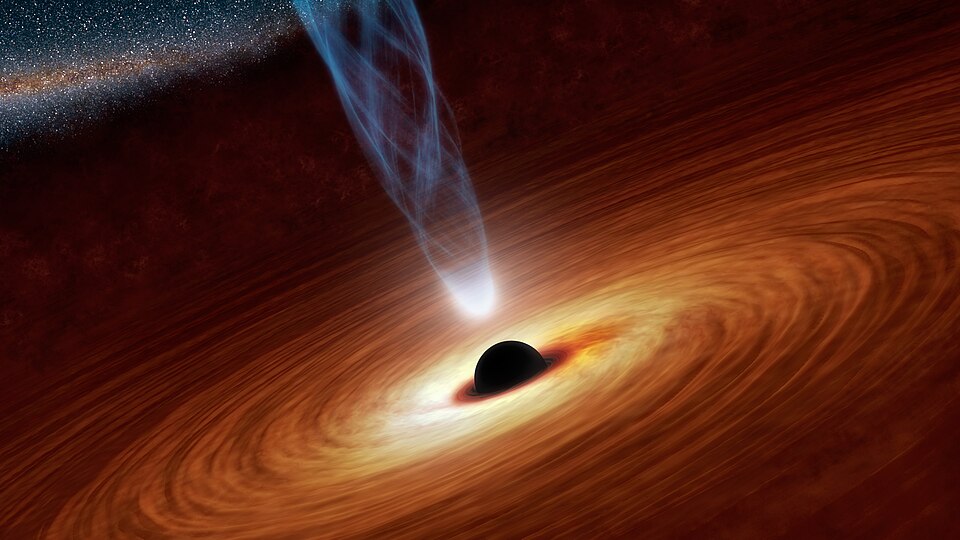
As Phys.org reported, the puzzle began when JWST started detecting massive black holes at the centers of galaxies within the first billion years of the universe. To estimate their mass, astronomers measure the speed of gas swirling around the black holes. Faster movement indicates stronger gravity, which suggests a heavier object. This method has been used reliably for decades when studying black holes in the nearby universe.
When applied to these early black holes, though, the method produced objects that looked far too massive compared to their host galaxies. The inferred mass relationships were very different from what scientists observe locally. Separately, many of these same black holes showed little or no X-ray emission. That was also strange, because black holes typically produce X-rays from an extremely hot region of plasma sitting above the swirling disk of gas, called the corona.
A team led by Alessandro Trinca of the INAF Astronomical Observatory of Rome developed a possible explanation for both problems at once. The answer involves a process called super-Eddington accretion. This occurs when a black hole feeds faster than the theoretical limit at which its own radiation should push infalling gas away. Feeding that aggressively could suppress X-ray output. It could also distort the very emission lines that astronomers use to estimate mass, making a smaller black hole look much heavier than it really is.
The team built a model combining the physics of super-Eddington feeding with a detailed accretion disk spectrum. They applied it to the same 14 X-ray-silent black holes that had previously been studied using standard methods.
The results showed that every single black hole in the sample could be explained in two very different ways. In one scenario, the black holes are enormous but nearly dormant, feeding on so little gas that they emit almost no light at any wavelength. In the other scenario, the black holes are relatively small but feeding at extreme super-Eddington rates, which naturally produces weak X-ray output as a side effect.
When the team compared the statistical likelihood of each explanation, almost all 14 objects strongly preferred the smaller, fast-feeding interpretation.
The finding matters because the apparent existence of overmassive black holes so early in cosmic history has been difficult to explain. Standard models of black hole growth struggle to account for how objects could have become that large so quickly after the Big Bang. If the new analysis holds up, many of those objects may simply be smaller black holes caught in an unusually aggressive feeding phase, which is far easier for current models to accommodate.
The research team used data already collected by JWST and did not require new observations to reach their conclusions.