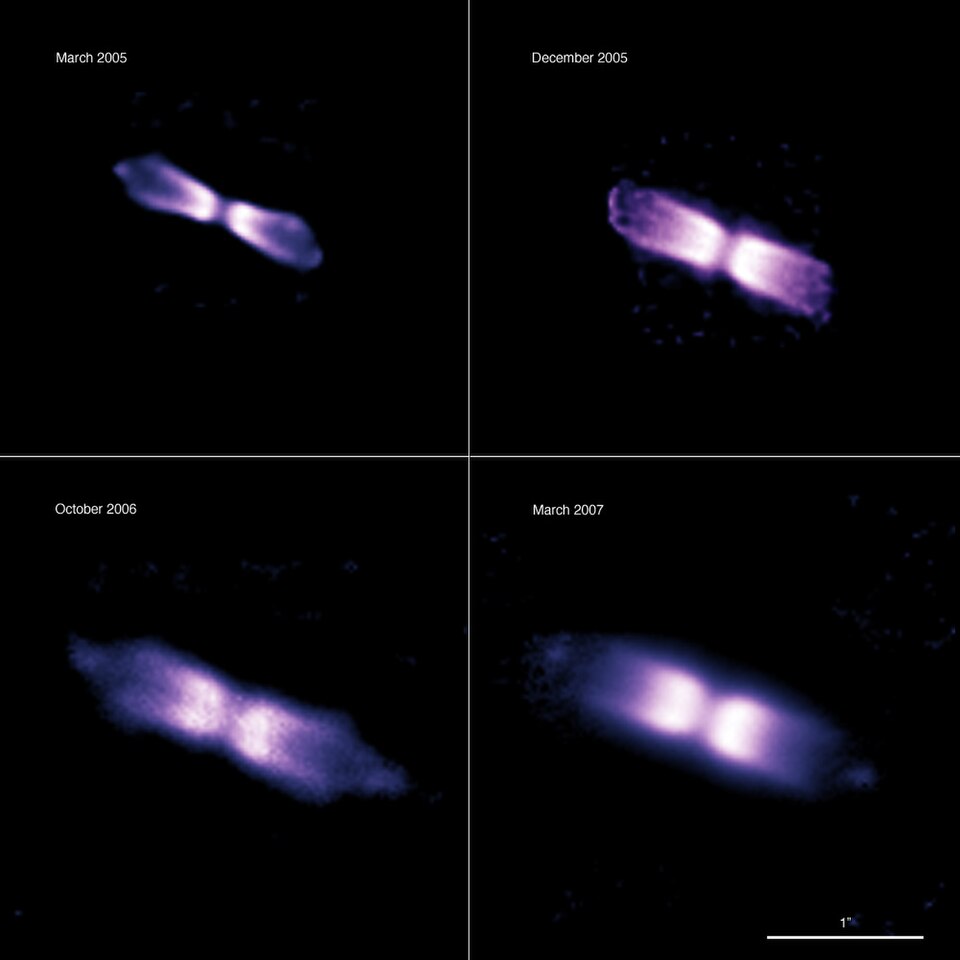
A cloud of debris that blocked astronomers' view for more than two decades has finally cleared, and what it revealed has left researchers puzzled. Clumps of possibly oxygen-rich gas are shooting out of the Milky Way's only known helium nova at speeds of up to 20 million miles per hour, and no one yet knows why.
According to a report presented this week at the Royal Astronomical Society's National Astronomy Meeting in Birmingham, the mysterious high-speed objects were spotted after the debris cloud surrounding the stellar system V445 Puppis thinned enough to allow direct observation. The research was conducted by John Mills, a doctoral student and researcher at the University of Warwick.
V445 Puppis erupted in late 2000, launching an enormous bipolar outflow that stretched more than a trillion miles across space. The explosion created a thick disk of dust that completely hid the star system from view. For more than 20 years, astronomers could study the expanding debris but could not determine what kind of stars had produced it.
Now, with the dust thinned enough to see through, Mills was able to confirm the nature of the binary system for the first time. V445 Puppis consists of a white dwarf, the dense remnant left behind after a sunlike star dies, pulling material from a rare companion called a helium star.
"The explosion's outflow has now faded sufficiently for us to probe its origin, so we can confirm that the star system does indeed consist of a white dwarf grabbing material from an extremely rare type of star called a helium star," said Mills.
The confirmation matters because helium novae are poorly understood. Almost all known novae are fueled by hydrogen-rich material. In a helium nova, the white dwarf accretes hydrogen-poor gas that is rich in helium instead. V445 Puppis has long stood apart from other novae precisely because of that absence.
"V445 Puppis has long stood out among novae for its complete lack of hydrogen. How could such an event be completely devoid of the most abundant element in the universe?" said Mills.
V445 Puppis is the only confirmed helium nova currently known in the Milky Way, making it the only available case study for this class of explosion. A nova occurs when a white dwarf pulls gas from a companion star. As accumulated material builds up on the white dwarf's surface, rising temperatures and pressures trigger a runaway thermonuclear explosion.
The gas bullets remain the deeper mystery. Nothing like them has been observed in other novae anywhere in the universe, and their origin has not yet been explained. The discovery gives astronomers an unprecedented opportunity to study one of the rarest types of stellar explosions up close, but the bullets themselves remain an open question.