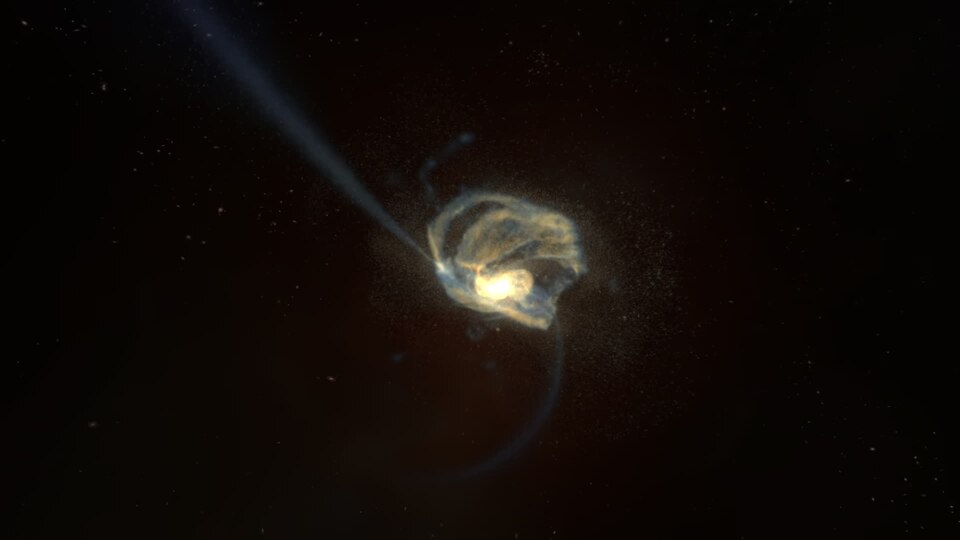
Astronomers have caught a rare glimpse of how some of the universe's largest galaxies may have been built, by observing six young galaxies in the process of merging just 1.2 billion years after the Big Bang, according to a report by Phys.org.
The findings were submitted to the arXiv preprint server on July 13. The study was led by Ronaldo Laishram of the National Astronomical Observatory of Japan.
The six galaxies form what researchers call a compact galaxy proto-group, designated SCGG-z5. The entire group fits within a patch of space just 16,000 parsecs across, roughly 52,000 light-years, which is about half the diameter of the Milky Way. That makes it an unusually tight and crowded environment for galaxies this early in cosmic history.
The widely accepted cosmological model, known as the Lambda Cold Dark Matter Model, holds that galaxies grow piece by piece over billions of years, building up through a series of mergers with smaller galaxies. Dense regions in the early universe, called proto-clusters and proto-groups, are considered natural laboratories for testing that idea. But spotting them requires telescopes sensitive enough to detect faint, low-mass galaxies across extreme distances, and precise enough to confirm that the galaxies are actually gravitationally connected to one another.
In this study, the team used deep imaging and slitless spectroscopy from the JWST SAPPHIRES survey. All six galaxies in SCGG-z5 were spectroscopically confirmed, meaning the distance to each was estimated by identifying specific spectral lines in its light rather than relying on color and brightness estimates alone. That level of confirmation is significant. It rules out the possibility that the galaxies only appear close together from Earth's vantage point.
The galaxies themselves are not calm. Three of the six are forming stars at or above the typical rate for galaxies at that point in cosmic history. One is forming stars notably faster than expected. All six show disturbed and irregular shapes, which researchers say is consistent with ongoing gravitational interactions or an active merger process.
Star-formation maps suggested that gas may be funneling inward toward the cores of some of the galaxies, a pattern that could indicate what researchers call inside-out growth. The most massive galaxy in the group, however, showed a different pattern: quieter at its center, more active at its outer edges.
Those differences between members of the same small group caught the researchers' attention. They suggest that the group environment is already differentiating the evolutionary trajectories of its members well before the system coalesces.
When the team studied how fast the six galaxies were moving relative to one another, they found the system is dynamically unsettled. The galaxies are moving fast enough relative to each other that they could be in the early stages of a complex, drawn-out merger process rather than a simple collision between two objects.
The discovery adds to a growing body of evidence gathered by the James Webb Space Telescope showing that the early universe was more structured and active than many models predicted. Dense groupings of young galaxies, once difficult to detect, are turning out to be more common in the early universe than previously thought.
The paper remains on the preprint server and has not yet completed peer review.