

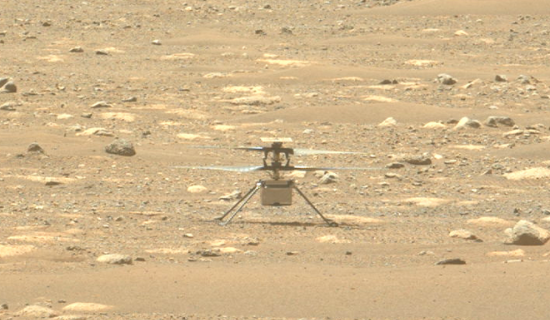
NASA is developing advanced helicopter blades that could dramatically expand aerial exploration of Mars, while preparing a separate mission to send three robotic helicopters to the Red Planet in 2028. Research announced October 20, 2026, shows that a new blade design could allow future Mars aircraft to travel much farther while carrying scientific instruments.
The work builds on the success of NASA's Ingenuity helicopter, which became the first aircraft to achieve powered, controlled flight on another planet in April 2021. NASA is also advancing Space Reactor-1 Freedom, a nuclear-powered spacecraft designed to transport its upcoming SkyFall helicopter mission to Mars.
New Rotor Blades Could Transform Mars Exploration
Engineers at NASA's Ames Research Center in California are studying a new helicopter blade design called roamx-0201. The design has a thinner, sharper profile than the blades used by Ingenuity and was developed specifically for the challenges of flying through Mars' thin atmosphere.
Researchers from Imperial College London and universities in Japan collaborated on the project. They combined advanced computer simulations with physical wind tunnel testing to evaluate how the new design performs under conditions resembling those found on Mars.
The results suggest that future Mars helicopters could travel as far as 18.7 kilometers (11.6 miles) in a single flight, compared with approximately 0.7 kilometers in performance estimates associated with Ingenuity's earlier design.
That distance represents a potential improvement of more than 26 times. However, the figure comes from research and performance modeling rather than a completed flight by a new helicopter on Mars.
The findings were published in September 2026 in AIAA Journal. The study compared the new roamx-0201 airfoil with the CLF5605 airfoil used on Ingenuity.
An airfoil is the cross-sectional shape of a wing or rotor blade. Its shape determines how air moves around the surface and how efficiently the blade generates lift.
The researchers found that roamx-0201 improved the lift-to-drag ratio by approximately 19% to 43% under the conditions examined. Computer simulations also indicated that the new design could produce about 20% more maximum lift than the older airfoil.
These improvements are important because Mars has an atmosphere roughly 1% as dense as Earth's near the surface. Helicopter blades must rotate rapidly to generate enough lift, making efficient aerodynamic designs essential.
Scientists Find Advantages in Turbulence
One unusual feature of the new blade is how it uses disturbed airflow to improve performance. Engineers normally try to control turbulence because it can increase drag and reduce efficiency.
The roamx-0201 design takes a different approach. Its sharp leading edge deliberately changes airflow near the front of the blade, creating conditions that can improve lift.
Researchers also examined how the airfoil behaves as blade speeds approach the local speed of sound. Under those conditions, aerodynamic drag can rise sharply and reduce helicopter performance.
NASA reported that the new design can operate more effectively at high speeds before encountering this problem, known as drag divergence.
The researchers also investigated aerodynamic stall, which occurs when airflow changes cause a sudden loss of lift. Stall can make aircraft difficult to control and limit the range of conditions in which they can fly safely.
Compared with Ingenuity's original airfoil, the new design showed improved stall behavior in simulations and testing. That finding suggests future helicopters might operate across a wider range of flight angles.
The study used NASA's OVERFLOW simulation software, the PyFR numerical simulation system and wind tunnel experiments at Tohoku University in Japan. Using different methods allowed researchers to compare findings and identify areas where predictions did not fully agree.
NASA emphasized that the design is not yet ready for flight on Mars. More development and testing are required before engineers can determine whether it is suitable for a future mission.
SkyFall Will Send Three Helicopters to Mars
While engineers continue developing next-generation blades, NASA is preparing SkyFall, a mission scheduled to launch in late 2028.
The mission will send three small helicopters to investigate the Martian surface, search for evidence of underground water ice and examine the planet's geological and climate history.
Unlike Ingenuity, which arrived on Mars attached to the Perseverance rover, the SkyFall helicopters are designed to deploy during their descent through the Martian atmosphere.
NASA plans to slow the descent system using a parachute and braking rockets. The helicopters would then separate in midair, fly independently and land at their assigned locations.
This approach eliminates the need for a conventional lander to place the aircraft on the surface.
Each helicopter will carry scientific equipment, including visible-light cameras, near-infrared imaging instruments, temperature sensors and ground-penetrating radar.
The radar will examine layers beneath the Martian surface, searching for possible ice deposits and geological structures. NASA expects the instruments to investigate the upper three meters of the crust, with potentially greater depth under favorable conditions.
Finding underground ice would provide scientists with information about Mars' changing climate. Ice deposits could also become valuable resources for future human exploration.
Water could eventually support astronauts and help produce oxygen or rocket propellant. However, SkyFall is a robotic science mission and will not attempt to extract those resources.
Each aircraft is expected to cover approximately one to two kilometers during a flight lasting about two and a half minutes. The helicopters will also communicate through spacecraft orbiting Mars rather than relying on a nearby rover.
These flight plans are distinct from the longer distances being studied for future aircraft using the experimental roamx-0201 blade.
Nuclear-Powered Spacecraft Will Deliver SkyFall
NASA's Space Reactor-1 Freedom mission will transport the SkyFall helicopters to Mars. The spacecraft is designed to demonstrate nuclear electric propulsion beyond Earth's orbit.
Unlike conventional chemical propulsion, nuclear electric propulsion uses a fission reactor to generate electricity that powers electric thrusters. The technology could provide an efficient option for long-duration missions.
NASA announced new progress on the spacecraft's nuclear power module on October 20. The agency said recent contract actions were intended to reduce development risks and support its planned 2028 launch.
Sierra Lobo Inc. will supply a closed Brayton cycle power conversion system, which converts heat generated by the nuclear reactor into electrical energy.
The work is being carried out under a contract awarded in 2024 and supports engineering activities at NASA's Glenn Research Center in Cleveland, Ohio.
The Department of Energy's Idaho National Laboratory is responsible for designing and developing the reactor that will be integrated with the power conversion equipment.
NASA said the program includes nuclear safety reviews, regulatory oversight and specialized safety management. The reactor will remain inactive until the spacecraft has traveled beyond Earth's orbit.
The spacecraft is intended to demonstrate the operation of a fission-powered propulsion system in deep space while delivering the SkyFall mission. NASA's current schedule calls for launch in late 2028, followed by its first Mars approach in 2029 and deployment of the helicopter mission during a later approach in 2030.
Building on Ingenuity's Historic Flights
SkyFall and the new rotor blade research both benefit from lessons learned during Ingenuity's successful Mars demonstration.
Originally designed to complete only five flights, Ingenuity ultimately flew 72 times over nearly three years. Its flights helped prove that powered aircraft could operate in the Martian atmosphere.
The helicopter also provided aerial observations that helped the Perseverance rover team understand terrain and plan routes.
SkyFall aims to extend those capabilities by sending several aircraft into areas that would be difficult or time-consuming for rovers to explore.
The experimental rotor blades represent another possible advance, but their use on a future mission will depend on additional engineering validation.
Meanwhile, Space Reactor-1 Freedom could help establish technology for later missions requiring sustained electrical power. NASA is also investigating how fission systems might support lunar installations during long periods without sunlight.
For now, NASA's immediate milestones involve preparing the SkyFall helicopters, qualifying their scientific equipment and advancing the spacecraft intended to deliver them. The planned 2028 launch will be an important test of both planetary helicopter exploration and nuclear electric propulsion.