

SpaceX reported a sharp increase in revenue and profits on October 20, 2026, as its expanding artificial intelligence business became the company's largest source of sales. The Elon Musk-led company also announced plans for a November Starship test flight that could mark a major advance in reusable rocket technology.
Third-quarter revenue reached $14.6 billion, an increase of 161% from a year earlier, according to the company's financial results. Its artificial intelligence division generated approximately $7.6 billion, accounting for nearly 52% of total revenue.
SpaceX also reported $4.4 billion in net income, reversing a $1.1 billion loss during the same quarter in 2025. The results reflect the company's transformation from a launch and satellite communications provider into a business increasingly focused on artificial intelligence infrastructure.
Artificial Intelligence Becomes SpaceX's Largest Business
SpaceX's artificial intelligence division, recently renamed Super Intelligence, reported revenue growth of 830% compared with the previous year. The division includes the Grok AI products, data center operations, cloud computing services and the Cursor AI coding platform.
The company completed its acquisition of Cursor on August 14, 2026, in a transaction with an implied equity value of $60 billion. The purchase expanded SpaceX's involvement in AI software while strengthening its position in computing infrastructure.
Cursor contributed $608 million in revenue between the acquisition date and September 30. SpaceX also recorded approximately $1.2 billion in stock-based compensation expenses connected to the acquisition during the quarter.
The Super Intelligence division generated $431 million in operating income, compared with an operating loss of $1.7 billion a year earlier. Its adjusted earnings before interest, taxes, depreciation and amortization reached nearly $5 billion.
These figures show that the AI operation has moved beyond its earlier period of heavy operating losses. However, expanding the business still requires enormous spending on computer equipment, electrical systems and data centers.
SpaceX reported that its available computing capacity reached 1.7 gigawatts at the end of September. That was an increase from 1.4 gigawatts at the end of June and 0.6 gigawatts one year earlier.
The capacity represents the scale of the company's computing infrastructure rather than the amount of electricity continuously consumed. Much of the expansion is connected to Colossus II, its developing data center project in Memphis, Tennessee.
Musk Identifies Power as a Major AI Challenge
During the company's earnings discussion, Musk described electrical power and cooling infrastructure as increasingly important restrictions on artificial intelligence expansion.
He argued that obtaining enough computing chips is no longer the only major obstacle. Building facilities capable of supplying reliable electricity and removing heat from thousands of powerful processors has become equally important.
The company is working to expand power generation capacity while addressing delays in the supply of industrial turbines. Some equipment suppliers face manufacturing schedules extending 12 to 18 months, potentially slowing construction.
SpaceX is pursuing greater control over its equipment supply chain to reduce those delays. Its broader manufacturing experience, developed through rocket production, provides opportunities to produce certain components internally.
The company also leases computing capacity to outside businesses. TechCrunch reported that increased demand for these services helped drive the division's revenue growth alongside enterprise use of Grok and the Cursor acquisition.
Musk believes demand for AI agents and computing services will continue increasing. However, those expectations depend on the company completing expensive infrastructure projects and securing enough electricity to operate them.
Capital Spending Could Reach $40 Billion in Fourth Quarter
SpaceX reported $19.6 billion in capital expenditures during the third quarter, with approximately $16.4 billion directed toward its Super Intelligence division.
That spending was substantially higher than the previous year's level and illustrates the cost of expanding AI infrastructure. It also demonstrates how heavily SpaceX is investing despite its return to quarterly profitability.
Chief Financial Officer Bret Johnsen said the company expects fourth-quarter capital expenditures of $35 billion to $40 billion. The forecast reflects anticipated investments in computing facilities, supporting infrastructure and other business expansion projects.
Starlink remains a major contributor to SpaceX's financial performance. The satellite communications division generated approximately $5.2 billion in quarterly revenue and $2.4 billion in operating income.
SpaceX reported 13.6 million Starlink consumer subscribers at the end of September. The service continues to provide recurring revenue while the company expands satellite coverage and communications capacity.
The traditional space business generated approximately $1.8 billion in revenue but recorded a $7 million operating loss. That segment includes launch services and major development programs such as Starship.
Although artificial intelligence now leads SpaceX in revenue, Starlink remains the company's largest contributor to operating profit. The difference is important because strong sales do not necessarily translate into equally strong earnings.
Starship Prepares for Major November Recovery Test
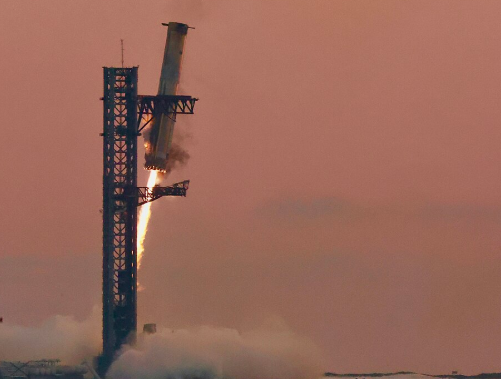
Alongside its financial results, SpaceX announced plans for another Starship flight in November. Musk said the company intends to attempt recovery of both the Super Heavy booster and the Starship spacecraft using mechanical arms mounted on launch towers.
The planned mission, designated Flight 15, would represent a major step toward the company's goal of creating a fully reusable orbital transportation system.
Starship consists of two stages: the Super Heavy booster and the Starship upper-stage spacecraft. Together, the vehicle stands roughly 120 meters tall and uses Raptor engines powered by liquid methane and liquid oxygen.
SpaceX has already demonstrated the ability to catch Super Heavy boosters during earlier test flights. The more difficult challenge is safely returning the upper-stage spacecraft from space and capturing it for eventual reuse.
The recovery system uses large mechanical arms, commonly called chopsticks, attached to specially designed launch towers. The arms are intended to support the returning vehicle without requiring conventional landing legs.
Musk acknowledged that the upcoming test might not succeed. However, he expressed confidence that the company is making progress toward recovering both stages and eventually flying them again.
Successfully catching both stages would demonstrate important recovery capabilities. Reusing the recovered hardware on a later mission would be a separate milestone requiring inspection, preparation and another launch.
September Flight Delivered Starlink Satellites to Orbit
The next mission follows Starship's 14th flight on September 28, when the rocket reached Earth orbit and deployed 26 Starlink V3 satellites.
That mission marked Starship's first orbital flight and its first delivery of operational communications satellites. The deployment represented a significant advance from earlier test missions that focused primarily on vehicle development.
The satellites are part of a new generation designed to expand Starlink's broadband capacity. SpaceX says the spacecraft can provide substantially greater communications performance than earlier versions.
The September flight was not without difficulties. One Raptor engine shut down during the Super Heavy booster's initial ascent, while an additional engine problem affected the spacecraft later in the mission.
Engineers adjusted the flight plan after the upper-stage problem shortened the intended mission. Despite those issues, the vehicle reached orbit and completed the satellite deployment.
The Super Heavy booster completed a controlled splashdown in the Gulf of Mexico. The Starship upper stage later returned through Earth's atmosphere and splashed down in the Pacific Ocean near Hawaii.
Neither stage was recovered for reuse. That makes November's planned recovery attempt an important next test of the company's long-term rocket development strategy.
SpaceX Faces Two Expensive Expansion Challenges
SpaceX's growing AI business and its Starship program place different demands on the company. Artificial intelligence requires electricity, computing equipment and large facilities, while Starship development requires repeated launches, manufacturing improvements and recovery tests.
The two businesses also have potential connections. More capable Starship rockets could lower satellite deployment costs and support proposals for future computing infrastructure in orbit.
For now, those possibilities remain longer-term ambitions rather than established commercial operations. SpaceX must still demonstrate reliable Starship recovery and reuse before the rocket can support the high launch frequency Musk envisions.
Investors are also watching the company's spending as it expands AI operations. The latest earnings show substantial revenue growth, but future results will depend partly on how efficiently SpaceX converts its infrastructure investments into sustained profits.
Following its June 2026 public offering, SpaceX faces increased scrutiny of financial performance and major development commitments. The company must now balance expectations from investors with the technical uncertainties involved in ambitious aerospace projects.
The next immediate milestone is Starship Flight 15, expected in November. If SpaceX successfully captures both stages, the test would move the company closer to its goal of recovering and eventually reusing the entire Starship launch system.