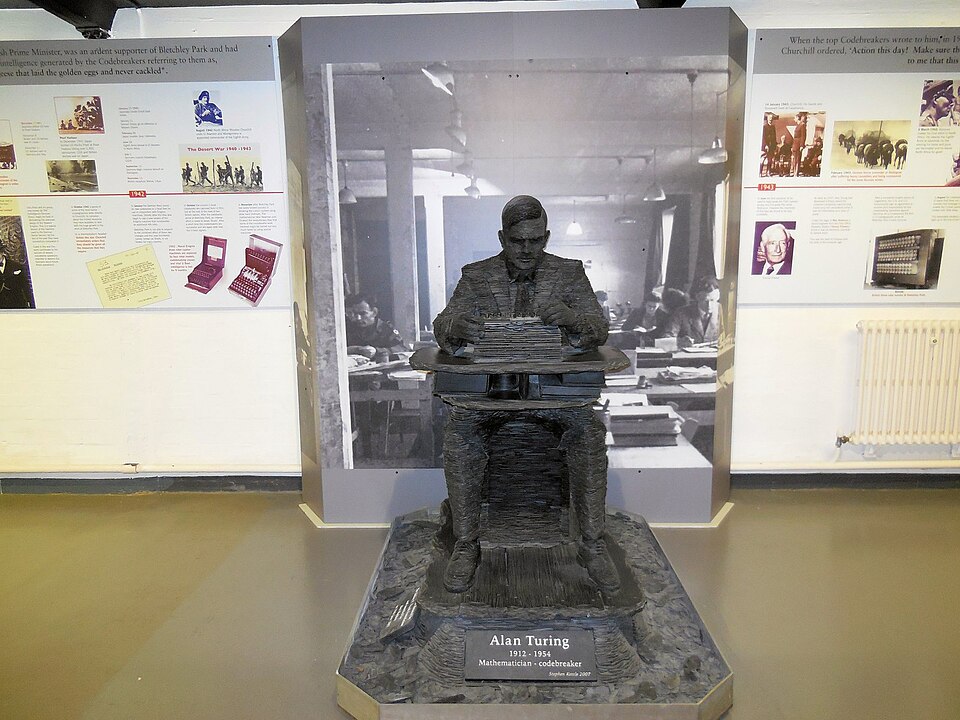
A handwritten short story by Alan Turing, stored for decades in the archives of King's College, Cambridge, offers a portrait of the mathematician that looks almost nothing like the one made famous by the 2014 film The Imitation Game. The story features a gay sexual encounter, working-class dialogue, and a narrator with a dry, observational sense of humor.
According to a report by Phys.org, Professor Sarah Dillon of Cambridge's Faculty of English has published the first full transcription and study of the fragment in The Review of English Studies. Dillon believes Turing wrote the story in late 1952 or early 1953, not long after a real encounter that led to his arrest on charges of gross indecency.
"We've distilled a version of Turing that is a two-dimensional stereotype," Dillon says. "He's come to be seen as socially unaware, entirely concerned with logic and numbers, and pretty isolated. His short story reveals a very different man: playful, funny, cheeky, literary and someone who really liked sex."
The story is titled Pryce's Buoy and runs six pages. It centers on two characters: Ron Miller, a working-class young man who earns money through sex, and Alec Pryce, a homosexual scientist known for an invention called Pryce's buoy. Dillon describes Alec as autofictional, a stand-in for Turing himself. The plot closely mirrors the late 1951 encounter that resulted in Turing's prosecution.
The story opens with Alec, tired from work and Christmas shopping, deciding he has earned some fun and going out to find a young man. The narrative then shifts to Ron's perspective. He is broke and unemployed. Turing writes that Ron thinks to himself: "If he let someone take him under the arches for 10 minutes he might get five bob."
The two men spot each other. Turing writes: "Ron caught Alec's eye and gave him a half-hearted smile. It was enough though." They sit on a park bench and size each other up. Ron thinks Alec looks shabbily dressed but probably has money. He wonders: "Could he be mistaken? No, he was having a furtive look. Just a bit shy;"
Alec's internal assessment of Ron is blunt. Turing writes that Alec thought: "Not a real beauty, but had a certain appeal. Beggars couldn't be choosers."
When the two walk to a restaurant, Turing captures the class difference between them through interior monologue. Ron, according to the text, "didn't go in for lah-di-dah ways of talking. It'd come to the same anyway. Bed's bed whatever way you get into it. Alec thought otherwise."
Dillon says the passage captures something emotionally precise and true to the experience of a potential sexual encounter between strangers. "I love the hesitancy, the way it evokes the uncertainty of a potential sexual encounter, the 'am I reading this situation wrong?' worry. 'Am I going to put my foot in it?' 'Am I going to go too far?' 'What did they want?' 'What do I want?' 'Can I back out?' Turing gets those tensions, the leaning in and backing out. He does it really w" — the transcription ends there, mid-sentence, where the manuscript breaks off.
Turing cracked the Nazi Enigma code during World War II, developed the theoretical foundation for modern computers, and laid early groundwork for artificial intelligence. He was convicted in 1952 and subjected to chemical castration as a condition of avoiding prison. He died in 1954. The British government issued a formal apology in 2009 and a royal pardon in 2013.
The short story has been held by King's College archivists for years but had never been fully studied before Dillon's work. Her findings are now published and available through The Review of English Studies.