

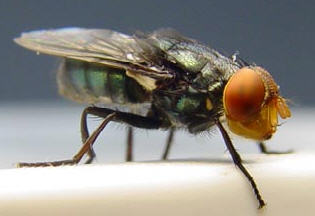
A Colorado State University researcher is analyzing the chemistry of rotting wounds to develop traps that can more accurately detect and catch the New World screwworm, a flesh-eating blowfly that has recently re-emerged in the United States after being eradicated more than 50 years ago.
According to Phys.org, Professor Jessica Metcalf is studying volatile organic compounds, the chemical byproducts produced by bacteria in open wounds, to figure out exactly what draws the New World screwworm to living tissue. The goal is to design lures that attract the New World screwworm specifically, rather than the similar but less dangerous secondary screwworm.
The New World screwworm blowfly lays its eggs in open wounds and body openings. The maggots that hatch then feed on living tissue. The parasite can infest any warm-blooded animal, including humans and pets. Left untreated, it can be deadly. As of July 23, the parasite had been detected in cattle, sheep, goats, and two dogs in Texas, and in one dog in New Mexico.
The screwworm was first found in Texas in early June, raising alarms across the livestock industry.
The problem with current detection methods is a case of mistaken identity at scale. The most widely used existing lure relies on bacteria-produced smells from rotting meat. That smell attracts the secondary screwworm, which prefers dead flesh, in large numbers. Traps fill up with the secondary screwworm, making it much harder to spot the more dangerous New World screwworm among the catch.
Metcalf's work focuses on distinguishing between the volatile organic compounds that attract each species. The key scientific question is what specifically makes live tissue, rather than dead flesh, appealing to the New World screwworm.
Blowflies add another layer to the problem. They carry their own bacteria, which they use to communicate with others of their species. Those bacteria signal to nearby blowflies where a suitable host can be found, which can compound an infestation quickly.
"We use these bacterial cues to stay away from certain things — to not eat spoiled meat, for example," Metcalf said. "The insects are using them for a different reason. They're like, Yes, bring it, that smells like a great place to lay eggs."
Metcalf's team will work to identify which bacteria are present on both the New World screwworm and the secondary screwworm. That information could be used not only to design more effective traps but potentially to redirect the New World screwworm away from live hosts entirely.