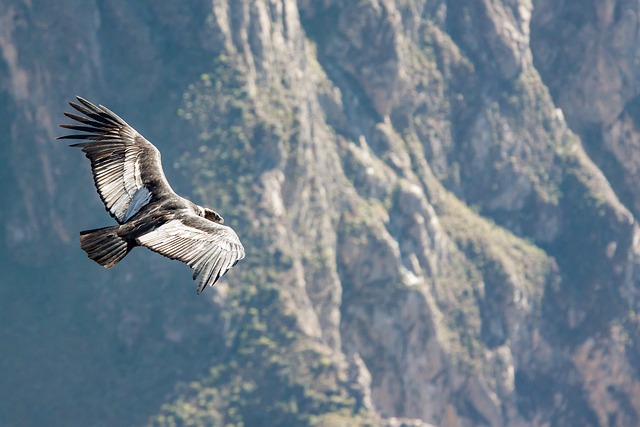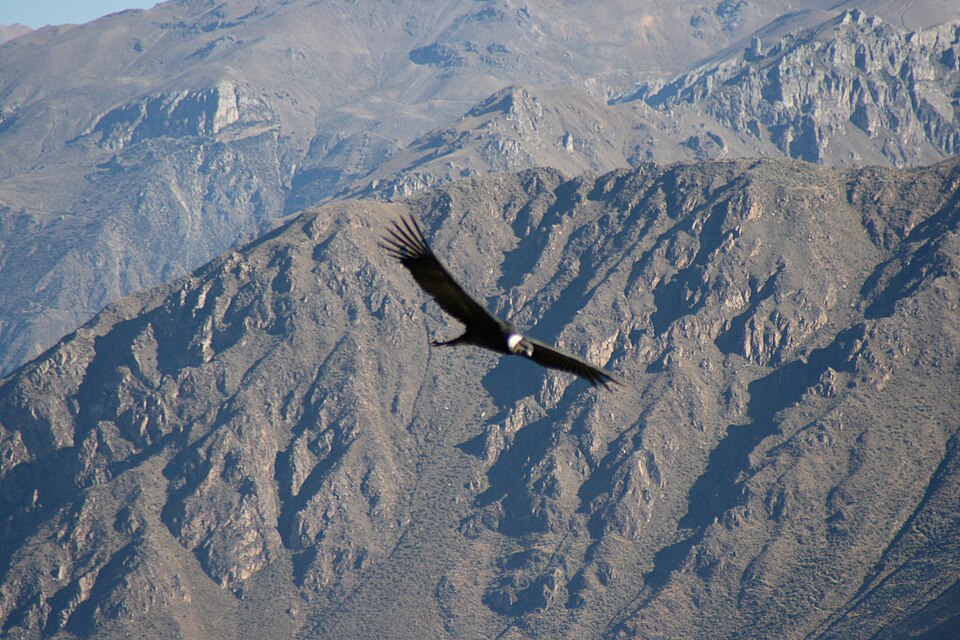
Andean condors, among the largest birds on Earth, gain measurable energy savings when they fly together rather than alone. A new study from the University of Konstanz used a computer model to figure out exactly how much those savings add up to, and the results were published in the Journal of the Royal Society Interface.
The research, according to Phys.org, centers on how condors navigate what scientists call patchy and dynamic landscapes, environments where food and other resources are unevenly spread and conditions keep changing. During long-distance flight, large birds like condors alternate between soaring, which means staying aloft by riding rising air currents with minimal wing flapping, and gliding, which means descending gradually without flapping at all. Both strategies conserve energy, but the landscape still presents constant uncertainty about where the next thermal current will be.
Researchers Eleonora Gatti, Andreagiovanni Reina and Hannah Williams built what is called an agent-based model to study the problem. Agent-based models use virtual, simulated agents that follow predefined behavioral rules. In this case, the rules were based on realistic aeronautical principles and data from actual Andean condors.
"Movement is costly, and animals are under strong selective pressure to move efficiently; however, in patchy, dynamic landscapes, decision-making is inherently uncertain," wrote Gatti, Reina and Williams in their paper. "We quantify the energy savings achieved by using up-to-date information presented within social cues to reduce movement costs."
The model tracked condors in three-dimensional space, accounting for altitude as the birds moved through sequences of soaring and gliding. The researchers examined what happened when birds could observe others, either birds fixed in place or birds moving collectively toward a shared destination. They also tested different risk-taking strategies, ranging from slow and cautious approaches to fast and risky ones.
"We use an agent-based model, which is founded on realistic aeronautical rules and is parameterized on the Andean condor, to study movement in patchy landscapes," the authors wrote. "By explicitly considering altitude, flight results in a sequence of soaring and gliding in three-dimensional space. We investigate how the cost of movement to an overall goal varies when birds use social information from others that are either fixed in space or moving collectively to the common goal, and under different risk-taking speed strategies, from slow and cautious to fast and risky. The value of social information is operationalized as energy savings in units of the basal metabolic rate (BMR)."
The basal metabolic rate is the minimum amount of energy an animal needs just to stay alive. Measuring savings against that baseline gives scientists a meaningful way to understand how significant the energy gains from flying in a group actually are.
Condors are a useful species for this kind of research. Their size means flight is energetically expensive, and they cover enormous distances across the Andes. The combination of large body mass and unpredictable terrain makes efficiency a survival issue, not just a convenience. Understanding how they manage that challenge through collective movement could have broader implications for how scientists think about group behavior in other large animals navigating difficult terrain.