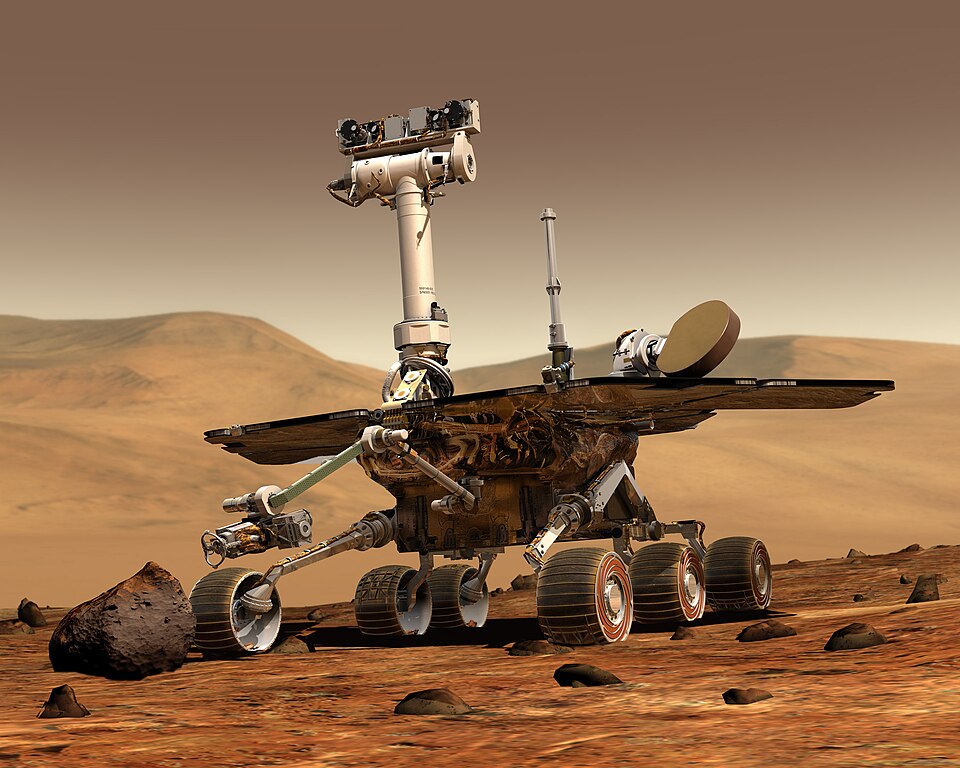
More than 20 years after NASA's Spirit rover landed on Mars, a researcher has found new evidence buried in the mission's own data suggesting water once covered large parts of the planet. The discovery came not from a new spacecraft or instrument, but from a fresh look at measurements already collected.
According to Phys.org, ECU Deputy Vice-Chancellor Research Professor Paulo de Souza, from Edith Cowan University in Australia, re-examined observations the Spirit rover gathered over more than 2,000 days on the Martian surface. He analyzed data from 32 undisturbed soil sites across Gusev Crater, collected between 2004 and 2010. By combining hundreds of individual measurements, he built the most detailed iron-mineral profile ever produced for typical Martian soil.
The key find was crystalline hematite. Scientists had previously believed hematite was largely absent from these soils. The new analysis shows the mineral was present all along, but in amounts too small for individual rover measurements to detect on their own.
"One of the most important discoveries was finding crystalline hematite in ordinary Martian soil," Professor de Souza said. "This mineral's widespread presence suggests not only that water was present, but that significant areas of Mars may have once been covered by water."
Hematite and altered magnetite, both found in the reanalyzed data, can form when rocks interact with water. Their presence in ordinary Martian soil strengthens the case that liquid water played a major role in shaping the planet's ancient surface. The findings were published in the journal Interactions.
De Souza pointed to limits in the original data collection as the reason the minerals went undetected for so long. The rover operated under constraints of time, power, and instrument aging.
"The original rover observations were limited by time, power and the gradual aging of the instrument used to collect the data," Professor de Souza said. "Many measurements were not detailed enough on their own to identify minerals present in very small quantities. By bringing the data together and analyzing it in a new way, we were able to reveal information that had been hidden for years."
The research also supports a broader theory about Mars geology. Scientists believe much of the planet is blanketed by a similar layer of dust and soil, formed over millions of years through wind erosion, extreme temperature swings, and dust movement across the surface. The uniformity of that layer is part of what made the combined analysis possible.
De Souza said the work points to the value of returning to old mission data rather than waiting for new instruments to arrive on Mars.
"This work shows that important discoveries are not always made by collecting new data," he said. "Sometimes they come from looking at existing data with fresh eyes and better analytical techniques."
The findings add to a growing body of research suggesting Mars was once a far wetter world than the dry, frozen landscape it is today.