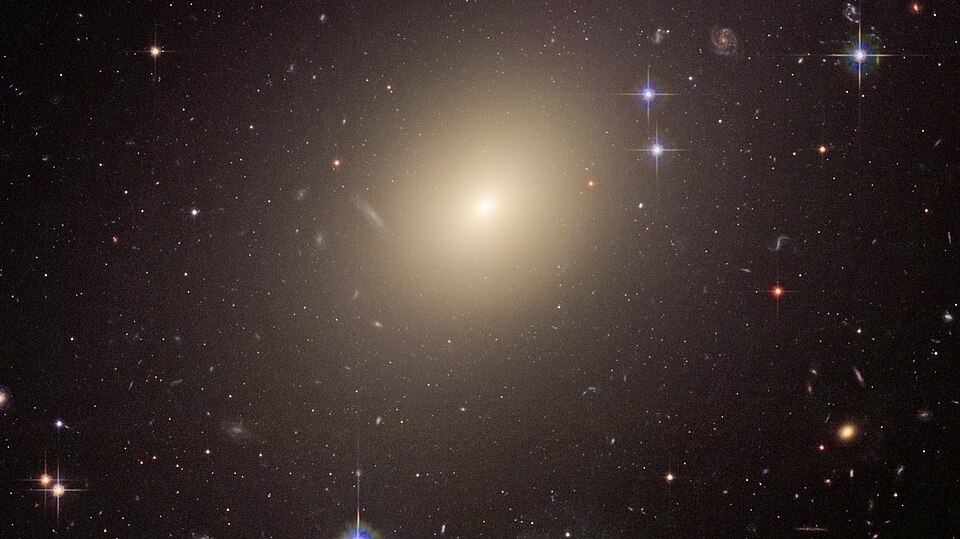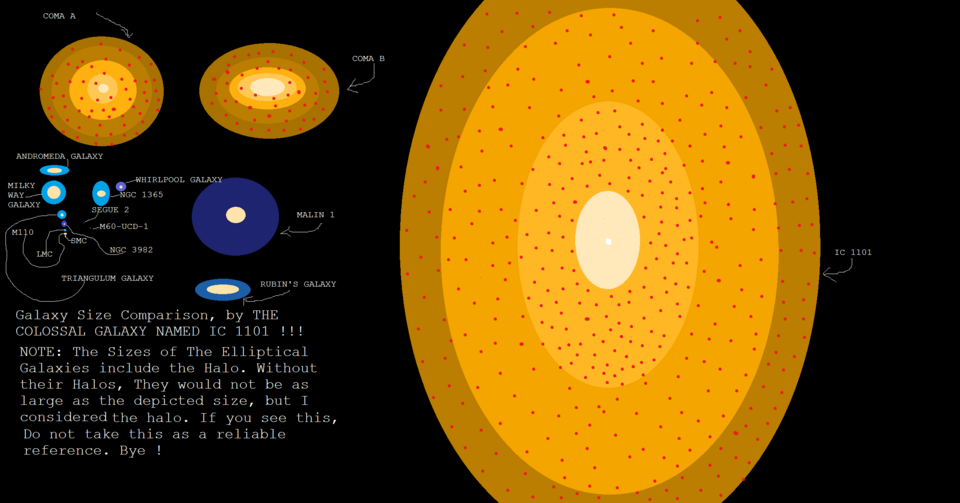
The largest known galaxy just got an official measurement. Astronomers have confirmed that IC 1101 spans roughly 520 kiloparsecs, or about 1.7 million light-years across, and contains an estimated 3.4 trillion solar masses in stars.
According to a report by Phys.org, researchers obtained the deepest images ever taken of IC 1101, allowing them to identify the galaxy's outer edge for the first time. The paper was posted to the arXiv preprint server on July 16, 2026.
The team was led by Carlos Marrero-de la Rosa of the Instituto de Astrofísica de Canarias. They used ultra-deep images from the Wide Field Camera at the Isaac Newton Telescope to detect the galaxy's edge. IC 1101 sits at the center of the galaxy cluster Abell 2029.
Getting a clean measurement was not simple. The faint outer regions of the galaxy overlap with the surrounding intracluster light, making it difficult to tell where the galaxy ends and the surrounding cluster begins. The researchers also had to deal with scattered light from foreground stars, which can spread a glow across an image and wash out the faint regions they were trying to detect.
To correct for that, the team built a detailed model of the telescope's point spread function using dozens of calibration stars of varying brightness. They then subtracted scattered light from more than 250 individual stars from the final image, one by one.
What they found placed the galaxy's edge at 260 kiloparsecs from its center. "The edge radius measured for IC 1101 remains among the largest values reported to date for an individual galaxy, corresponding to a projected diameter of ~520 kpc," the team writes in the paper.
For comparison, the Milky Way stretches only about 30 kiloparsecs across. IC 1101 spans roughly 17 times that. The stellar mass of IC 1101 alone also outweighs the total estimated mass of the Milky Way, which includes dark matter, and is placed somewhere between 1 and 1.5 trillion solar masses.
IC 1101 belongs to a class of objects called brightest cluster galaxies. These form through hierarchical galaxy formation, growing over billions of years by absorbing smaller galaxies. Their faint stellar halos blend into the diffuse gas and stars that fill the space between galaxies in a cluster, which is part of what made measuring IC 1101's true boundary so difficult.