

A team of high school students working through a NASA-supported internship program has developed computer models to improve fuel measurement during future lunar missions. Their research, announced by NASA on October 26, 2026, focuses on helping spacecraft determine how much propellant remains in their tanks while operating in the Moon's low-gravity environment and during spaceflight.
The students participated in the STEM Enhancement in Earth Science (SEES) internship program at the University of Texas Center for Space Research. During summer 2026, their Mission Architecture Tool for Research, Integration, and eXploration (MATRIX) team investigated an experimental technology scheduled for testing aboard Intuitive Machines' IM-3 lunar mission in 2027.
Measuring Fuel in Space Presents Unique Challenges
Determining how much fuel remains inside a spacecraft is more complicated than measuring fuel in a vehicle on Earth. In microgravity, liquid propellant does not reliably settle at the bottom of a tank, making conventional measurement techniques less effective.
Instead, the liquid can spread along tank walls, form floating masses or move unpredictably during spacecraft maneuvers. These conditions make it difficult for mission controllers to determine how much usable propellant remains, particularly during critical operations such as entering lunar orbit or landing.
Accurate measurements are especially important because spacecraft must carry enough propellant to complete their planned maneuvers. An incorrect estimate could affect decisions about engine burns, spacecraft navigation or mission safety.
The MATRIX team studied a technology called Modal Propellant Gauging (MPG), which uses vibrations and acoustic responses to estimate the amount of liquid inside a tank. Instead of depending on the liquid settling in one location, the technology examines how the tank responds to mechanical excitation.
As the amount of propellant changes, the tank's vibration characteristics also change. By analyzing those differences, the system can estimate the remaining propellant mass without relying on traditional gravity-dependent measurements.
Students Work With Experienced Aerospace Researchers
The MATRIX team worked under the guidance of Dr. Kevin Crosby, a researcher associated with Carthage College in Kenosha, Wisconsin, and the Wisconsin Space Grant Consortium. Crosby helped develop Modal Propellant Gauging with colleagues at NASA and has participated in previous experiments testing its performance in reduced-gravity conditions.
The technique has already undergone successful testing during several spaceflight experiments. NASA plans to demonstrate the technology on Intuitive Machines' third lunar landing mission, providing another opportunity to evaluate its usefulness during actual spacecraft operations.
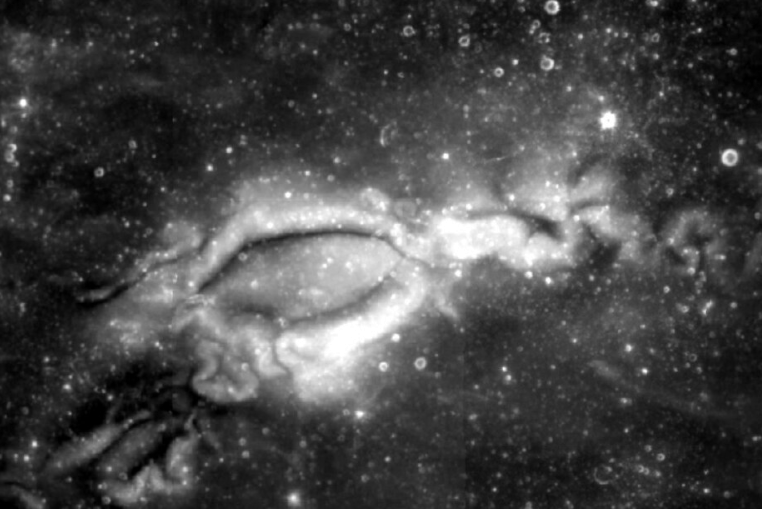
The IM-3 lander, named Trinity, is scheduled to travel to the Moon in 2027. Its destination is Reiner Gamma, a distinctive lunar region known for bright, swirling surface patterns and unusual magnetic properties.
Intuitive Machines plans to deliver scientific instruments and experimental technologies to the landing site. The mission is also designed to support investigations into the Moon's surface environment and technologies needed for future exploration.
Public NASA Data Supports Advanced Modeling
One of the most notable aspects of the students' research was their reliance on publicly available spacecraft information. Although the complete flight trajectory for IM-3 has not been released, the team used data from earlier Intuitive Machines missions to develop its calculations.
The students examined published information from the IM-1 and IM-2 missions, including trajectory records provided through NASA's Jet Propulsion Laboratory. Those records came from the Navigation and Ancillary Information Facility, which maintains spacecraft navigation information used by researchers and mission planners.
By reconstructing the IM-2 spacecraft's flight path, the students were able to identify periods when its engines operated. They compared the recorded trajectory with a model showing how the spacecraft would have moved without engine thrust, allowing them to estimate the velocity changes produced by those burns.
The team then developed an algorithm to approximate possible flight conditions for IM-3. Because the mission's complete trajectory remains unavailable, these calculations represent modeled estimates rather than confirmed flight instructions.
The students also used computational fluid dynamics simulations to examine how liquid propellant might move inside the lander's tanks. These calculations helped estimate fuel sloshing and changing liquid distributions during different stages of flight.
Another part of the research involved Monte Carlo simulations, a technique that repeatedly calculates outcomes using varied input conditions. This allowed the team to examine a range of possible propellant states rather than depending on a single prediction.
Models Identify Important Measurement Opportunities
The students found that Modal Propellant Gauging could provide reliable measurements during two important phases of the planned mission. Those phases include Lunar Orbit Insertion, when a spacecraft uses its engines to enter orbit around the Moon, and Powered Descent, when engine thrust controls the final approach to the lunar surface.
The models also identified possible measurement opportunities during Descent Orbit Insertion, depending on the conditions encountered. These findings could help mission planners determine when fuel measurements would be most useful and technically feasible.
The spacecraft's starting mass emerged as the most important factor affecting the duration of these measurement opportunities. Changes in mass influence propulsion requirements and spacecraft motion, which can affect when the propellant behaves in ways suitable for measurement.
The research did not establish that MPG will perform with a particular level of accuracy aboard IM-3. Instead, it identified predicted periods when the technology should be capable of collecting dependable measurements, subject to confirmation during the actual mission.
Students Examine Launch and Landing Conditions
Beyond measuring propellant, the MATRIX team also studied potential launch opportunities for the planned 2027 mission. Their analysis identified candidate launch periods based on orbital conditions and the spacecraft's expected trajectory.
The students also developed a landing analysis for the Reiner Gamma region. Their models examined the distribution of potential landing locations near the mission's designated target, helping illustrate how different flight conditions could affect the final approach.
Reiner Gamma is scientifically important because its bright surface patterns differ noticeably from the surrounding lunar terrain. Scientists continue investigating how magnetic fields and interactions with the solar wind may contribute to the formation and preservation of these unusual features.
Intuitive Machines identifies Reiner Gamma as the destination for IM-3, which will carry multiple scientific and technology demonstration payloads. The mission will also include a lunar data relay satellite intended to support future communication services around the Moon.
Research Presented to Intuitive Machines Engineers
The MATRIX team presented its methods and findings directly to the propulsion engineering group at Intuitive Machines. The presentation demonstrated how publicly available mission data could support detailed spacecraft analysis without access to a complete set of proprietary flight information.
The students also shared their research at the SEES Annual Symposium and the Wisconsin Space Grant Consortium Annual Conference. Their presentation, titled Computational Models to Estimate Modal Propellant Gauging (MPG) Windows on the Intuitive Machines IM-3 Mission, described their modeling techniques and predicted measurement opportunities.
Crosby praised the team's work, saying the students developed an understanding of advanced methods comparable to that of graduate students. He also noted that they accomplished their research in less than a month and impressed industry engineers with the quality of their analysis.
The eight students came from communities in Texas, Florida, California, Wisconsin, Pennsylvania and Massachusetts. Their backgrounds and geographic locations illustrate the national reach of the SEES program, which introduces students in grades 11 and 12 to scientific research.
Fuel Measurement Could Support Future Lunar Exploration
Reliable propellant measurement is an important capability for spacecraft operating far from Earth. NASA and commercial companies are studying technologies that could eventually support refueling in space, orbital fuel storage facilities and long-duration missions.
Future spacecraft may need to transfer propellant between tanks or vehicles while operating in microgravity. Technologies such as Modal Propellant Gauging could help engineers monitor those operations and make better decisions about fuel reserves.
The MATRIX team's models provide preliminary analysis relevant to those challenges, but further testing will be necessary to establish the technology's performance during IM-3. The actual mission will provide an opportunity to compare predicted measurement conditions with the behavior of a spacecraft operating near the Moon.
The students are scheduled to present their findings again at the American Geophysical Union Annual Meeting in San Francisco in December 2026. Their research will remain connected to the planned 2027 IM-3 mission, when the Modal Propellant Gauging technology is expected to undergo its next lunar flight demonstration.