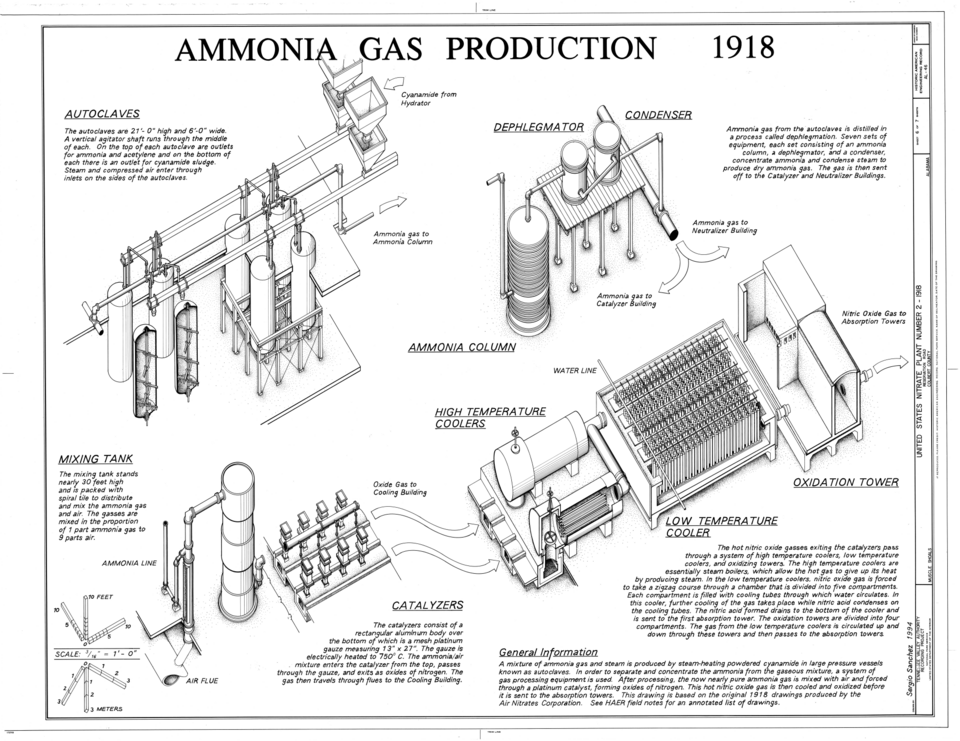
Ammonia is the second most produced chemical in the world, and almost all of it is made the same way it has been for more than a century. That process is now under pressure to change.
Researchers at MIT have developed a way to use computer models to predict which materials could work best as catalysts in a low-emissions method of making ammonia. The findings were published August 11 in the Royal Society of Chemistry journal EES Catalysis, according to Phys.org.
The traditional method, called the Haber-Bosch process, relies on fossil fuels to generate the heat needed to drive the reaction. The hydrogen used in the process is also largely produced from fossil fuels. Together, ammonia production accounts for up to 2% of the world's energy consumption and about 1.5% of greenhouse gas emissions. More than 90% of the world's ammonia goes toward making fertilizer.
An electrochemical alternative exists, one that uses electricity rather than heat and pressure. But it has not come close to being economically competitive at the scale needed to replace Haber-Bosch. A key obstacle is finding the right catalyst material to make the reaction efficient enough.
That search has traditionally involved testing possible combinations one at a time, a process that can take years given that there are millions of possible alloys to consider. The MIT team's new approach uses computer modeling to narrow that field by identifying which physical properties most strongly drive catalytic activity.
"Our approach identifies the key physical properties that drive catalytic activity in ammonia production," said Bilge Yildiz, the Breen M. Kerr Professor in the departments of Nuclear Science and Engineering and Materials Science and Engineering. The results, she said, can guide the search for new and more effective catalyst compounds.
The paper was co-authored by Yildiz and doctoral students Constantine Athanitis and Filip Grajkowski. Athanitis described the scale of the problem in plain terms. As the world's population grows, he said, "we're just going to need more and more food, and the only reason we're able to sustain so many people is because of fertilizer." The Haber-Bosch process, he noted, "has been hyper-optimized since it first came out more than a century ago."
The world currently uses about 200 million metric tons of ammonia each year. Athanitis said the goal is to find a production method that matches or exceeds that output. "So ideally we want to be able to find a way to produce the same amount of ammonia, or even more, but in a more energy-efficient way and also with lower CO2 emissions," he said.
The new modeling approach does not replace laboratory testing but is designed to focus that testing on the most promising candidates, cutting down the time and resources needed to find a viable industrial catalyst. The open-access paper is available through EES Catalysis.