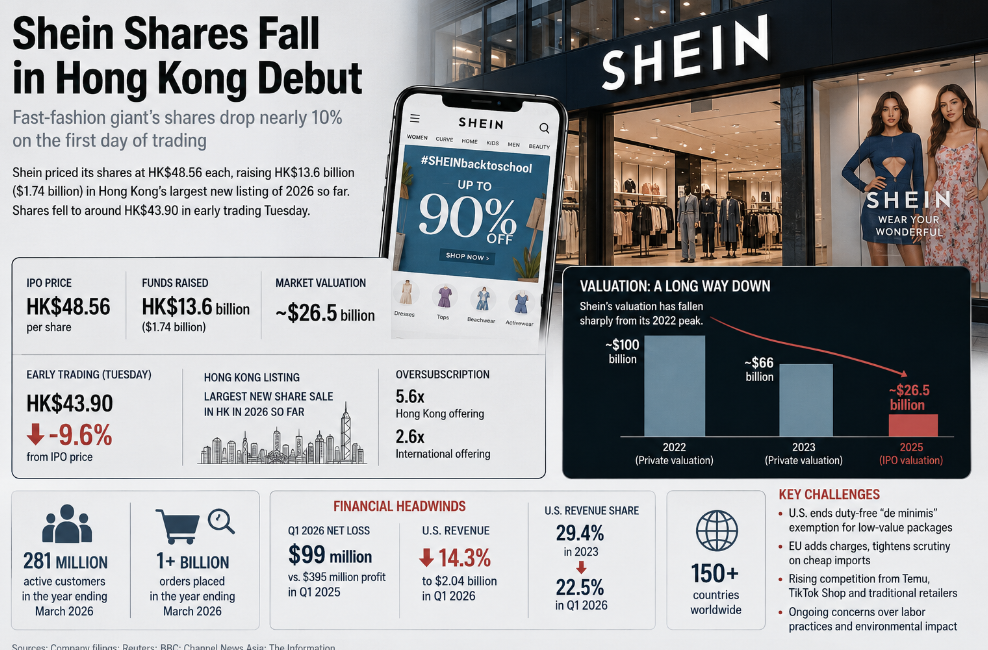
Shares in fast-fashion giant Shein fell by almost 10% in early trading Tuesday as the company made its long-awowing years of unsuccessful attempts to secure a listing elsewhere.
Shein priced its shares at HK$48.56 each, raising HK$13.6 billion, or about $1.74 billion, through the sale of 280 million shares. The price gave the Singapore-headquartered company a valuation of roughly $26.5 billion. Shortly after trading began, the shares fell below HK$44, representing a decline of nearly 10% from the offering price.
The lower share price underscores how dramatically investor expectations for Shein have changed. The company reached a private-market valuation of approximately $100 billion in 2022, when rapid growth in online shopping and Shein's popularity with younger consumers made it one of the world's most valuable privately held companies. A 2023 fundraising round valued it at about $66 billion. Its IPO valuation is now roughly one-quarter of its peak.
Despite the disappointing start for its shares, the offering represents an important event for Hong Kong's financial markets. Shein's $1.7 billion offering is the largest new share sale in Hong Kong so far in 2026, surpassing autonomous-driving company Momenta Global's roughly $751 million listing in July. Hong Kong has been experiencing a broader recovery in IPO activity, with companies raising about $41 billion through listings this year.
Investor demand for the offering was substantial, although not overwhelming by the standards of some heavily sought-after Asian IPOs. The portion offered to Hong Kong investors was oversubscribed about 5.6 times, while the international offering was approximately 2.6 times oversubscribed. Shein said money raised through the IPO will be used in areas including technology, brand development and further international expansion.
Shein was founded in China but moved its headquarters to Singapore in 2021. The company has built an enormous global e-commerce operation selling inexpensive clothing and accessories in more than 150 countries. Its business model relies heavily on a network of suppliers, particularly in China, that can rapidly manufacture relatively small batches of new products and increase production when an item proves popular.
That system has allowed Shein to introduce new clothing designs at extraordinary speed and keep prices low, helping the company attract a particularly large following among teenagers and younger adults.
The scale of the operation is substantial. Shein said in filings ahead of the IPO that it had 281 million active customers who placed more than one billion orders during the year ending in March 2026.
However, the economics that helped produce Shein's explosive growth are becoming more difficult.
The company reported a $99 million net loss during the first quarter of 2026, compared with a $395 million profit during the same period a year earlier. U.S. revenue fell approximately 14.3% to $2.04 billion during the quarter. Overall revenue growth slowed to about 1.1%.
One of the biggest problems has been the loss of favorable customs treatment for inexpensive packages entering the United States.
For years, Shein's direct-to-consumer shipping model benefited heavily from the U.S. "de minimis" exemption, which allowed packages valued at less than $800 to enter the country without the normal import duties. The removal of that exemption increased costs and forced Shein to adjust prices, inventory and fulfillment operations.
The company acknowledged in its IPO filings that the change had hurt U.S. sales and increased fulfillment expenses. The United States accounted for 29.4% of Shein's revenue in 2023 but just 22.5% during the first quarter of 2026.
Europe is creating additional pressure. The European Union has also moved against the flood of inexpensive direct-to-consumer imports, including new charges on low-value e-commerce shipments. Shein faces regulatory scrutiny in Europe as well as the United States over its business practices and online marketplace.
Shein's supply chain has also faced years of scrutiny from lawmakers, environmental organizations and human-rights groups. Critics have questioned working conditions among suppliers, the environmental consequences of producing enormous volumes of inexpensive clothing, and the origins of some materials used in its products. Shein has disputed allegations that its supply chain uses forced labor and says suppliers are required to comply with its standards.
Those controversies complicated Shein's earlier attempts to become a publicly traded company.
The retailer originally sought a listing in New York but encountered regulatory and political resistance in the United States. It subsequently pursued London, where its plans also stalled amid questions surrounding its supply chain and business practices. Hong Kong ultimately became the company's route to the public markets.
Competition has also intensified. Chinese-founded shopping platform Temu has spent heavily to acquire customers around the world, while TikTok Shop has expanded aggressively into e-commerce. Traditional fashion companies including Zara owner Inditex and H&M have also accelerated their online businesses.
At the same time, several once-prominent online fashion companies have struggled. Shares in British retailers Asos and Boohoo have fallen sharply from their earlier highs as investors questioned whether the extraordinary online-shopping growth seen during the pandemic could continue.
Louise Deglise-Favre of research firm GlobalData described Shein's listing as coming at a "complex moment" for fast fashion, with investors increasingly skeptical about the sector's growth prospects and concerned about sustainability and ethical issues. Because Shein is one of the few enormous standalone online fashion retailers, its performance on the public market could also provide investors with a new benchmark for judging the industry.
Shein nevertheless enters the public market as an unusually large global retailer. The company generates more than $40 billion in annual revenue and has accumulated substantial cash reserves, giving it resources that many struggling online fashion competitors lack.
The central question for investors is whether Shein can adapt its model to a world in which inexpensive cross-border shipments face higher tariffs and fees, regulators are paying closer attention to online marketplaces, and competitors are spending heavily to capture the same consumers.
The steep decline from a nearly $100 billion private valuation to approximately $26.5 billion at its IPO suggests investors have already priced in much of that uncertainty. The nearly 10% drop in early trading indicates that, at least initially, some investors believe even that reduced valuation may still carry considerable risk.