

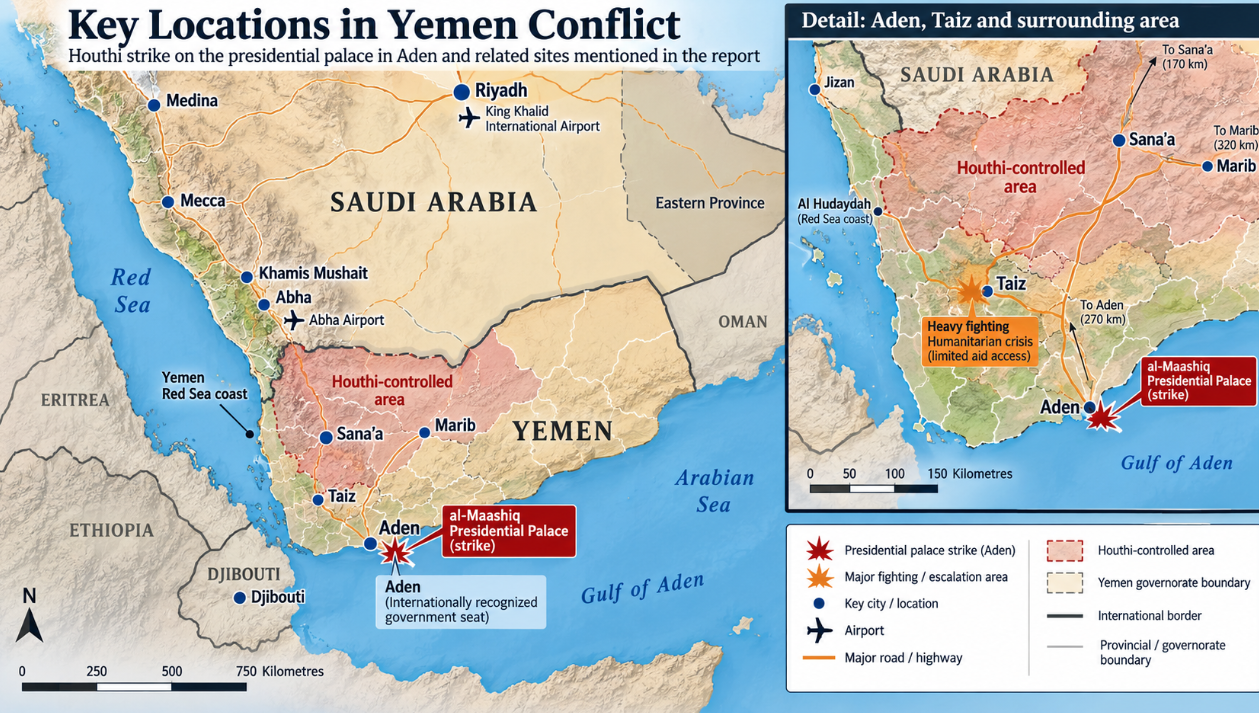
Houthi rebels launched a missile attack on Yemen's presidential palace complex in the southern city of Aden on Thursday, October 15, 2026, killing at least two security guards and injuring several others. The attack targeted the headquarters of Yemen's internationally recognized government amid escalating fighting with Saudi-backed forces.
Witnesses reported at least six explosions around the al-Maashiq presidential palace, sending smoke into the air and forcing frightened residents to flee nearby streets. Government officials confirmed that Prime Minister Shaya al-Zindani and members of his cabinet were unharmed.
The attack marked a major escalation in a conflict that had experienced several years of relative calm before fighting intensified again. It also raised concerns about the security of Aden, which has served as the temporary seat of Yemen's internationally recognized government since Houthi forces captured Sanaa in 2014.
Missiles Strike Government Headquarters
Yemeni Information Minister Moammar al-Eryani said the Houthis launched five missiles toward the palace complex. The facility houses government offices and security installations associated with the Saudi-backed administration.
Security officials reported explosions near the hilltop palace and its main entrance. Residents described hearing repeated blasts before seeing smoke rising over the government compound.
Initial reports from the Associated Press indicated that at least two people had been killed and six wounded. Subsequent reporting from Reuters cited a higher toll of five deaths and 16 injuries.
The differing figures reflect casualty information emerging from officials as the situation develops.
The Houthis claimed responsibility for the attack, saying they targeted a military operations center used by Saudi forces inside the presidential complex.
A Yemeni government official also told Agence France-Presse that missiles struck facilities used by the Saudi-led coalition. The reported targets included an operations headquarters and another military installation within the compound.
Although the Houthis described the operation as an attack on military facilities, the strike occurred at a complex central to the country's internationally recognized government.
The Yemeni government condemned the assault, while security personnel worked to secure the area and assess the damage.
Saudi Arabia Accuses Iran of Supporting Attacks
The palace strike came during a period of intensifying confrontation between the Houthis and Saudi Arabia.
The Saudi-led coalition has accused the rebels of using advanced missiles and drones supplied through regional networks, including support from Iran.
Iran has denied allegations that it directs Houthi military operations.
The Houthis, also known as Ansar Allah, have maintained close political and military ties with Tehran. Their expanding missile and drone capabilities have allowed them to strike targets well beyond territory under their control.
During a news conference in Riyadh on Thursday, coalition spokesperson Maj. Gen. Turki al-Maliki described a series of attacks against Saudi infrastructure.
According to figures presented by the coalition, Riyadh's King Khalid International Airport had experienced 20 attacks during October, resulting in 17 deaths and 333 injuries.
The coalition also reported attacks on Abha airport that killed three people and wounded 28 others.
These figures were provided by Saudi authorities and were not independently verified in the reporting reviewed.
Saudi officials said coalition forces had destroyed 127 Houthi weapons storage and launch sites during recent military operations.
The increasing exchanges have raised concerns that fighting in Yemen could become an even larger part of the regional conflict involving Iran, the United States and Israel.
Missile Intercepted Near Medina
Saudi Arabia also reported intercepting a cruise missile over the Medina region on Thursday.
The Saudi-led coalition did not immediately identify who launched the weapon.
A Houthi military spokesperson denied responsibility for that incident, saying the group had maintained a policy against attacking the Islamic holy cities of Mecca and Medina.
That denial was separate from the Houthis' acknowledgment of the missile strike on the presidential palace in Aden.
Saudi authorities also reported intercepting drones over the kingdom's Eastern Province and near Khamis Mushait.
The Eastern Province is particularly important because it contains major oil production and processing facilities.
Attacks near energy infrastructure can create wider economic concerns because Saudi Arabia is one of the world's largest oil exporters.
The Houthis have also warned civilians and airlines about operating near Saudi airports, adding to concerns about the safety of regional air travel.
The conflict has already disrupted aviation and commercial activity across parts of the Middle East.
Fighting Intensifies Around Taiz
While the palace attack attracted international attention, renewed ground fighting has placed civilians in several Yemeni provinces at serious risk.
The city of Taiz has become one of the most heavily affected areas.
Taiz, Yemen's third-largest city, has experienced years of fighting, road restrictions and shortages of essential supplies. Recent Houthi advances have further restricted movement into and out of the area.
Government forces continue to resist rebel advances, but residents face increasingly difficult conditions.
Food supplies are running low, fuel has become harder to obtain and medical facilities are struggling to handle casualties.
Some neighborhoods have experienced disruptions to schools and public services as fighting approaches populated areas.
Residents have reported difficulties finding flour, cooking gas and other basic necessities.
The renewed fighting threatens to worsen a humanitarian emergency that has already displaced millions of Yemenis during more than a decade of war.
More Than 600,000 People Cut Off From Food Assistance
The United Nations World Food Programme warned on October 14 that escalating fighting had prevented humanitarian assistance from reaching approximately 800,000 people across affected parts of Yemen.
That includes more than 600,000 people in Taiz who depend on emergency food assistance.
The agency said shifting front lines, blocked roads and deteriorating security were preventing aid workers from reaching vulnerable communities.
Its monitoring indicated that wheat flour stocks were nearly exhausted in some inaccessible districts. Remaining food supplies could run out quickly if transportation routes remain blocked.
The agency also reported that ten of Taiz's 16 districts had previously been classified at Emergency levels of food insecurity.
Such conditions indicate that many households face severe food shortages and heightened risks of malnutrition.
The World Food Programme warned that delays in restoring humanitarian access could rapidly worsen the situation.
Across Yemen, approximately 18.3 million people face acute food insecurity, while 2.2 million children under age five are affected by acute malnutrition.
These figures illustrate the scale of humanitarian needs even before the latest military escalation.
Hospitals Struggle to Treat Growing Numbers of Casualties
The International Committee of the Red Cross has also raised concerns about Yemen's deteriorating humanitarian conditions.
Hospitals in Taiz, Marib and areas along the Red Sea coast have experienced increasing numbers of patients injured during the fighting.
Some medical facilities have reported shortages of surgical supplies, oxygen, anesthetics and other essential materials.
The Red Cross warned that Yemen's weakened healthcare system has limited capacity to absorb another major increase in casualties.
Years of conflict have damaged hospitals, interrupted medical supply chains and forced healthcare workers to operate under dangerous conditions.
The latest fighting is also making it harder for patients with illnesses unrelated to the conflict to receive treatment.
Humanitarian organizations are calling for safer access routes and stronger protections for civilians and medical personnel.
Yemen's Fragile Stability Faces Another Test
Yemen's civil war began escalating in 2014 when Houthi forces seized Sanaa and expanded their control across northern areas.
Saudi Arabia intervened militarily in 2015 at the head of a coalition supporting the internationally recognized government.
The conflict produced widespread destruction, economic collapse and one of the world's most severe humanitarian emergencies.
A United Nations-brokered truce in 2022 helped reduce major fighting, although it did not produce a comprehensive peace agreement.
Recent military developments have weakened that period of relative stability.
The Houthis continue to control significant territory in northern Yemen, while the internationally recognized government operates from Aden with Saudi support.
The attack on al-Maashiq palace demonstrates the vulnerability of government facilities despite their location far from traditional northern Houthi strongholds.
It also places additional pressure on diplomatic efforts to prevent Yemen's conflict from expanding.
The immediate priorities are securing Aden, treating the wounded and determining the full extent of the damage.
Meanwhile, humanitarian organizations are seeking access to hundreds of thousands of civilians trapped by renewed fighting around Taiz.
The Saudi-led coalition has indicated that it will continue responding to Houthi attacks, while the rebels have shown they can strike strategically important targets in Yemen and Saudi Arabia.
With the presidential palace now targeted and humanitarian access deteriorating, the next military developments could further complicate efforts to restore stability in Yemen.