

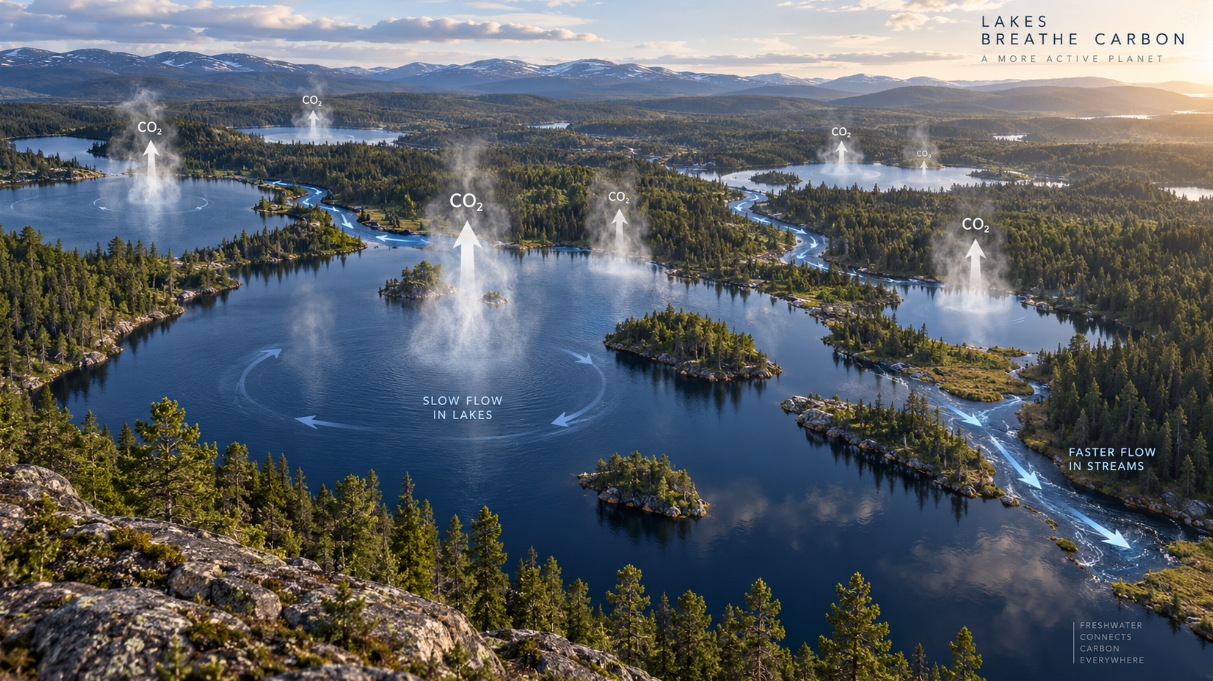
Lakes are not passive features of the landscape. A new study suggests they play a much larger role in the global carbon cycle than previously understood, releasing significant amounts of carbon dioxide into the atmosphere rather than allowing it to flow downstream.
The research, published in Geophysical Research Letters and reported by Phys.org, examined 32 connected stream-and-lake networks in northern Sweden. Scientists measured how much carbon escaped into the atmosphere from each network and how much continued moving downstream. The results showed a clear pattern: the more lake surface area a network contained, the more carbon it released.
Networks with ten times more aquatic surface area had approximately 35 times longer water residence times and 1.8 times higher carbon emissions relative to downstream carbon export.
The key variable is time. Streams carry carbon quickly, giving it little opportunity to be transformed before it reaches the ocean. Lakes slow that journey considerably. The researchers measured what they called the network residence time, or how long water stays within a stream-and-lake system before moving on. In the Swedish networks studied, that time varied enormously, from just 42 minutes to as long as 29 years. Lakes accounted for nearly all of that variation.
When carbon lingers in the water, microbes have more time to break down dissolved organic material. That breakdown process can produce carbon dioxide, which then escapes from the water's surface into the air. The longer the water sits, the more carbon goes up rather than downstream.
Fredrik Alriksson, of Sweden's Umeå University, and colleagues argue that lakes and streams should not be treated as separate parts of the landscape when scientists model the carbon cycle. They need to be considered together as connected networks.
The team sampled the networks during four different seasonal periods: spring snowmelt, early summer, late-summer low flow, and autumn high flow. They collected measurements across more than 360 sections of streams and from 42 lakes. The consistency of the pattern across seasons strengthened the finding.
The researchers were careful to note limitations. They did not directly measure all of the processes responsible for the pattern and could not determine the exact contribution of each one. Still, the study points to a part of the carbon cycle that may have been systematically undercounted. Further work is planned to measure those underlying processes more directly.