

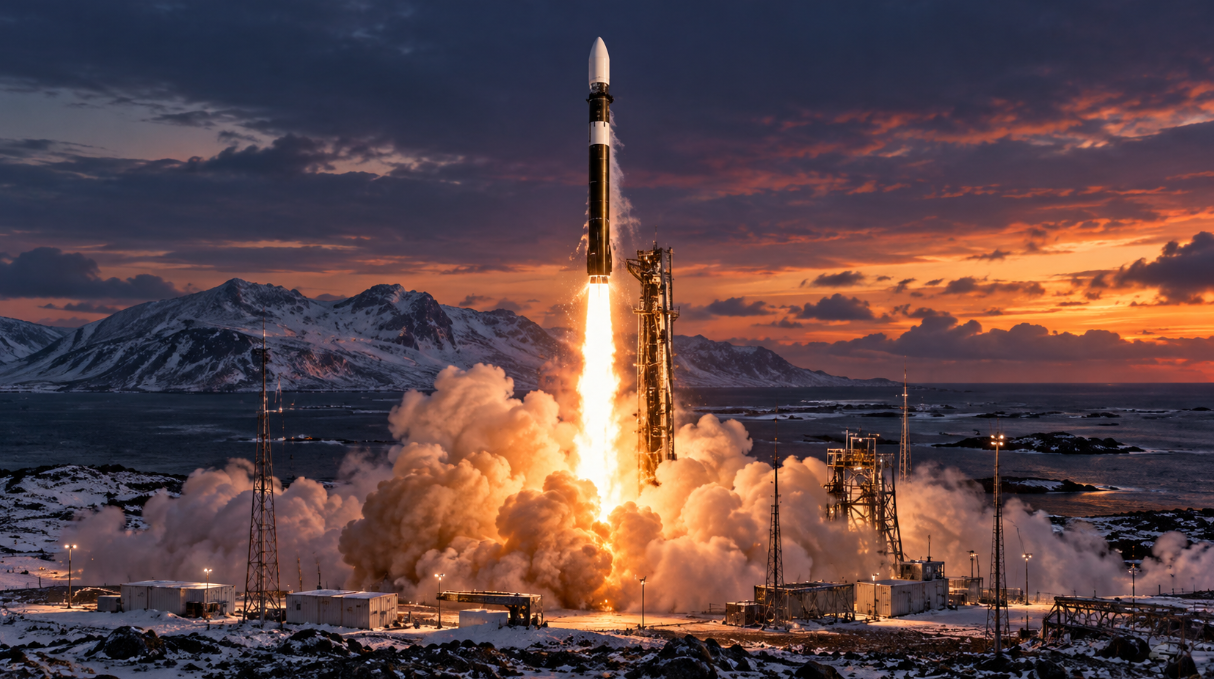
Isar Aerospace, a company founded in 2018 by three students at the Technical University of Munich, achieved a major milestone by launching its Spectrum rocket into low-Earth orbit from Norway. The two-stage rocket, named Spectrum, became the first commercially developed rocket to reach orbit from continental Europe. The launch took place on Saturday from Andøya Spaceport in northern Norway, a location inside the Arctic Circle. The rocket lifted off at 4:12 pm EDT, which was 10:12 pm local time in Norway, as the evening sky darkened. Seven minutes after liftoff, the Spectrum rocket was in orbit. The mission, called “Onward and Upward,” carried five small satellites and a technology experiment.
This was Spectrum’s second flight. Its first test flight in March 2025 lasted about 30 seconds before the rocket lost attitude control and fell into the sea after an unintended vent valve opening. No one was injured in that flight.
Isar Aerospace’s CEO Daniel Metzler said the company had opened space access for continental Europe, according to Ars Technica. He added that this success gives commercial and institutional customers a new option in the global space industry. Metzler noted that Isar had achieved in years what had taken European space efforts decades to accomplish. He also said the company now provides Europe with sovereign access to space and has ushered in a new chapter for European spaceflight.
The company’s name comes from the river Isar, which flows through Munich. Before founding Isar, Metzler and two classmates had spent time working with rocket parts in a university workshop. They began by tinkering as a hobby, but eventually saw the possibility of turning their interest into a business.
The journey to orbit was not easy, and it took eight years for Isar to reach this point. During that time, the company raised around $1 billion through private funding rounds. Isar now employs nearly 500 people, making it the most well-funded private launch company in Europe.
Metzler emphasized that long-term thinking is key to success, and that the human element is important in such projects. Isar’s achievement is significant for the European Space Agency and the broader European space industry. Europe’s traditional launcher industry has relied heavily on government funding, while Isar established itself primarily through private investment. This success may help push European launch companies to become more competitive and cost-effective.
Isar has also received substantial public support. In August 2026, the company signed an agreement under ESA’s European Launcher Challenge carrying approximately €200 million in program commitments, and it had previously received support through ESA’s Boost! program and Germany’s space agency.
European launch providers like Arianespace and Avio have used government support to operate rockets such as Ariane 6 and Vega-C. These rockets are reliable but not very cost-competitive, even with subsidies. European officials hope that new competition will drive innovation in the region’s space sector. Ars Technica reported that European governments currently pay a premium to launch satellites on European rockets compared with some U.S. alternatives.
The traditional European model involves government funding and control over where rockets are built. Isar’s business model is different, as it was built on private investment and aims to serve both commercial and government clients.
The launch also has geopolitical significance, as European startups often struggle to attract venture capital compared to their American counterparts. The structure of Europe’s legacy space industry is not always compatible with the entrepreneurial style of Silicon Valley.
Isar’s success shows that it is possible for European companies to compete in the global space market. The company’s performance highlights a shift toward more dynamic private efforts in Europe’s space industry.
This achievement marks a turning point for European rocket development and could lead to more innovation in the future. Isar Aerospace’s Spectrum rocket is now part of a growing list of commercial launch vehicles around the world, according to a report from The Guardian. Other major players in the satellite launch market include SpaceX and ArianeGroup; SpaceX launches from the United States, while Ariane rockets launch from Europe’s spaceport in French Guiana.
Isar’s launch adds a privately developed European rocket to this global competition.