

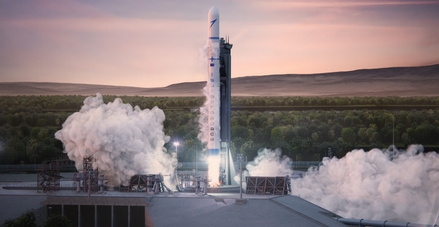
Isar Aerospace, a German startup founded in 2018 by three university students, has successfully launched its Spectrum rocket into low-Earth orbit. The rocket lifted off from Andøya Spaceport in northern Norway on Saturday evening, marking a historic moment for European spaceflight. The two-stage Spectrum rocket reached orbit seven minutes after takeoff, becoming the first fully commercial launch vehicle in Europe to achieve this feat. Spectrum carried five small satellites along with an in-flight technology experiment.
Isar Aerospace’s CEO Daniel Metzler said the company had opened up space access from continental Europe, according to Ars Technica. He added that this success gives commercial and institutional customers a real alternative in the global space industry.
Metzler, along with two classmates from the Technical University of Munich, started working on rocket technology in a campus workshop before turning it into a business. The company began as a hobby project but grew into a major player in the space industry over several years.
It took Isar eight years to reach orbit, a timeline similar to other commercial rocket startups in the West. During that time, the company raised approximately $1 billion through private funding rounds and now employs nearly 500 people.
This makes Isar the most well-funded private launch company in Europe.
The company’s success is especially notable given that European space industry has been historically slow to embrace innovation and private investment. Early on, many people doubted the company’s ability to succeed in a field dominated by government-backed firms.
Metzler said that the team had to prove critics wrong through persistence and dedication.
The Spectrum rocket’s launch was not without prior setbacks, as the company had a failed test flight in March 2025, according to a report from The Verge. That earlier attempt lasted only 30 seconds before the rocket crashed into the sea and exploded.
Despite that failure, Isar continued its development and eventually achieved success with the current mission.
The European Space Agency and other space officials are watching closely, as Isar’s rocket could bring more competition to a market dominated by government-funded companies. Arianespace and Avio, the two main European launch providers, have relied heavily on government funding to operate their Ariane 6 and Vega-C rockets.
These rockets have proven reliable but are only marginally competitive, even with government subsidies. European governments have traditionally used a model called geographical return, under which ESA seeks to award industrial contracts to member states in rough proportion to their financial contributions.
Isar’s approach is different, as it was established on a privately funded basis and aims to attract both commercial and government customers. The company has also begun receiving significant public support, including about €200 million secured from the European Space Agency to help fund new rockets and expand testing and launch infrastructure.
The launch also carries geopolitical significance, especially in light of recent tensions with Russia and the United States. European countries are seeking more independent access to space, especially after losing access to Russian Soyuz launches following Russia’s invasion of Ukraine and amid concerns about dependence on U.S. launch providers.
Isar’s success shows that Europe can develop a competitive private launch industry alongside its traditional government-supported space programs. This achievement is a sign that private companies can play a major role in Europe’s future space efforts.
The company’s progress also reflects a broader shift toward private innovation in the European space sector. With its rocket now in orbit, Isar Aerospace has entered a new chapter for European spaceflight.