

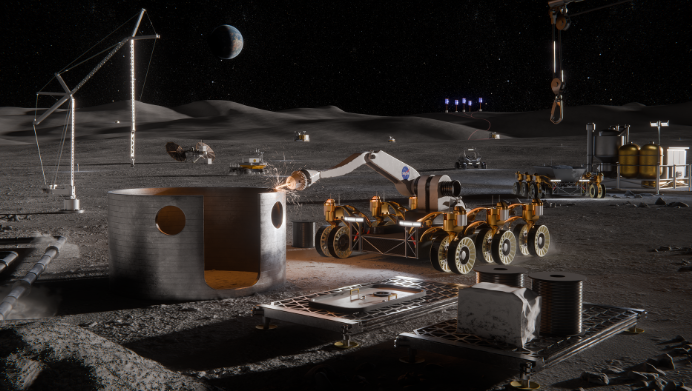
Lauren E. Low reported that NASA is inviting new ideas to help move forward with the tools and systems needed for Moon exploration and building a permanent base near the lunar South Pole. The announcement came on Tuesday, September 8, and focused on areas where current technology falls short. These include the ability to generate and store power, extract oxygen from lunar soil, and make materials needed for construction on the Moon. The goal is to support a major step forward in space exploration by making long-term human presence on the Moon possible. NASA describes its Moon Base as a long-term outpost that will be constructed near the lunar South Pole in stages, beginning with robotic missions and technology demonstrations before more extensive human operations.
The final Lunar Enabling Infrastructure Accelerator solicitation was posted on September 8, according to federal procurement records, with proposals due October 8. The solicitation is being managed through NASA's Glenn Research Center.
Greg Stover, who leads NASA’s Advanced Research and Technology Division, said the agency is working to close gaps in needed capabilities, according to news.google.com. He added that the effort is part of a larger push to prepare for sustained presence on the Moon, according to a report from NASA. NASA says the program is intended to address technology gaps identified through its Civil Space Shortfalls process.
The initiative is called NextSTEP-3 Broad Agency Announcement Appendix A: Lunar Enabling Infrastructure Accelerator. It aims to develop and test five main areas of technology in preparation for lunar missions. NASA says the technologies generally require additional risk reduction and ground-based testing, with the goal of maturing competing systems to Technology Readiness Level 5 or 6.
The first area involves surface power systems, including vertical solar arrays, power management and distribution, and energy storage. Another focus is using resources already present on the Moon to make oxygen from regolith, which is a mix of rock and dust covering the surface. NASA says reliable, scalable power will be essential during both the lunar day and periods of darkness as Moon Base operations expand.
NASA has been working on vertical lunar solar arrays for years. Space.com reported that the agency awarded a combined $19.4 million to Astrobotic, Honeybee Robotics and Lockheed Martin in 2022 to develop and test vertical solar-array prototypes designed for the lunar South Pole. The vertical design is intended to reach sunlight that could otherwise be blocked by the Moon's terrain when the Sun sits low on the horizon.
NASA has also been testing ways of extracting oxygen from simulated lunar soil. Space.com reported on tests in which NASA researchers used a high-powered laser inside a vacuum chamber to melt simulated regolith as part of a process aimed at extracting oxygen. Producing oxygen locally could eventually reduce the amount that has to be transported from Earth and could also support the production of propellant.
A third area involves nuclear power systems called radioisotope Stirling generators. These can produce electricity in places where solar power is not reliable, such as deep lunar craters or during long nights. NASA describes radioisotope power as particularly useful for operating equipment in dark, dusty and remote environments where dependable sunlight may not be available.
The fourth area looks at manufacturing materials in space to reduce the need for supplies from Earth. This would help make lunar missions more flexible and less dependent on resupply missions. NASA says advancing in-space manufacturing could eventually allow explorers to produce essential tools and materials away from Earth rather than transporting every item from the ground.
Space.com reported in August that NASA is also repurposing technology from the canceled Habitation and Logistics Outpost project for Lunar Infrastructure Demo missions, another example of the agency's broader effort to accelerate development of Moon Base systems.
The final area focuses on advancing the production, availability and performance of innovative nanomaterials that can be used in lunar exploration. This would make these materials more available and better suited for use in space environments. NASA says these materials will need to perform under demanding environmental conditions while meeting strict limits involving mass and performance.
Companies selected through the Lunar Enabling Infrastructure Accelerator will be expected to develop and demonstrate prototype systems and produce test data and analytical models that NASA can use to evaluate the technologies. The work is part of a much broader effort to create the infrastructure necessary for sustained operations near the lunar South Pole.