

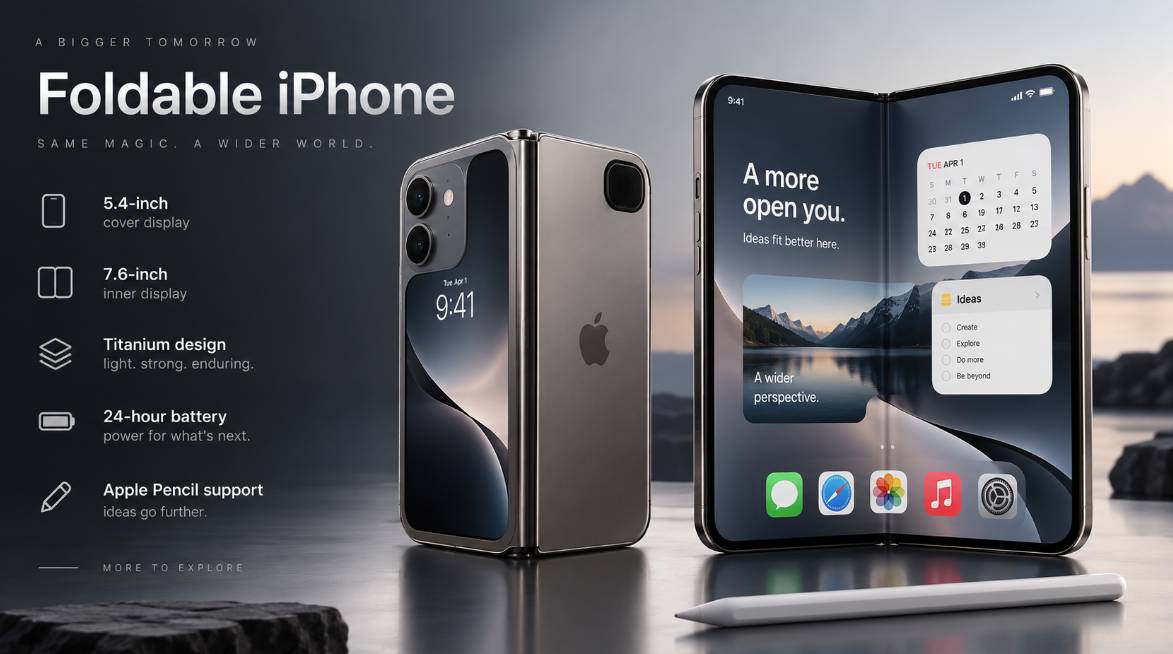
Apple has officially launched the iPhone Duo, its first foldable smartphone that features a unique hinge design and two large displays. The device is positioned as a premium product with a starting price of $1,999 for the 256GB model. Unlike previous rumors that suggested Apple would name it the iPhone Ultra, the company chose the more straightforward moniker iPhone Duo. The phone is designed to be compact and versatile, allowing users to watch videos in landscape mode or view vertical content in portrait orientation. Apple unveiled the phone on September 9 and plans to open preorders on October 16. The first units are scheduled to go on sale on October 23. It includes a 7.6-inch inner screen and a 5.4-inch outer cover screen, both of which are meant for different viewing experiences. Both are Super Retina XDR OLED displays with ProMotion and peak outdoor brightness of 3,000 nits. The inner display is the largest screen Apple has put on an iPhone. One notable feature is the matte nano-texture inner display that helps reduce reflections and minimize creasing. The iPhone Duo also has an IP68 rating for water resistance, allowing it to withstand immersion up to 6 meters deep for half an hour. It weighs 254 grams when closed, making it slightly heavier than Samsung’s Galaxy Z Fold 8 Ultra which weighs 215 grams. When folded, the Duo is 11.3 millimeters thick and has a short and wide shape that Apple compares to a passport.
The Duo lacks a dedicated telephoto camera and has shorter typical-use battery life compared to the iPhone 18 Pro Max, but it’s still comparable in price and features to Samsung’s Galaxy Z Fold 8 Ultra. The phone runs on Apple's A20 Pro chip, which is also used in the iPhone 18 Pro models. Apple claims that the Duo can provide up to 31 hours of video playback on its inner screen and 44 hours using the outer screen. Apple rates the Duo for up to 24 hours of typical use while the iPhone 18 Pro Max is rated for up to 30 hours. The device supports charging up to 50% in about 20 minutes with a 60-watt adapter or higher. Apple also gave the Duo two 48-megapixel rear cameras. The main camera can provide an optical-quality 2x zoom even though the phone does not have a separate telephoto lens. Face ID is also absent from the Duo. Apple instead placed Touch ID in the side button and allows the phone to be unlocked with an Apple Watch. The phone will be sold in Star White and Night Sky with storage choices ranging from 256GB to 2TB. Apple also plans to add support for the USB-C Apple Pencil later this year.
Apple’s new interface update, iOS 27, introduces a customizable slider for the Liquid Glass feature that adjusts how transparent the display appears, according to Engadget. Users can now tweak the appearance of Liquid Glass by dragging a slider to make it more or less transparent depending on personal preference. This update replaces older toggle options with a more flexible adjustment method that allows users to preview changes directly in the settings screen. For those who prefer less Liquid Glass transparency, there is an option in Accessibility settings to reduce transparency even further. That setting does not completely remove the Liquid Glass design. The iOS 27 update is compatible with iPhone 11 models and newer devices, meaning older iPhones can also benefit from these interface changes. Apple plans to release iOS 27 on September 14. The iPhone Duo is scheduled to ship with iOS 27.1 because it will arrive more than a month later.
Apple’s new foldable phone enters a competitive market where Samsung has already been selling foldables for several years, according to a report from CNET. Samsung's Galaxy Z Fold 8 Ultra offers more advanced camera specs and larger battery capacity than the iPhone Duo, CNET reported. Samsung lists a 200-megapixel main camera, a 50-megapixel ultrawide camera and a 10-megapixel telephoto camera on the Fold 8 Ultra. Samsung also lists a 5,000 mAh typical battery for the device. However, the iPhone Duo stands out with stronger dust resistance and a shorter, wider passport-style design, while Samsung’s Galaxy Z Fold 8 Ultra feels more like a traditional phone when closed. The Samsung model has an IP48 rating compared with the Duo’s IP68 rating. The Fold 8 Ultra starts at $2,099.99 in the United States. That puts it about $100 above the base iPhone Duo. CNET has also compared the Duo with the standard Galaxy Z Fold 8, which starts at $1,899 and has a similarly compact foldable shape.
Early adopters are encouraged to try the iPhone Duo and provide feedback on how it works for them in daily use. Apple believes that user input from a broader audience will help shape future versions of the foldable phone. The next six months will be critical for determining how well the iPhone Duo performs in the market and what features are most valued by users. Foldable phones still make up a small share of the overall smartphone business. Apple is entering the category more than seven years after Samsung introduced its first Galaxy Fold. Apple’s approach to foldables differs from its past products, such as the Apple Watch, which evolved based on early user feedback. The company’s willingness to take risks with new technologies like foldables shows its commitment to innovation in mobile devices. Despite the high price tag and uncertain reception, Apple is pushing forward with the iPhone Duo as a bold step into the foldable smartphone space.