

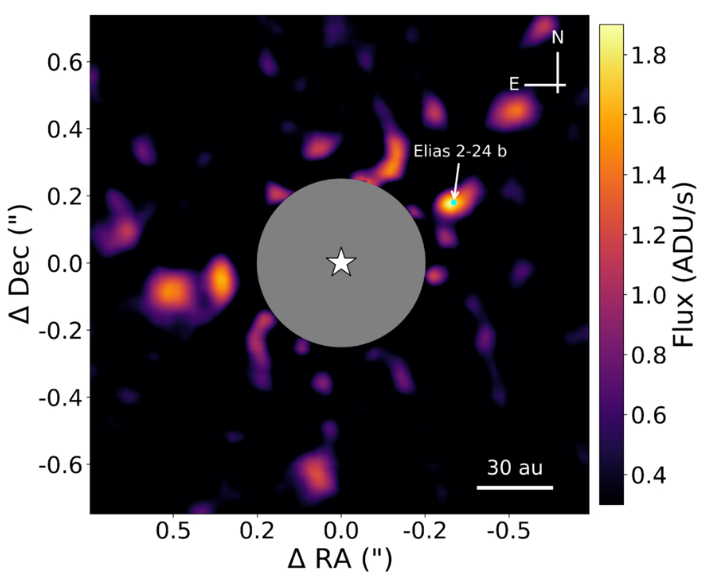
Astronomers have confirmed the discovery of what may be the youngest known exoplanet ever found, named Elias 2-24b. This planet orbits a star located about 450 light-years from Earth in the constellation Ophiuchus. The young star is called Elias 2-24 and is surrounded by a disk of gas and dust where planets can form.
Its orbit lies at about 55 astronomical units from its host star. That distance is about 10 times farther from its star than Jupiter is from the Sun.
Elias 2-24b is estimated to be less than one million years old.
Most confirmed exoplanets are billions of years old, but this one appears to have formed much more quickly than expected. The planet was identified by researchers who studied protoplanetary disks around stars and searched for gaps in the gas and dust. These gaps are often signs of growing planets that have cleared out their orbital paths.
One such gap had been noticed around the star Elias 2-24 for nearly ten years. The European Southern Observatory’s Very Large Telescope first spotted a point of light in that gap. This finding sparked debate among scientists about whether the object was truly a planet or something else.
Researchers later used images from the Keck Observatory in Hawaii to track the object’s movement over time. The team that made this discovery is led by Andrea Bernardi from Diego Portales University in Chile. The researchers compared Keck observations from 2018 and 2020 to determine whether the object was moving with its host star.
Elias 2-24b is estimated to have between 1.9 and 4.0 times the mass of Jupiter. Its rapid formation challenges current models of how planets grow and develop. The study was published in The Astrophysical Journal Letters in September 2026.
One widely accepted theory is called the core accretion model. It explains how planets can form as solid material builds a core that later gathers gas. NASA says current models predict that a Jupiter-size planet takes about five million years to form at Jupiter's distance from the Sun and even longer at greater distances.
Elias 2-24b appears to have formed in less than one million years despite orbiting much farther from its star. Previous record holders included planets around PDS 70 and WISPIT 2 that are more than five million years old.
This discovery suggests that planetary formation may be more flexible and quicker than previously believed.
The findings also highlight the importance of continuing to search for young exoplanets to improve our understanding of how they form. NASA’s Nancy Grace Roman Space Telescope launched on August 30 and is traveling toward its final orbit. Roman carries a powerful coronagraph that is designed to block starlight so astronomers can study faint planets and planet-forming disks.
Scientists believe this could lead to more discoveries of young planets in the near future. Researchers hope that studying such early-stage planets will help them better understand how planetary systems evolve over time. Roman could eventually make planets in smaller orbits easier to detect than they are with current instruments.
The discovery of Elias 2-24b offers a rare look into the very beginning of planetary development. It could change how scientists think about how planets form in different environments.