

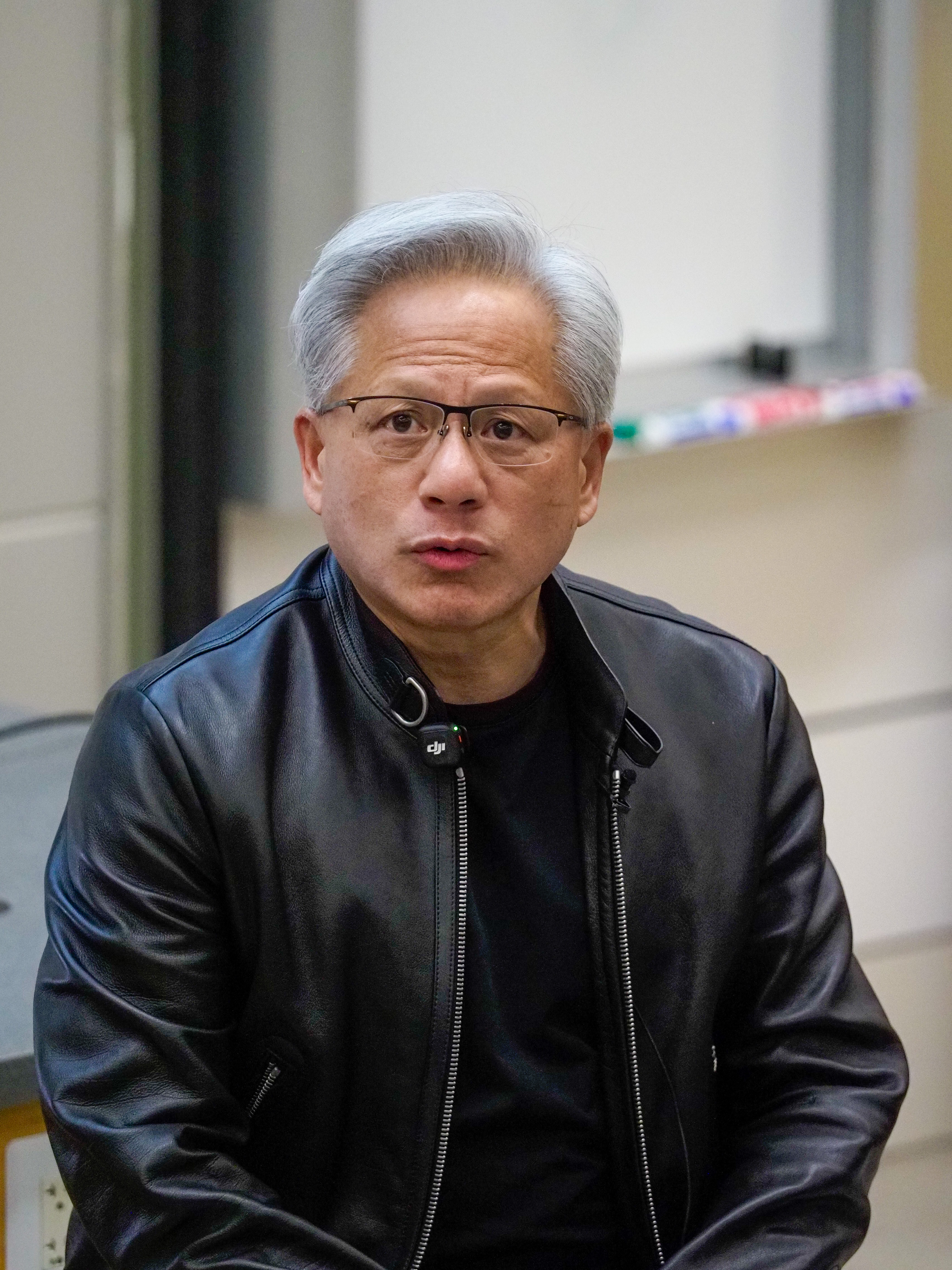
Nvidia is facing growing political and regulatory scrutiny following the resignation of co-founder and chief executive Jensen Huang, whose reported relationship with a businesswoman suspected by U.S. officials of Chinese intelligence ties has raised questions about the company's handling of sensitive technology sales.
Huang resigned on November 12, 2026, ending more than three decades as the leader of the semiconductor company he helped establish. Nvidia appointed longtime Chief Financial Officer Colette Kress as interim chief executive and launched a search for a permanent replacement.
The controversy has expanded beyond Huang's personal conduct. Investigators and lawmakers are examining whether companies in Southeast Asia helped restricted Chinese customers obtain advanced Nvidia artificial intelligence chips, either through unauthorized shipments or remote computing services.
New statements from Singapore's government and Megaspeed International, a cloud computing company associated with the controversy, have provided additional information about earlier investigations. However, the espionage allegations remain unproven, and Megaspeed denies wrongdoing.
Singapore Reveals Details of Investigation Into Alice Huang
On November 12, Singapore's Ministry of Home Affairs released a detailed account of its investigation involving Alice Huang, also known as Huang Le, and Megaspeed International.
The government confirmed that police and customs officials began investigating Megaspeed and related companies in February 2025. Authorities were examining possible false declarations involving computer servers purchased by companies operating through Singapore.
Investigators wanted to determine whether servers exported through Singapore to Malaysia had subsequently been sent elsewhere, contrary to information provided in shipping documents. The matter raised concerns because advanced computer equipment can contain processors subject to U.S. export restrictions.
Alice Huang was investigated because she had served as Megaspeed's chief executive, chairperson and one of its principal controllers. Singaporean officials emphasized that their investigation concerned possible violations of local law, not espionage.
Police questioned Huang on June 24, 2025, the same day U.S. export-control officials conducted a voluntary inspection at Megaspeed. Singaporean authorities temporarily seized her passport to ensure her availability during the investigation.
In February 2026, investigators determined that there was insufficient evidence to establish that Huang had committed offenses involving the suspected inaccurate declarations.
However, Singaporean police concluded that she had provided information she knew was inaccurate to minimize her role at Megaspeed. She received a formal warning and was barred from returning to Singapore.
Authorities returned her passport on February 26, allowing her to leave the country. Investigations involving Megaspeed and six other individuals remain ongoing.
Megaspeed Denies Illegal Chip Transfers
On November 15, Megaspeed confirmed that Alice Huang had officially left the company on August 30, 2025, and no longer held a position there.
The Singapore-based company said it operates legally and follows applicable export-control requirements. It rejected allegations that its business operations and supply arrangements had been used to transfer restricted technology unlawfully.
Megaspeed also announced that it had retained outside legal counsel to conduct an internal investigation. The company said it would cooperate with appropriate authorities while reviewing its business practices.
Its statement addressed speculation that Huang might still influence company operations despite leaving her formal positions. Megaspeed maintained that she had no current role, although questions about her past involvement have continued to attract attention.
The company was part of the rapidly expanding market for artificial intelligence computing services in Southeast Asia. Its business involved high-performance servers capable of supporting advanced AI applications.
That market has become increasingly important as restrictions on direct exports of sophisticated American chips to China have encouraged customers to seek computing capacity in other countries.
U.S. Officials Question Nvidia's Export Compliance
Treasury Secretary Scott Bessent has intensified the controversy by questioning whether Nvidia adequately investigated companies purchasing its advanced processors.
Speaking to CNBC on November 13, Bessent said the Treasury Department had supported placing Megaspeed on a U.S. restricted-trade list for several months. He emphasized that decisions involving export restrictions fall primarily under the Commerce Department's Bureau of Industry and Security.
Bessent also raised concerns about companies that may function as intermediaries for Chinese customers seeking access to American semiconductor technology.
On November 15, he questioned whether potentially improper chip transactions had influenced Nvidia's reported financial performance. He also called for the company to appoint an outside chief executive rather than simply promoting an existing executive.
Those statements represent concerns raised by a senior government official, not findings that Nvidia committed export violations. No criminal conviction involving Nvidia or Huang has been established in connection with the controversy.
Nvidia has maintained that it takes export-control compliance seriously. The company previously rejected suggestions that it knowingly facilitated illegal shipments of restricted processors.
According to recent reporting, Nvidia stopped doing business with Megaspeed in June 2025. The company said the restriction prevented new orders and existing shipments and remained in effect as of November 2026.
Nvidia Launches Independent Investigation
Nvidia's independent directors announced on November 10 that they had retained former acting U.S. Attorney Joon H. Kim and the law firm Wachtell, Lipton, Rosen & Katz to conduct an independent investigation.
The inquiry followed reports about Huang's relationship with Alice Huang and questions concerning whether sensitive company information or national security interests had been compromised.
Nvidia initially said it had no reason to believe that national security or proprietary company information had been compromised. Nevertheless, the board decided that the allegations required a formal review.
Huang also acknowledged having been unfaithful to his wife in a message to employees. He apologized for the personal harm caused by his conduct and said he had fallen short of the responsibility associated with his leadership position.
His acknowledgment of an extramarital relationship does not establish that he knowingly shared protected information or participated in any unlawful export arrangement.
Questions about possible espionage remain separate from the confirmed personal relationship and the investigations into semiconductor sales.
Colette Kress Takes Control of Nvidia
Nvidia's board formally accepted Huang's resignation on November 11 and publicly announced the leadership transition the following day.
Kress, 59, has served as Nvidia's chief financial officer since 2013. She previously held senior financial positions at Cisco, Microsoft and Texas Instruments.
Her appointment provides continuity during a period of uncertainty for one of the world's most influential technology companies. Nvidia supplies advanced graphics processors and computing systems used by major artificial intelligence developers, cloud providers and research institutions.
The board also appointed longtime director Harvey C. Jones as its first board chair. Nvidia said the leadership changes would not interrupt customer commitments, business operations or product development.
Kress is expected to oversee the company while directors evaluate both internal and external candidates for the permanent position.
Among the names discussed by industry observers are Nvidia executive Ian Buck, AMD chief executive Lisa Su and Arm chief executive Rene Haas. Nvidia has not announced an official shortlist or indicated that any outside candidate has agreed to participate.
Financial Markets Await Nvidia's Next Earnings Report
Huang's departure created uncertainty for investors because his leadership had become closely associated with Nvidia's growth in artificial intelligence.
After years of developing graphics processors, Nvidia emerged as a leading supplier of the hardware used to train and operate advanced AI systems. The company's rise made Huang one of the most prominent executives in the technology industry.
Its shares declined sharply following the resignation announcement, adding to concerns about the sustainability of AI infrastructure spending and the company's ability to maintain its competitive position.
The next immediate test will arrive on November 17, when Nvidia is scheduled to release its third-quarter fiscal 2027 financial results.
The company plans to publish its earnings at approximately 1:20 p.m. Pacific Time, followed by a conference call at 2 p.m.
Investors will be watching for evidence that demand for Nvidia's processors remains strong. They may also seek further information about customer relationships, export compliance and the company's plans for permanent leadership.
Investigations Could Bring Additional Restrictions
The controversy has renewed debate in Washington over how effectively the United States can prevent restricted AI technology from reaching Chinese organizations.
Current restrictions limit exports of certain powerful processors, but they also create difficult questions involving cloud computing. A Chinese customer may seek remote access to computing equipment physically located outside China rather than purchasing restricted processors directly.
Some lawmakers want tighter controls over those arrangements. Proposed measures include additional requirements for cloud providers and technology designed to help identify where advanced processors are being operated.
For Nvidia, the challenge involves more than selecting a new chief executive. The company must maintain customer confidence while responding to regulatory questions and completing its independent investigation.
The situation remains unresolved on several fronts. Singapore continues investigating Megaspeed, U.S. officials are examining possible export-control violations, and Nvidia's board has not announced when its inquiry will be completed.
The next scheduled corporate development is Nvidia's November 17 earnings announcement, when Kress will face one of her first major public tests as interim chief executive.