An international team of scientists has identified rare genetic variants that help explain why some people grow considerably taller or shorter than expected. The study examined genetic information from 1,450,633 individuals, making it the largest investigation of rare genetic variants associated with human height to date.
Researchers identified 207 genes associated with adult height, including 17 genes containing exceptionally rare variants with particularly strong effects on growth.
Some of these genetic changes were associated with height differences exceeding 10 centimeters. Their effects were substantially greater than those typically associated with common genetic variants.
The research was led by scientists at the Regeneron Genetics Center and published on November 25, 2026, in the scientific journal Nature.
Understanding the Genetics of Human Height
Human height is influenced by thousands of genetic variants, along with environmental factors such as nutrition, childhood illnesses and overall health.
Previous genetic studies have identified numerous common DNA variants associated with differences in adult height. Individually, most of these variants have relatively small effects.
Researchers can combine information about these variants to create a polygenic score, which estimates an individual's genetic tendency toward particular physical characteristics.
However, predictions based on common variants cannot fully explain why some individuals are considerably taller or shorter than expected.
The international research team investigated whether rare changes in protein-coding genes could help account for some of those differences.
Researchers Analyze More Than 1.4 Million People
The study combined genetic and height information from 12 research cohorts across multiple countries, including the United States, United Kingdom, Sweden, Mexico and Bangladesh.
The initial discovery analysis involved 826,066 individuals. Researchers subsequently examined an independent group of 624,567 people to determine whether the initial findings could be reproduced.
Approximately 98 percent of the identified gene associations were replicated in the additional participants.
The researchers focused on the exome, the portion of human DNA containing instructions for producing proteins.
Although protein-coding sequences represent only a small fraction of the human genome, changes within these regions can have substantial consequences for biological development.
The team examined variants predicted to disrupt protein function and variants that alter individual amino acids within proteins.
Amino acids are the building blocks of proteins. Changing their arrangement can affect how proteins function, although not every genetic change produces a noticeable biological effect.
Exceptionally Rare Variants Have Large Effects
Among the 207 height-associated genes, researchers identified 17 through an analysis of particularly rare genetic changes known as singleton loss-of-function variants.
Each of these individual variants appeared only once within the discovery dataset.
Loss-of-function variants can prevent a gene from producing a functional protein or significantly reduce the protein's normal activity.
Of the 17 genes identified through this analysis, 11 were associated with shorter stature and six with taller stature.
The estimated effects averaged 52 times those of common height-associated genetic variants.
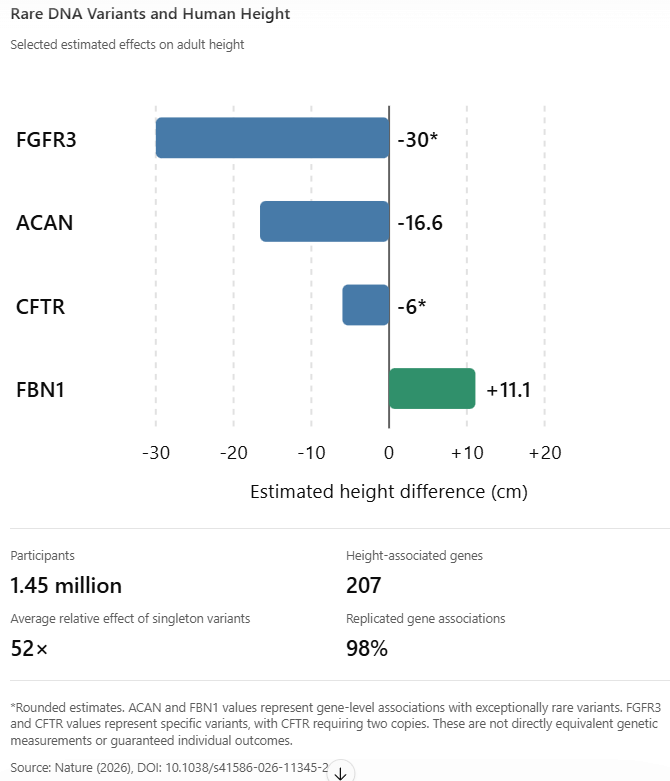
One particularly strong association involved the ACAN gene, which helps produce a protein important for cartilage development. Certain rare variants in this gene were associated with a reduction in height of approximately 16.6 centimeters.
Rare variants affecting the FBN1 gene were associated with an increase of approximately 11.1 centimeters.
The FBN1 gene produces fibrillin-1, a protein that contributes to the structure and flexibility of connective tissues.
These estimates represent average statistical associations for specific categories of variants. Individual carriers may experience different effects depending on their other genes and environmental circumstances.
Genetic Variants Associated With Growth Disorders
Some of the strongest individual genetic associations involved genes already known to influence skeletal development and inherited growth disorders.
The researchers identified a variant in FGFR3 associated with achondroplasia, a genetic condition affecting bone growth.
This particular variant was associated with an estimated height reduction approaching 30 centimeters.
Other significant associations involved PTPN11, a gene connected to several developmental processes and certain inherited growth conditions.
Researchers also identified a recessive variant in CFTR associated with a height reduction of nearly six centimeters when inherited in two copies.
The CFTR gene is best known for its involvement in cystic fibrosis. Its association with height demonstrates how genetic conditions affecting multiple organs can also influence physical growth.
The researchers found that different variants within the same gene sometimes had opposite effects on height.
This means that identifying a gene associated with growth does not necessarily establish whether every variant in that gene will increase or decrease stature.
Expanding Knowledge of Human Growth
The researchers used several statistical methods to identify genetic associations that might remain undetected in conventional analyses.
One approach combined rare variants within individual genes to evaluate their collective association with height. Other methods allowed researchers to identify genes containing variants with different or opposing effects.
Together, these approaches identified 207 height-associated genes, representing a substantial expansion of earlier sequencing research.
The findings demonstrate the value of examining uncommon genetic changes alongside the more widespread variants traditionally used in genetic prediction.
Although rare variants collectively explain only a portion of height differences across the general population, their influence on individual carriers can be substantial.
Including these variants in genetic models could improve predictions for some people whose height differs considerably from expectations based on common variants alone.
Limitations and Future Clinical Applications
Despite the study's large international sample, approximately 78 percent of participants were of European genetic ancestry.
This imbalance means that some rare variants may have been more easily identified in certain populations than in others.
Future research involving more diverse populations could uncover additional genetic associations and improve the usefulness of genetic prediction across different ancestry groups.
The findings also do not mean that every unusually tall or short individual carries a rare genetic variant associated with growth.
Nutrition, hormonal function, childhood health and numerous other genetic factors remain important influences on adult height.
The researchers hope that a better understanding of rare genetic variants will eventually improve the identification and interpretation of inherited growth disorders.
Further studies will be needed to determine how newly identified variants affect protein function, skeletal development and other biological processes before their full clinical significance can be established.