Scientists in China have created a detailed cellular map of the reproductive system of the African four-toed hedgehog, revealing how sperm production may slow during the non-breeding season. The findings suggest that these mammals preserve their reproductive machinery while adjusting the activity of individual cells.
The research was conducted by Chu-wen Zhu, Wen-hua Liu, Guang Yang and Si-min Chai, representing several Chinese research institutions, including the Southern Marine Science and Engineering Guangdong Laboratory in Guangzhou.
Their study was published on August 28, 2026, in the Journal of Zoological Systematics and Evolutionary Research, with wider coverage appearing in late November.
Understanding Seasonal Reproduction
Many mammals reproduce during particular times of the year when environmental conditions are favorable for raising offspring.
Changes in temperature, daylight and food availability can influence reproductive activity. During less favorable periods, reducing reproductive activity may help animals conserve energy.
Hedgehogs provide an interesting subject for reproductive research because their testes remain inside the abdominal cavity.
Although earlier studies have investigated hormonal changes associated with seasonal breeding, researchers wanted to understand how individual cells respond during different reproductive stages.
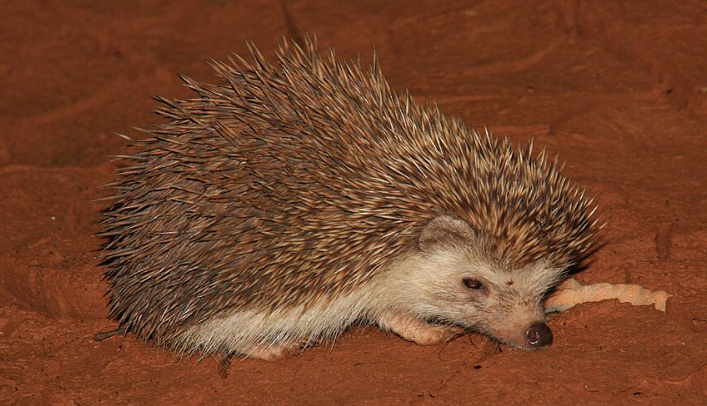
The new study focused on the African four-toed hedgehog, scientifically known as Atelerix albiventris.
Researchers Examine Nearly 17,000 Cell Nuclei
The scientists collected testicular tissue from two naturally deceased adult male hedgehogs in 2025.
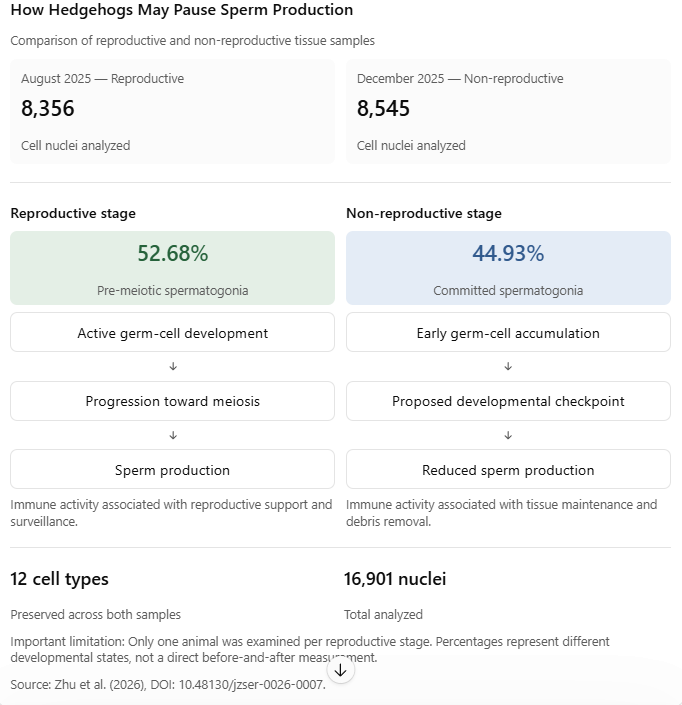
One animal was sampled in August during the reproductive period, while the other was sampled in December during the non-reproductive period.
The researchers used a technique called single-nucleus RNA sequencing. This method measures gene activity using RNA collected from individual cell nuclei.
After filtering the data, the scientists examined 16,901 nuclei. Of these, 8,356 came from the reproductive-stage sample and 8,545 came from the non-reproductive-stage sample.
The team identified 12 major cell types, including cells involved in sperm development, hormone production, tissue support and immune protection.
All 12 major cell types were detected in both samples. Rather than disappearing entirely during reproductive inactivity, these cellular populations appeared to retain much of their basic organization.
A Possible Checkpoint in Sperm Development
The researchers examined spermatogonia, immature reproductive cells that eventually develop into sperm.
They divided these cells into four developmental states and used computational analysis to reconstruct their progression toward meiosis.
Meiosis is a specialized form of cell division that reduces the number of chromosomes by half. This process allows reproductive cells to combine during fertilization while maintaining the correct chromosome number in offspring.
In the reproductive-stage sample, 52.68 percent of spermatogonia were classified as pre-meiotic cells.
In the non-reproductive-stage sample, 44.93 percent occupied an earlier developmental state. Very few had progressed to the pre-meiotic stage.
The difference suggests that sperm development may slow at a specific transition point before meiosis begins.
The researchers also identified changes in gene activity associated with calcium signaling, RNA processing and protein production during reproductive activity.
These biological processes help regulate communication within cells and support their development.
Mature Reproductive Cells Remain Present
Another important finding was that mature spermatids and spermatozoa remained detectable in the non-reproductive sample.
Spermatids are reproductive cells that have completed meiosis but are still undergoing changes necessary to become fully developed sperm.
The researchers found differences in gene activity involving energy regulation, mitochondrial function and protein maintenance.
Mitochondria help cells generate the energy required to perform their biological functions. Maintaining their activity could contribute to the preservation of reproductive cells during periods of reduced sperm production.
However, detecting mature reproductive cells does not establish whether they remain capable of fertilization throughout the non-breeding season.
Further experiments would be needed to determine their survival and reproductive capabilities.
Immune Cells Adjust Their Activity
The researchers also identified differences in the activity of immune cells within the testes.
During reproductive activity, certain immune cells displayed gene-expression patterns associated with monitoring potential threats and supporting sperm development.
During reproductive inactivity, immune cells showed patterns more closely associated with tissue maintenance, the removal of cellular debris and immune tolerance.
Immune tolerance is particularly important within reproductive tissues because developing sperm contain proteins that could otherwise trigger immune responses.
Macrophages, which help remove damaged cells and unwanted material, were among the immune populations examined.
The observed changes suggest that the reproductive system may coordinate cellular maintenance with reduced sperm production during unfavorable breeding conditions.
Important Limitations of the Research
Despite the large number of cell nuclei analyzed, the study involved only two animals.
Each reproductive stage was represented by a single hedgehog. Consequently, the researchers could not reliably distinguish seasonal changes from natural differences between individual animals.
Thousands of measurements from one animal do not replace the scientific value of studying multiple independent animals.
The researchers also relied on computational models of cellular development rather than directly observing the same cells progress through reproductive stages.
Future studies will need to examine larger groups of hedgehogs at multiple times throughout the year. Laboratory experiments could then determine whether the proposed developmental checkpoint directly controls seasonal changes in sperm production.
The cellular atlas provides a foundation for those investigations and could help explain how mammals temporarily reduce reproductive activity while preserving the ability to resume breeding.