Scientists in South Korea have identified a brain circuit that contributes to heightened sensory responses in mice carrying an autism-associated genetic mutation. The discovery provides new insight into why certain sensory experiences can become unusually intense or overwhelming.
Researchers from the Institute for Basic Science (IBS) and the Korea Advanced Institute of Science and Technology (KAIST) found that excessive activity in the anterior cingulate cortex contributed to abnormal responses to touch and painful stimulation.
By selectively reducing the activity of specific neurons, the scientists improved several sensory responses in the mice.
The research was led by Eunjoo Kim and Changuk Chung, with findings published on November 25, 2026, in the journal Molecular Psychiatry.
Understanding Sensory Hypersensitivity in Autism
Many autistic people experience differences in how they process sensory information. Everyday experiences involving touch, sound, light or temperature can sometimes become uncomfortable or overwhelming.
Sensory experiences vary considerably between individuals. Some people experience heightened sensitivity, while others respond less strongly to particular sensations.
Although scientists have identified numerous genes associated with autism, understanding how genetic changes influence sensory processing remains challenging.
The South Korean research team focused on the ADNP gene, which produces a protein involved in brain development and the regulation of other genes.
Disease-causing mutations in this gene are associated with ADNP syndrome, a rare neurodevelopmental condition that can involve developmental delays, autism and differences in sensory processing.
Genetic Changes Affect Sensory Responses
Researchers examined mice that had only one functioning copy of the Adnp gene instead of the usual two. This genetic condition is known as haploinsufficiency.
The adult mice exhibited stronger reactions to mechanical stimulation, painful heat and electrical stimulation than mice without the genetic alteration.
Interestingly, younger mice did not display the same degree of hypersensitivity. This suggested that the abnormal sensory responses developed as the animals matured.
The scientists also studied another group of genetically modified mice in which Adnp function was reduced in tissues below the upper cervical spinal cord while preserving its function in the forebrain.
These mice did not develop the same abnormal sensory responses.
The results suggested that genetic changes affecting the brain were more important to the observed hypersensitivity than changes restricted to lower spinal and peripheral tissues.
However, the experiment did not completely rule out contributions from other parts of the nervous system.
Scientists Identify an Overactive Brain Region
The researchers used functional magnetic resonance imaging and other laboratory techniques to examine brain activity following sensory stimulation.
Their investigation identified unusually strong responses within a network of brain regions involved in sensory and emotional processing.
One particularly important region was the anterior cingulate cortex, commonly abbreviated as ACC.
Located toward the front and inner surface of the brain, the ACC participates in several functions, including attention, emotional processing and responses to pain.
Pain involves more than detecting a potentially harmful stimulus. The brain also processes the unpleasant feelings associated with that experience and helps determine how the body responds.
Laboratory recordings revealed that certain excitatory neurons within the ACC were more easily activated in the genetically modified mice.
Excitatory neurons help transmit signals through the nervous system. Changes in their activity can affect how information travels between different brain regions.
The researchers identified differences in neuronal excitability and communication that could help explain the exaggerated sensory responses.
Targeting Specific Neurons Produces Better Results
To investigate whether excessive ACC activity contributed directly to hypersensitivity, the scientists used an experimental technique called chemogenetics.
This approach allows researchers to control selected neurons using specially engineered receptors activated by chemical compounds.
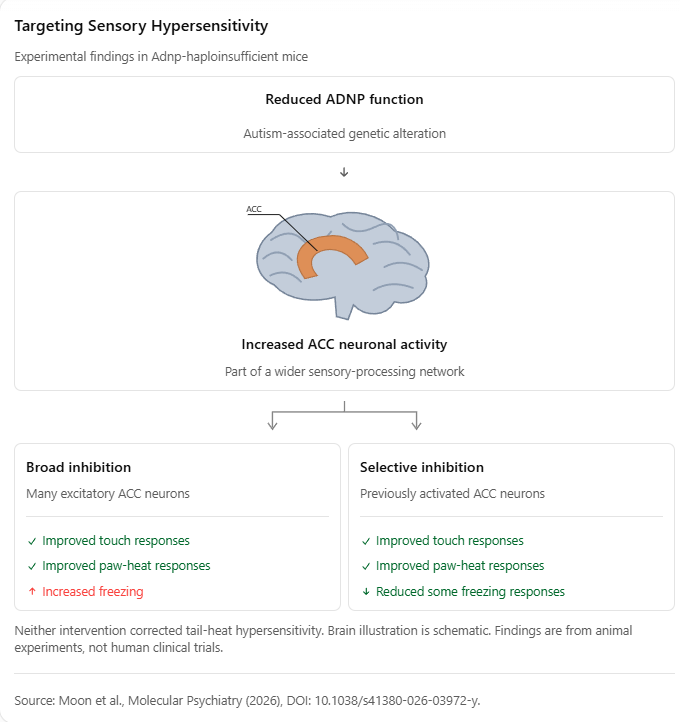
Initially, the researchers broadly reduced the activity of excitatory neurons within the ACC.
The intervention improved responses to mechanical stimulation and painful heat applied to the paws. However, it did not improve every sensory measurement and increased freezing behavior during electrical stimulation experiments.
Freezing is a defensive behavior commonly measured in animal studies.
The researchers then tested a more selective approach. They inhibited groups of ACC neurons that had previously become active during electrical stimulation.
This targeted intervention restored more typical responses to mechanical stimulation and painful heat applied to the paws. It also reduced certain aspects of abnormal freezing behavior.
However, responses to painful heat applied to the tail remained unchanged.
The contrasting results suggest that different groups of neurons within the same brain region can have distinct roles in sensory and defensive responses.
Molecular Changes Provide Additional Clues
The research team also examined how reduced ADNP function affected gene activity and communication between brain cells.
Their analyses identified changes involving synapses, the structures through which neurons communicate, and ion channels, which help regulate electrical activity within cells.
Several important molecular changes were concentrated in excitatory neurons within particular layers of the ACC.
These findings provide possible explanations for how a genetic alteration can influence the electrical behavior of individual neurons and eventually affect wider brain networks.
Understanding these molecular changes could help scientists identify more precise targets for future experiments.
Human Treatments Remain a Long-Term Goal
Although the findings provide encouraging scientific evidence, the experiments were conducted in mice rather than people.
ADNP syndrome represents a specific genetic condition, and the same brain mechanisms may not explain sensory differences across the broader autistic population.
The researchers also identified the ACC as one important contributor within a larger network, rather than the sole brain region responsible for hypersensitivity.
Chemogenetic techniques used in laboratory animals do not represent an established treatment for autism or sensory hypersensitivity in humans.
Further research will need to determine whether similar neuronal changes occur in people with ADNP syndrome and whether those changes can be safely addressed.
The study provides a foundation for investigating approaches that target specific groups of neurons instead of suppressing activity throughout an entire brain region.