

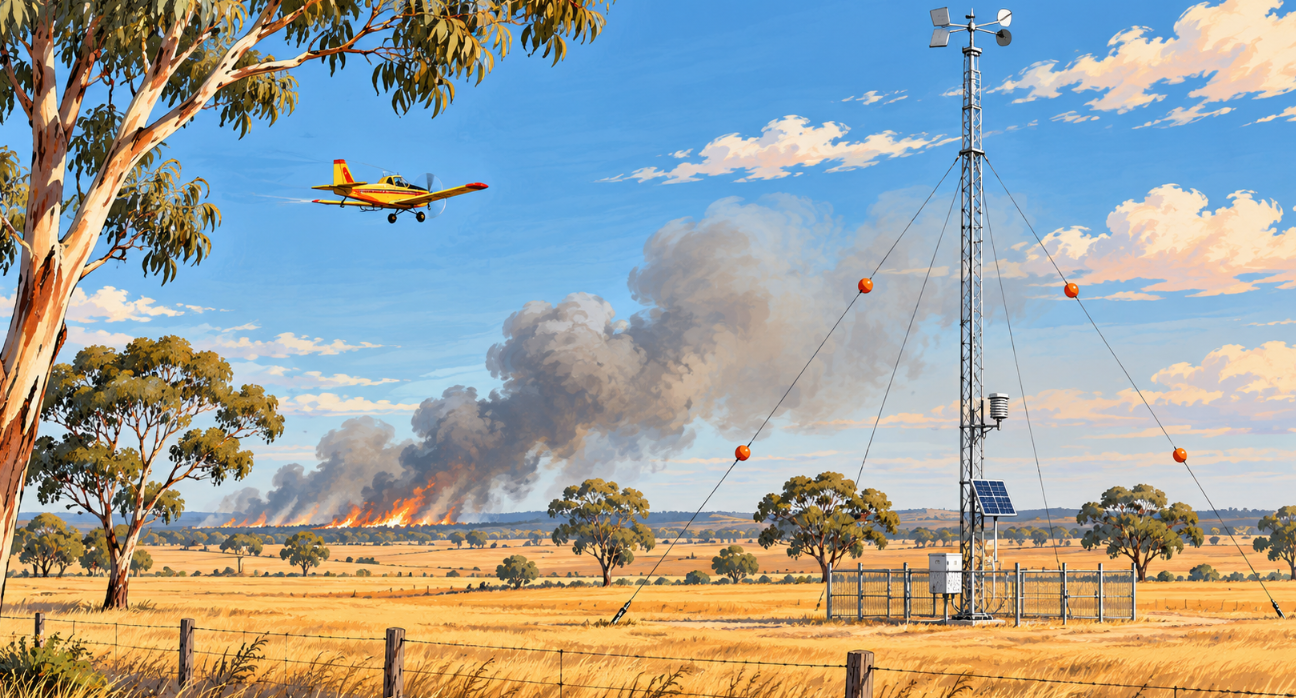
Australian authorities are preparing for an increased risk of bushfires across several regions as summer approaches. Meanwhile, concerns about aviation safety have prompted renewable energy company Vestas to remove a wind-monitoring tower from a proposed wind farm site in Queensland.
The two developments have drawn attention to the importance of protecting rural communities and ensuring that agricultural pilots and emergency responders can operate safely.
Australia's national seasonal bushfire outlook, released on November 27, 2026, identifies elevated fire risks across large portions of the country.
Agricultural Pilots Report Dangerous Near Misses
Grain farmer and agricultural pilot Kieran Cook reported several near misses involving wind-monitoring towers near Tara in Queensland's Western Downs region.
The approximately 120-meter-tall structures were installed by Danish renewable energy company Vestas in December 2023 to collect atmospheric information for a proposed wind farm.
Unlike conventional wind turbines, monitoring towers are narrow structures supported by cables anchored to the ground. Their appearance can make them difficult for pilots to distinguish from the surrounding landscape.
Cook told ABC Australia that he encountered the structures while flying his aircraft to spray and fertilize crops.
He also raised concerns about their proximity to rural airstrips used by agricultural aircraft and aerial firefighting operations.
The Australian Transport Safety Bureau confirmed that it had received multiple reports concerning the towers and was investigating the safety issues.
Vestas Removes One Monitoring Tower
Vestas removed one of the two monitoring towers on November 20.
The company explained that sufficient atmospheric information had been collected and that the remaining tower would meet its monitoring requirements.
Vestas had previously introduced several measures intended to improve the visibility of the structures. These included repainting the towers, adding brightly colored markers to supporting cables and installing flashing lights.
The company maintained that its installations complied with relevant approvals and industry safety practices.
However, Cook expressed concern that the improvements were insufficient to make the structures easily visible from an aircraft.
The situation has raised questions about whether existing regulations adequately protect pilots operating near smaller rural airstrips.
Aviation Safety and Emergency Operations
Aircraft play an important role in Australian agriculture and emergency management.
During bushfires, aerial firefighting crews can help contain spreading fires by dropping water or fire retardant. Aircraft also assist with monitoring fire activity and identifying threats to communities.
Smoke and reduced visibility can complicate these operations. Tall structures and supporting cables represent additional hazards that pilots must consider.
Australia's Civil Aviation Safety Authority identifies wind-monitoring masts as a recognized aviation hazard requiring appropriate safety measures.
Improved communication between energy developers, landowners, pilots and emergency services could help identify potential conflicts before new infrastructure is installed.
However, the reported near misses in Queensland occurred during agricultural flights, not during confirmed bushfire response operations.
Australia's Summer Bushfire Outlook
The Australian and New Zealand Council for Fire and Emergency Services (AFAC) has warned of increased bushfire potential during the upcoming summer.
Regions facing elevated risks include parts of Western Australia, South Australia, New South Wales and Tasmania, along with extensive areas of Victoria and the Northern Territory.
The outlook identifies dry soil, accumulated vegetation and anticipated dry weather as important factors contributing to the increased danger.
Above-average temperatures are expected across much of Australia between December 2026 and February 2027.
A strong El Niño climate pattern is also influencing seasonal weather forecasts. However, rainfall conditions are expected to vary considerably between regions.
Queensland and the Australian Capital Territory were not identified as having elevated seasonal fire risks in the latest national outlook. Authorities nevertheless encourage residents in those areas to remain prepared because dangerous fires can develop under suitable local conditions.
Preparing Communities for Bushfire Season
Australia's National Emergency Management Agency is encouraging households to review their emergency preparations before summer.
Residents in fire-prone areas should establish evacuation plans, maintain emergency supplies and monitor official weather and fire warnings.
Property maintenance can also reduce vulnerability to airborne embers. Clearing gutters, removing accumulated vegetation and maintaining surrounding grass are among the recommended precautions.
The national government continues to support emergency preparedness through disaster resilience programs, improved fire intelligence systems and aerial firefighting resources.
These measures are intended to strengthen the ability of communities and emergency services to respond when dangerous conditions develop.
Balancing Renewable Energy and Public Safety
Australia's renewable energy expansion will require additional infrastructure across agricultural and rural regions.
Wind-monitoring towers provide important information about whether proposed locations are suitable for electricity generation. However, their placement and visibility must also be considered alongside existing activities in surrounding areas.
The Queensland dispute illustrates the importance of assessing infrastructure safety during the planning process.
The Australian Transport Safety Bureau is expected to publish its findings concerning the Tara monitoring towers in the coming weeks. Meanwhile, emergency authorities continue encouraging communities across Australia to prepare for the summer bushfire season.