An international team of astronomers and computer scientists has achieved the highest-resolution computer simulation of the Milky Way galaxy to date. Using artificial intelligence and three exascale supercomputers, researchers demonstrated simulations containing up to 5.4 trillion particles.
The project, known as PHEASANT, represents a major advance in computational astronomy. Its unprecedented resolution could help scientists investigate how individual stars, supernova explosions and interstellar gas influence the evolution of entire galaxies.
The research was led by Keiya Hirashima of Japan's RIKEN research institute, working alongside Michiko Fujii of the University of Tokyo and an international team of scientists.
The findings were presented at the SC26 international supercomputing conference, held in Chicago from November 15 through November 20, 2026.
Simulating the Milky Way in Unprecedented Detail
The Milky Way contains hundreds of billions of stars, along with enormous quantities of gas, dust and dark matter.
These components interact through gravity and other physical processes over millions or billions of years. Reproducing those interactions in a computer simulation presents an enormous computational challenge.
Conventional galaxy simulations often represent groups of stars as single computational particles. Although this approach reduces computing requirements, it can obscure important events involving individual stars.
The PHEASANT project aims to overcome these limitations by increasing the resolution of galaxy simulations.
Its largest demonstration contained approximately 10,000 times as many computational particles as conventional state-of-the-art galaxy simulations, according to the research team.
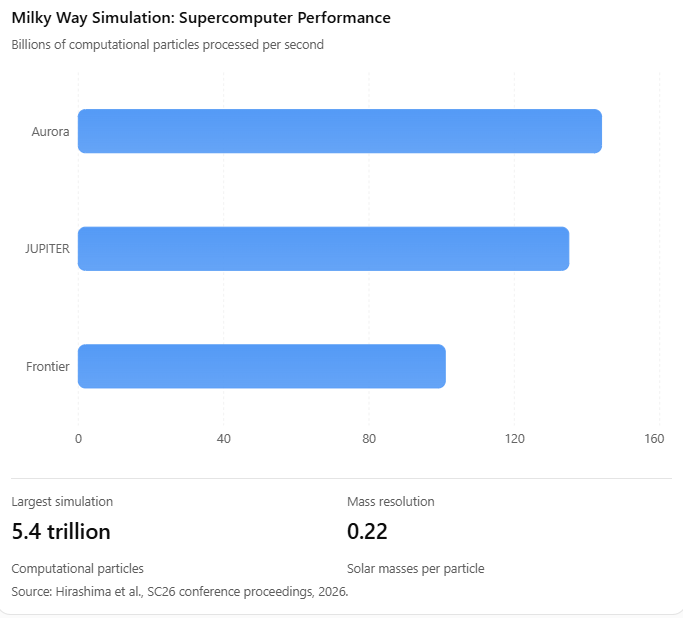
The highest-resolution calculation achieved a mass resolution of approximately 0.22 times the mass of the Sun per particle. This allows scientists to investigate physical processes at scales comparable to individual stars.
However, the 5.4 trillion particles do not represent 5.4 trillion actual stars. Computational particles also represent other components of the simulated galaxy.
Three Exascale Supercomputers Power the Research
The scientists adapted their simulation framework to operate efficiently on three of the world's most powerful supercomputers.
Aurora is located at Argonne National Laboratory in Illinois, while Frontier operates at Oak Ridge National Laboratory in Tennessee. The third system, JUPITER, is located at the Jülich Supercomputing Centre in Germany.
Each machine uses a different hardware architecture. Aurora features Intel graphics processing units, Frontier uses AMD technology, and JUPITER incorporates NVIDIA hardware.
Rather than creating an entirely separate simulation program for each machine, the researchers developed software that could operate efficiently across all three architectures.
Aurora achieved a processing rate of 144 billion particles per second using 60,236 graphics processing units. Frontier processed approximately 101 billion particles per second, while JUPITER reached 135 billion.
Frontier's substantial memory capacity enabled the researchers to conduct their largest simulation containing 5.4 trillion particles.
These results demonstrate that highly specialized scientific software can operate across different computing platforms without being restricted to a single hardware manufacturer.
Artificial Intelligence Helps Model Supernova Explosions
One of the greatest challenges in simulating galaxies involves accurately reproducing supernova explosions.
These powerful events occur when certain stars reach the end of their lives. The resulting explosions release energy and distribute chemical elements into surrounding space.
Supernovae can compress nearby gas, potentially encouraging the formation of new stars. They can also disperse gas, temporarily preventing star formation in affected regions.
Traditional simulations must calculate rapid changes in temperature, density and gas movement using numerous small time intervals. Repeating those calculations across an entire galaxy consumes substantial computing resources.
The researchers addressed this challenge by incorporating a machine-learning surrogate model into their simulation software.
The AI component predicts how surrounding gas will respond to a supernova over a longer interval. This reduces the need to calculate every intermediate stage of the explosion individually.
The approach does not eliminate conventional physics calculations. Instead, it helps accelerate particularly demanding portions of the simulation.
Understanding How Galaxies Evolve
Scientists hope the improved resolution will help explain how relatively small events influence the overall structure of galaxies.
Individual supernova explosions can produce enormous cavities in interstellar gas. Multiple explosions occurring within the same region can create even larger structures known as superbubbles.
Understanding these interactions could help researchers determine how galaxies regulate star formation and redistribute matter.
Professor Michiko Fujii explained that the project could also help investigate how groups of newly formed stars develop into larger star clusters.
Another long-term objective is to better understand the environment in which the Sun and the solar system formed approximately 4.6 billion years ago.
Detailed simulations could allow astronomers to test different explanations for the formation and evolution of our galaxy against astronomical observations.
Potential sources of observational data include the European Space Agency's Gaia mission, the Vera C. Rubin Observatory and NASA's Nancy Grace Roman Space Telescope.
Further Research Remains Necessary
The latest achievement builds upon earlier work by the research team.
In November 2025, researchers demonstrated a Milky Way simulation that represented more than 100 billion individual stars. The new project substantially expands the computational capabilities available for this type of research.
The largest 2026 calculations were primarily demonstrations of computational performance and resolution. They do not constitute a complete reconstruction of the actual Milky Way throughout its entire history.
Researchers still need to incorporate additional physical processes, including the effects of radiation emitted by stars and the expansion of surrounding regions of ionized gas.
Artificial intelligence predictions must also remain consistent with physical calculations and observational evidence.
The team plans to make its simulation software publicly available so other researchers can conduct high-resolution astronomical simulations across different computing systems.
Its next major objective is to move beyond large-scale computational demonstrations toward more scientifically complete simulations of the Milky Way and its evolution.