

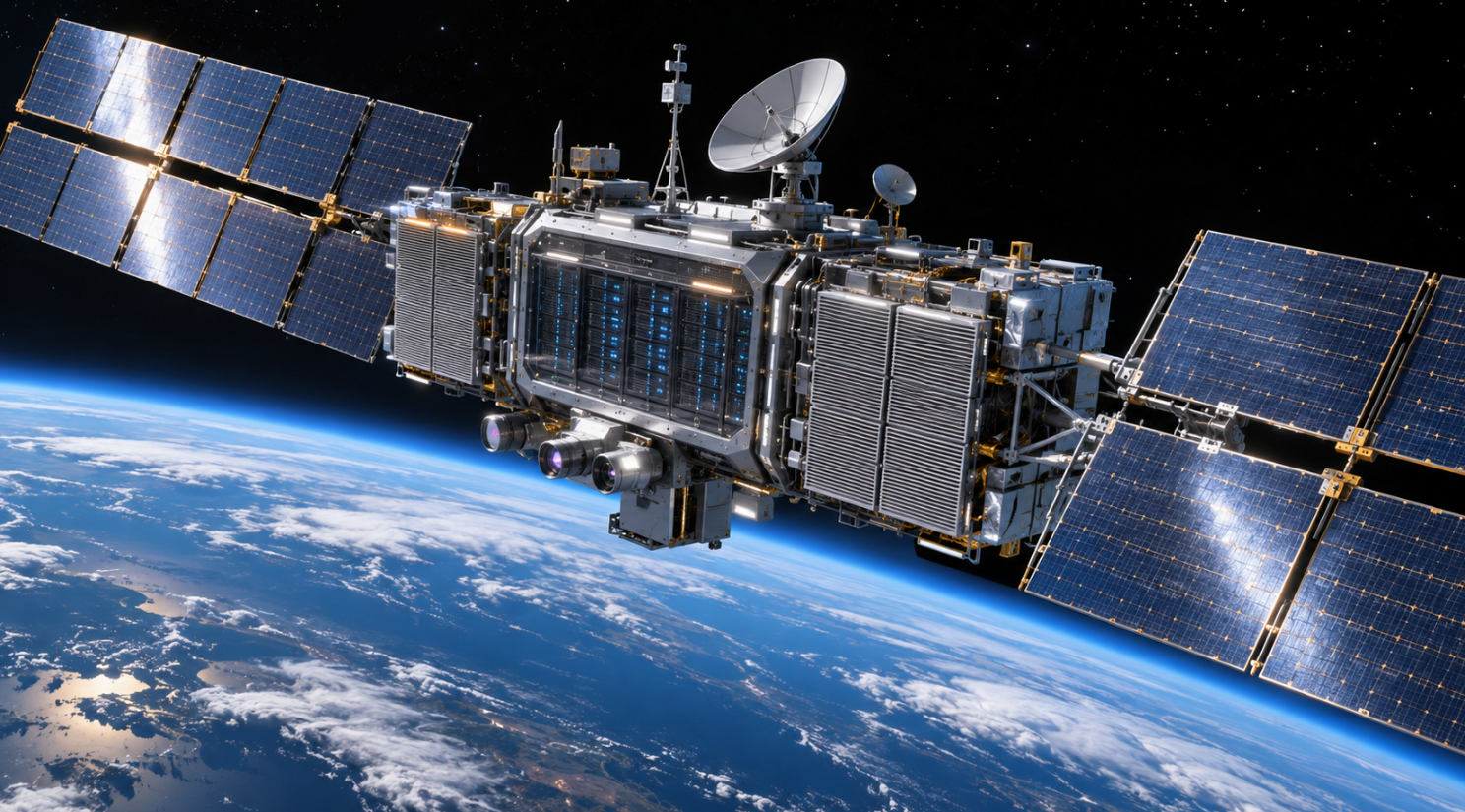
The Federal Communications Commission granted SpaceX conditional approval on November 25, 2026, to deploy up to one million satellites that would function as data centers in space. The decision represents a major regulatory victory for Elon Musk's plans to expand artificial intelligence computing beyond Earth.
The proposed satellite constellation, known as Starmind, would use solar energy to power computer equipment in low Earth orbit. However, astronomers and environmental experts have raised concerns about light pollution, orbital congestion, atmospheric contamination and the potential for satellite collisions.
The European Southern Observatory issued a statement Thursday warning that the project could fundamentally change how people experience the night sky.
FCC Establishes Deployment Deadlines
The authorization marks the first time the United States has approved a satellite constellation specifically designed to operate data centers in space.
FCC Chairman Brendan Carr described the decision as an opportunity to strengthen American leadership in artificial intelligence and space technology.
The agency established several deployment deadlines for SpaceX:
- November 25, 2033: At least one operational satellite.
- November 25, 2035: 100,000 operational satellites.
- November 25, 2038: 500,000 operational satellites.
- November 25, 2040: Completion of the authorized constellation.
These deadlines establish regulatory milestones rather than guaranteed launch forecasts. SpaceX must still demonstrate that it can manufacture, launch and operate the satellites at the proposed scale.
The FCC authorization covers orbital altitudes between 500 and 1,002 kilometers above Earth. SpaceX must submit a final orbital debris mitigation plan through an application to modify its authorization before deploying satellites above 600 kilometers.
Moving AI Computing Into Space
Musk has long advocated placing solar-powered data centers in orbit as an alternative to constructing additional facilities on Earth.
Artificial intelligence systems require substantial amounts of electricity to train models, process information and respond to users. Large terrestrial data centers can also consume considerable quantities of water for cooling.
Supporters of orbital computing argue that satellites could obtain abundant solar energy while reducing some of the infrastructure demands associated with Earth-based facilities.
SpaceX intends to use optical communication links to transfer information between satellites. These connections could also integrate with the company's existing Starlink satellite communications network.
The FCC permitted limited radiofrequency communications for emergency and backup operations.
However, the financial advantages of operating data centers in space remain unproven on the proposed scale.
Cooling Computer Equipment in Space
Despite the extremely low temperatures associated with outer space, keeping powerful computer equipment cool presents significant engineering challenges.
Data centers generate substantial heat during operation. Facilities on Earth can remove that heat through circulating air, water and other cooling systems.
Space is almost entirely a vacuum, preventing equipment from dissipating heat through ordinary convection.
Instead, orbital data centers must rely heavily on radiators that release thermal energy as infrared radiation. Large computing systems could require extensive radiator surfaces, increasing satellite weight, size and manufacturing costs.
Radiation exposure, equipment failures and the difficulty of repairing computers in orbit introduce additional complications.
Engineers must also demonstrate that communication networks can reliably accommodate the enormous quantities of information processed by orbital AI systems.
Astronomers Warn About Night Sky Pollution
The European Southern Observatory, which operates major astronomical research facilities in Chile, expressed strong concerns about the authorization.
Its director general, Andreas Kaufer, warned that the project could have consequences extending well beyond professional astronomy.
Satellites reflect sunlight, particularly when they pass above locations experiencing twilight or darkness. Their movement across the sky can create bright streaks in long-exposure astronomical photographs.
These streaks can interfere with observations of distant galaxies, planets outside the solar system and potentially hazardous asteroids.
Even if manufacturers substantially reduce the brightness of individual satellites, astronomers warn that deploying hundreds of thousands of additional spacecraft could overwhelm existing methods of removing interference from observations.
Radio astronomy faces separate challenges. Electronic equipment and satellite communications can produce signals that interfere with sensitive instruments used to detect faint emissions from distant astronomical objects.
The American Astronomical Society said it was “disheartened and dismayed” by the FCC's decision. The organization called for stronger consideration of optical and infrared astronomy when evaluating future satellite applications.
Space Debris and Collision Concerns
A constellation containing one million satellites would introduce unprecedented challenges for managing traffic in low Earth orbit.
Satellites must regularly adjust their positions to avoid collisions with other spacecraft and existing debris.
A collision can produce fragments that remain in orbit and threaten other satellites. Under certain circumstances, repeated collisions could generate increasing amounts of debris in a process known as the Kessler syndrome.
The FCC determined that SpaceX's proposal was consistent with its orbital debris regulations, subject to the conditions imposed through the authorization.
SpaceX plans to test satellites at lower altitudes before moving them into higher operational orbits. The spacecraft would also carry propulsion systems for adjusting their positions and assisting with collision avoidance and eventual disposal.
Scientists nevertheless question whether current satellite traffic management systems can safely accommodate a constellation of this size.
Environmental researchers have also raised concerns about atmospheric pollution associated with rocket launches and the repeated reentry of retired satellites.
The long-term atmospheric consequences of operating and replacing such a large satellite population remain uncertain.
Opposition and International Oversight
The American Astronomical Society, Viasat and Amazon's satellite business were among the organizations that opposed SpaceX's application.
The FCC maintained that the authorization serves the public interest by encouraging technological innovation. It also determined that certain objections concerning environmental consequences and optical astronomy fell outside the scope of its authority over the relevant radiofrequency operations.
The European Southern Observatory has called for international mechanisms to evaluate projects that affect the global space environment.
Its position reflects concerns that satellite authorization decisions made by individual countries can have consequences for scientific institutions and communities worldwide.
Other technology and aerospace companies are also exploring orbital computing, including Google and Blue Origin. Their research could eventually introduce additional demand for limited orbital space.
For SpaceX, the next challenge is demonstrating that Starmind satellites can operate reliably and economically before attempting deployment on a much larger scale. Under the current authorization, the company must have its first operational satellite in orbit by November 2033.