

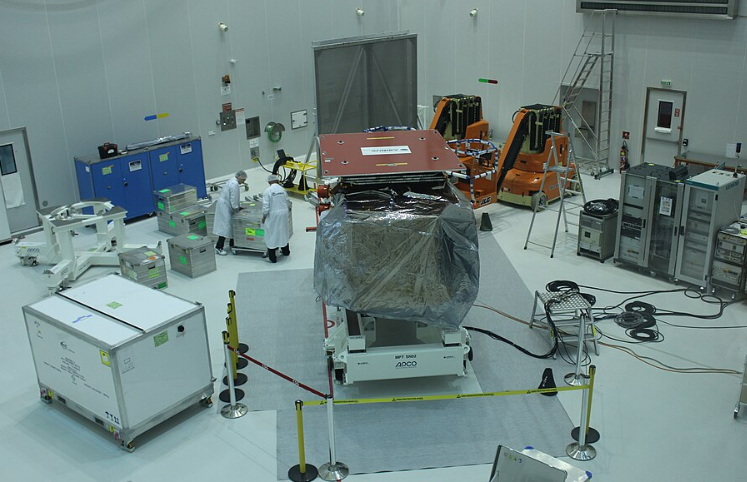
Belgium has inaugurated Europe's largest satellite manufacturing facility as the European Union works to establish an independent satellite communications network. King Philippe attended the opening ceremony on November 24, 2026, in Marcinelle, a district of Charleroi in southern Belgium.
The factory, operated by Belgian satellite manufacturer Aerospacelab, will play a major role in developing the European Union's IRIS² satellite constellation. The network is intended to provide secure communications for governments, businesses and emergency services while reducing Europe's reliance on foreign providers such as SpaceX.
Belgium Expands Its Satellite Manufacturing Industry
The new manufacturing facility covers approximately 20,000 square meters and represents an investment of around €100 million. It includes 7,000 square meters of production space and another 4,000 square meters of specialized cleanrooms for assembling satellite components.
According to Euronews and AFP, the factory is designed to manufacture approximately 500 satellites annually when operating at full capacity. Employees are expected to begin moving into the facility in January 2027, with IRIS² production expected to begin by the end of 2028.
Aerospacelab was founded in 2018 by Benoît Deper and has grown from a small technology company into a major European satellite manufacturer. The company announced that it will officially change its name to Ectro on November 30.
In September 2026, the company secured a €2.4 billion contract to design, manufacture and deliver 264 satellite platforms for IRIS². The agreement covers approximately three-quarters of the satellites planned for the European network.
Europe Develops Its Own Secure Satellite Network
IRIS² stands for Infrastructure for Resilience, Interconnectivity and Security by Satellite. The project is intended to strengthen European control over critical communications infrastructure while providing connectivity in areas underserved by conventional telecommunications networks.
The European Commission signed a 12-year concession agreement with the SpaceRISE consortium in December 2024. The consortium includes satellite operators SES, Eutelsat and Hispasat, supported by European aerospace manufacturers and technology companies.
Major industrial participants include Airbus, Thales Alenia Space and OHB. The project also involves the European Space Agency and the European Union Agency for the Space Programme.
Unlike Starlink's low Earth orbit network, IRIS² will use satellites operating at two different orbital levels. Satellites closer to Earth generally provide lower communication delays, while those at higher altitudes can cover larger geographical areas.
The European network is not intended solely as a residential internet service. Its responsibilities will also include protecting sensitive government communications, supporting critical infrastructure and maintaining connectivity during emergencies.
European Commission Expands the Constellation
On August 7, 2026, the European Commission announced an agreement to expand the planned IRIS² constellation to 348 satellites. The revised design includes 330 satellites in low Earth orbit and 18 in medium Earth orbit.
The expansion adds 66 satellites to strengthen communications for defense, security and emergency response. These spacecraft are included in the revised total of 348 rather than representing an additional constellation beyond that figure.
The European Commission projects that the expanded system will provide 60 percent more secure governmental communications capacity within the EU than previously planned. Worldwide governmental capacity is expected to increase by 54 percent compared with the earlier design.
The European Space Agency expects the first satellites to launch in 2029, with initial services becoming available in 2030. These dates remain subject to manufacturing progress, launch availability and technical testing.
Ukraine Raises Concerns About Satellite Dependence
Russia's invasion of Ukraine has demonstrated the importance of satellite communications when conventional networks are damaged or unavailable. Starlink has helped maintain connectivity in Ukraine throughout the conflict, while Starshield provides specialized services for government and military customers.
However, reported restrictions affecting Ukrainian access to Starshield during October and November 2026 have raised concerns about the reliability of externally controlled communications services.
Reuters reported on October 15 that American and Western officials attributed the initial restrictions to a decision originating within the White House. A senior American official disputed the claim that President Donald Trump personally requested the restrictions.
Secretary of State Marco Rubio subsequently said that decisions concerning Ukraine's Starlink access were the responsibility of SpaceX and its leadership. SpaceX founder Elon Musk, meanwhile, maintained that Starshield restrictions were determined by the American government.
The conflicting statements have left questions about responsibility for the reported disruptions. Ukrainian President Volodymyr Zelensky continued to express concerns about restricted connectivity during a BBC interview on November 26.
British officials have also questioned the reliability of depending on a single external provider. On November 23, Britain's defense minister said the restrictions had weakened European confidence in SpaceX's services.
European Satellite Alternatives Face Significant Challenges
Europe already has access to satellite communications through Eutelsat's OneWeb constellation, which operates in low Earth orbit. However, building an independent network with broad coverage and substantial communications capacity requires considerable investment.
Manufacturing satellites represents only one part of that effort. European operators must also establish secure ground stations, obtain launch services, develop compatible customer equipment and maintain the network after deployment.
IRIS² will initially operate with substantially fewer satellites than Starlink. Its success will depend on the reliability, security, coverage and affordability of its services rather than simply the number of spacecraft in orbit.
The opening of the Charleroi factory gives Europe additional manufacturing capacity to support its space industry. The next major milestones will be the start of IRIS² satellite production, the first scheduled launches in 2029 and the planned introduction of initial communications services in 2030.