

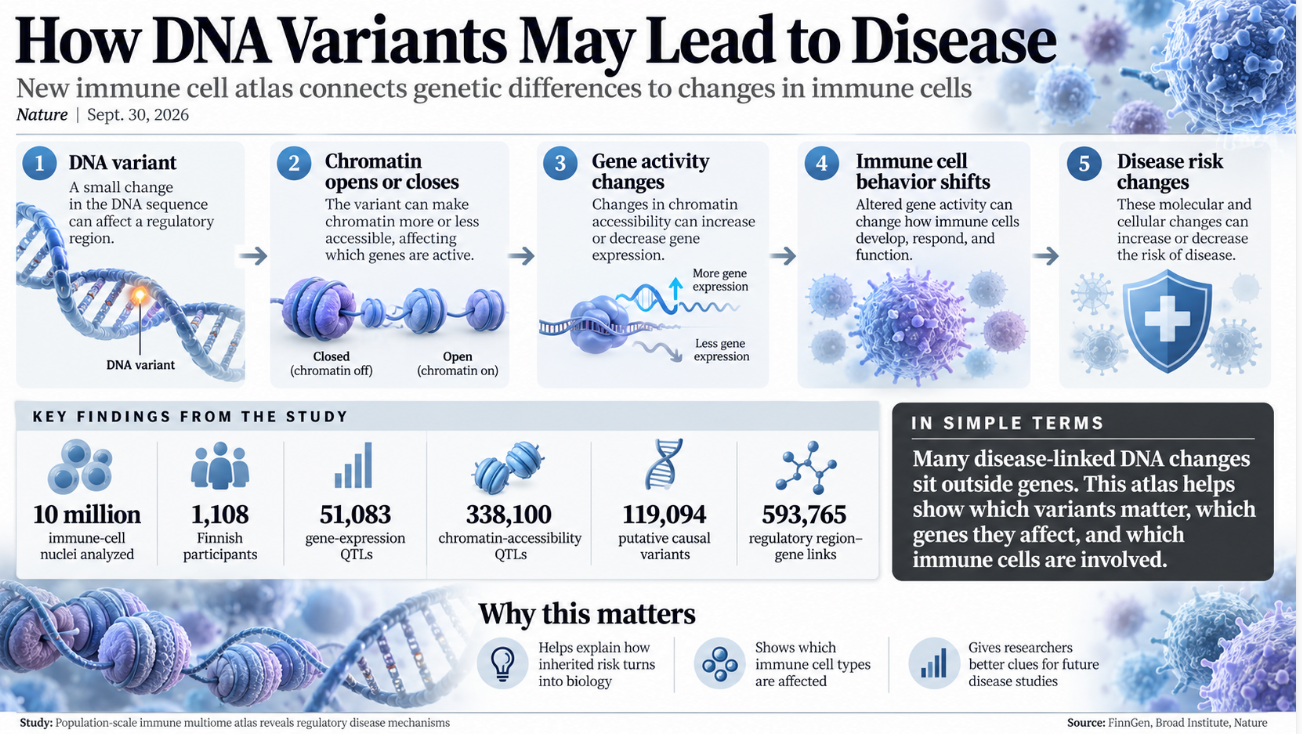
Researchers have created one of the largest single-cell maps of the human immune system, using more than 10 million immune-cell nuclei from 1,108 people in Finland. The work connects genetic differences to changes in DNA activity and gene expression, giving scientists a clearer view of how inherited variants may contribute to disease.
| Summary: This study helps show how small differences in a person's DNA may raise the risk of disease. Researchers looked at millions of immune cells and tracked how certain genetic changes can affect the way DNA is used inside the cell. In simple terms, they are finding the steps between having a genetic variant and developing a health problem. That could help scientists better understand autoimmune diseases and other conditions in the future. |
The study was published September 30 in Nature. It was led by researchers working with FinnGen, the Broad Institute of MIT and Harvard, Massachusetts General Hospital, and other institutions.
For years, genetic studies have identified thousands of DNA variants linked to conditions such as autoimmune disease, asthma, thyroid disease, and other health problems. The difficulty has been explaining what many of those variants actually do.
That problem is especially important because many disease-associated variants are not located inside protein-coding genes. Instead, they sit in regulatory regions of DNA that can influence when nearby genes are turned on, how strongly they are used, and in which types of cells they become active.
The new study tried to connect those pieces directly.
Researchers analyzed peripheral blood mononuclear cells from 1,108 FinnGen participants. They used two single-nucleus techniques at the same time. One measured gene activity, while the other measured chromatin accessibility.
Chromatin is the combination of DNA and proteins that packages genetic material inside the cell nucleus. Some areas are tightly packed and difficult for the cell's machinery to use. Other areas are more open, making nearby DNA easier to access.
By measuring both gene expression and chromatin accessibility, the researchers could ask whether a genetic variant changed how open a section of DNA was and whether that change was followed by a change in the activity of a nearby gene.
The researchers identified 51,083 genetic effects associated with gene expression across 20,829 genes. They also found 338,100 genetic effects linked to chromatin accessibility across more than 210,000 regulatory regions.
The researchers then narrowed the data to 119,094 variants considered strong candidates for directly causing molecular changes. They also mapped 593,765 links between regulatory regions and genes, creating a much more detailed chain of evidence than is usually available from a standard genetic association study.
A genome-wide association study can show that people carrying a particular genetic variant are more likely to have a disease. However, the variant identified by such a study may simply be located near the real biological cause. It may also be unclear which gene the variant affects.
The new atlas is designed to help close that gap.
The researchers developed an analytical framework called CASCADE to trace variants through several possible steps. A variant might change chromatin accessibility, which can then affect a regulatory element, alter a gene's activity, and potentially influence disease risk.
The CASCADE database reports results across major immune-cell populations and more specific immune-cell types. Because the same genetic variant may behave differently in different cells, that cell-level information is important.
The study found that variants showing a complete chromatin-to-gene-expression pathway were about twice as likely to line up with disease-associated genetic signals as variants that affected chromatin alone.
That finding suggests that following the entire regulatory chain can help distinguish biologically important variants from genetic changes that may have little effect on disease.
The researchers also uncovered evidence that some important genes have a built-in buffering system.
Genes that have been strongly conserved through evolution are often essential to normal biological function. Large changes in their activity can be harmful. The researchers found that genetic variants could still alter chromatin near these genes, but those changes were less likely to produce equally large changes in gene expression.
In other words, the regulatory system appeared to absorb part of the effect.
The paper describes this as multilayered regulatory buffering. Instead of relying on a single strong regulatory connection, some highly constrained genes appear to be controlled through multiple weaker links. That arrangement may help keep gene activity stable even when a genetic variant changes one part of the system.
Broad Institute researchers said the atlas helps address a longstanding problem in human genetics: moving from a statistical association to a plausible biological mechanism.
The study included examples involving specific disease-related regions.
One involved TNRC18, where a Finnish-enriched genetic variant was linked to reduced expression of the gene in T cells. The effect was strongest in T helper 1 cells, and the researchers found evidence that the change pushed the cells toward a more inflammatory state.
Another example involved a region containing IL4R and IL21R. Genetic variants in the area have been linked to different conditions, including asthma and autoimmune hypothyroidism. The new analysis helped separate the regulatory effects and connect one thyroid-related signal to increased IL21R activity.
These examples show why simply identifying the nearest gene to a disease-associated variant can be misleading. A regulatory variant may influence a more distant gene, and its effect may appear only in a particular type of immune cell.
FinnGen has made the atlas and many of its results publicly available so other researchers can examine variants, genes, cell types, and disease associations.
The scale of the project is important. The researchers analyzed more than 17 million genetic variants and profiled millions of nuclei using paired measurements of RNA activity and chromatin accessibility.
However, the study does not prove that every proposed pathway causes disease.
Many of the connections identified by the atlas are testable hypotheses. Researchers will still need laboratory experiments, gene editing, studies of diseased tissue, and other methods to confirm specific mechanisms.
The samples also came from Finnish participants, a population with a distinctive genetic history. Some findings may be especially informative because certain variants are enriched in Finland, but broader studies in other populations will be needed to determine how widely every result applies.
The research team is also interested in studying immune cells taken directly from diseased tissues. Blood cells provide an accessible view of the immune system, but immune behavior inside the intestine, lungs, joints, brain, or tumors can be different.
Even with those limits, the atlas gives researchers a new way to investigate one of genetics' hardest questions.
Finding a variant associated with disease is only the beginning. The more difficult task is determining what that variant changes inside a cell, which gene it affects, which cell type matters, and how those changes contribute to illness.
This study brings those steps closer together.
Rather than producing only a list of disease-linked DNA changes, the researchers created a framework that can trace many variants through the regulatory machinery of immune cells. That could help scientists choose better targets for laboratory experiments and better understand why inherited genetic differences change disease risk.